

You've found a card that looks like an obvious buy. The character is popular, the artwork is excellent, and the asking price seems reasonable. Then you check recent sales and discover that comparable copies sell slowly, raw examples have inconsistent condition, and graded copies carry a premium you didn't account for. The “best Pokémon singles to buy” suddenly looks less like a ranked list and more like a decision about your goal.
A collector buying a display piece shouldn't use the same filter as someone planning a quick resale. A long-term holder may prefer a scarce vintage holo or a high-grade Japanese chase card, while a player might prioritize a card with current competitive relevance. Popularity starts the conversation, but condition, grade spread, transaction depth, and exit liquidity often decide whether the purchase works.
Table of Contents
- Introduction Why Best Depends on Your Goal
- How to Evaluate the Best Pokemon Singles Before You Buy
- Which Categories to Prioritize Right Now
- How to Check Condition and Authenticity Like a Pro
- Timing Your Purchase and Managing Risk and Liquidity
- Your Next Smart Single and Final Takeaways
Introduction Why Best Depends on Your Goal
The Pokémon Trading Card Game launched in Japan in 1996, and The Pokémon Company reported that approximately 43.2 billion cards had been printed globally by 2022. Later reporting in 2026 described cumulative output as more than 85 billion cards, evidence of a durable, high-volume ecosystem rather than a short-lived collectible fad. You can review that market history in the Waterloo Business Review analysis of the Pokémon TCG market.
That enormous supply doesn't make every card common. It makes condition scarcity and demand concentration more important. Entry-level singles remain accessible because so many cards exist, while early-era holos, key chase cards, and high-grade examples can be much harder to replace. A raw card with whitening and surface damage isn't equivalent to a clean copy because both share the same set number.
Three different buying jobs
Before you compare cards, decide which job the purchase must perform.
- Collection piece: Buy the card you'll enjoy owning, displaying, or completing. Artwork, character attachment, language, and personal nostalgia matter more than a perfect exit.
- Long-term hold: Favor durable demand, recognizable characters, finite older supply, and a meaningful difference between average and top condition. Graded vintage and carefully selected Japanese chase cards fit this role better than disposable hype.
- Quick flip: Choose cards with recent transaction depth, clear pricing, and buyers across more than one marketplace. A theoretical bargain is useless if you can't sell it efficiently.
A popular modern English chase can be a terrific collection card and a poor short-term trade. A less fashionable vintage holo may have stronger downside protection because collectors understand its history and the supply of clean copies is limited. The right choice depends on what you need the card to do after you buy it.
Collector rule: Popularity gets a card noticed. Liquidity and condition determine whether your money can get out.
This guide uses an investor's lens without pretending that every purchase needs to be purely financial. Buy cards you want, but price them as if you'll eventually need to sell. That discipline keeps enthusiasm from turning into overpayment.
How to Evaluate the Best Pokemon Singles Before You Buy
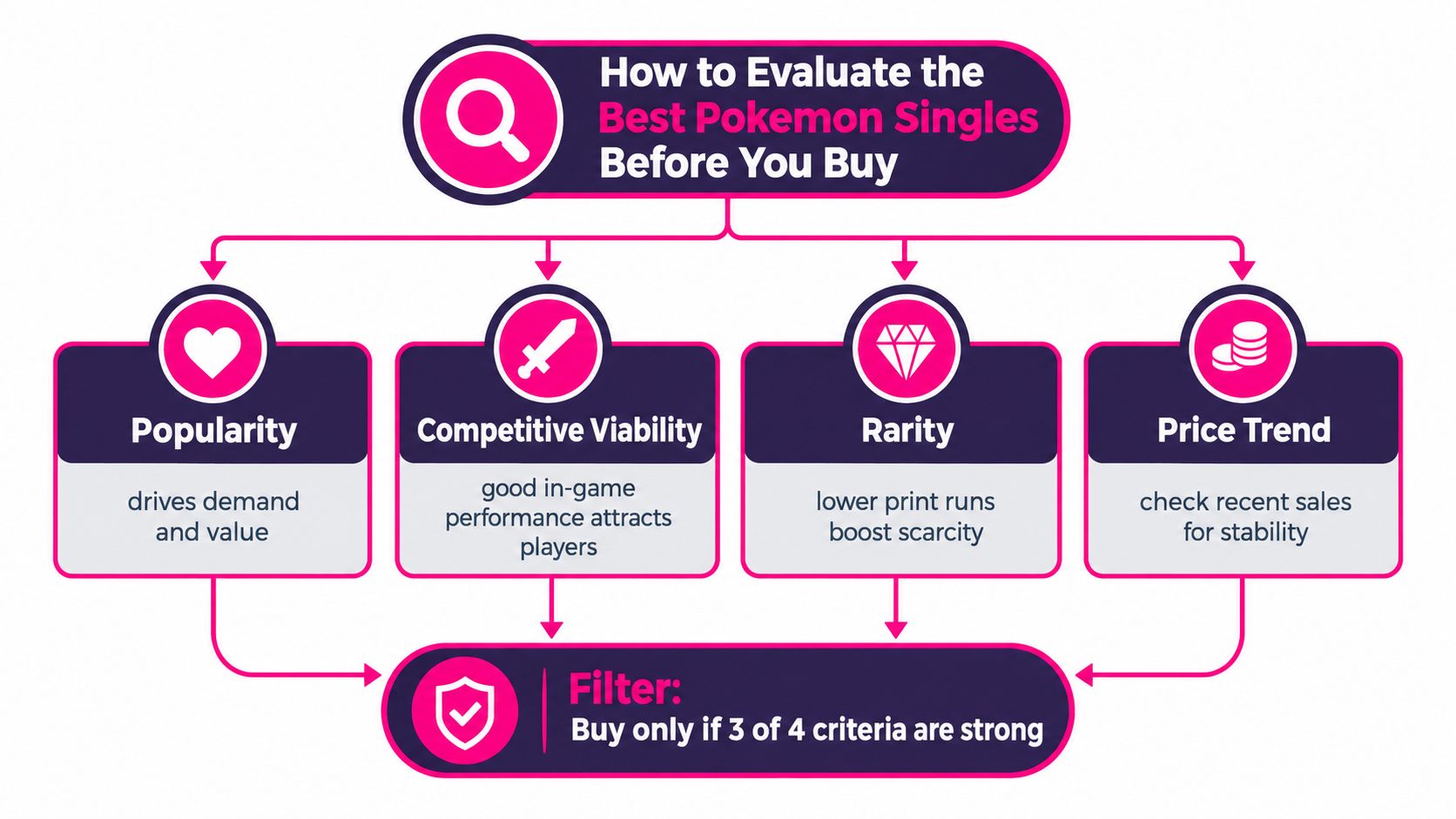
Start with a four-part screen. A candidate doesn't need to dominate every category, but it should show strength in at least three: character popularity, competitive viability, rarity, and price stability. This prevents a beautiful card with weak demand, or a playable card with excessive supply, from automatically becoming your next purchase.
Start with demand, not the artwork
Character popularity creates a broad collector base. Charizard, Pikachu, Umbreon, Gengar, Eeveelutions, and major Trainer characters can attract buyers even when a card leaves competitive play. That doesn't guarantee profit, but it gives you more potential exits than a card whose appeal depends entirely on a temporary tournament trend.
Competitive relevance works differently. Players may buy a card because it performs well, then sell it when the format changes or a stronger option appears. Treat gameplay demand as useful but less durable than deep character attachment unless the card also has strong artwork, rarity, or historical importance.
Confirm what makes the copy scarce
Set era, rarity, print context, language, and chase status matter. A card from the 1999 launch period belongs to a different collecting conversation than a recent mass-market release, even when both feature the same Pokémon. Vintage supply may be broad in raw form, but clean surfaces, strong centering, and sharp corners create a much smaller pool of desirable copies.
Modern cards need a stricter filter. High print volume means you shouldn't confuse “hard to pull today” with “permanently scarce.” Compare the card's current attention with its likely supply, reprint exposure, and the number of condition-perfect copies entering the market.
For a practical primer on how foil treatments affect collecting decisions, use this guide to foil trading cards before you compare surface quality or display appeal.
Check sales depth instead of trusting the cheapest listing
Asking prices are opinions. Recent completed transactions provide evidence. Live market trackers can aggregate hundreds to thousands of sales per card and expose trend, median price, country mix, and liquidity, as described by CardTrack's Pokémon market data.
Look for repeated sales across a useful period, not one dramatic result. A card with regular turnover is easier to exit than a supposedly underpriced card with little activity. Compare condition-specific sales too. Raw, near-mint, and graded copies shouldn't be blended into one average.
Use this quick decision matrix:
| Question | Strong signal | Warning sign |
|---|---|---|
| Character | Recognizable, enduring fan appeal | Interest depends on a short trend |
| Playability | Current player demand plus collector appeal | Gameplay is the only reason to buy |
| Rarity | Meaningful chase status or finite older supply | Large supply with weak differentiation |
| Price trend | Recent sales show stable turnover | Listings dominate, completed sales are scarce |
Buy only when three of the four signals are strong. If a card fails popularity, rarity, and liquidity, a low asking price doesn't rescue it.
Which Categories to Prioritize Right Now
The market isn't moving as one block. Recent coverage describes a split in which top-tier chase cards and graded vintage are outperforming, while mid-tier modern singles are flat to down 5% and low-tier modern is down 15% to 30%. Those figures come from Misprint's 2026 Pokémon card market trends report. The practical message is simple: don't buy “modern” as one category.
Modern English chase cards still have obvious strengths. They're easy to recognize, often supported by a large English-speaking buyer base, and can offer strong upside when the character and artwork break through. They're also exposed to fresh supply, reprints, changing attention, and a wide range of raw condition. Buy them for a personal collection or a targeted speculation, not because every chase card automatically becomes a long-term winner.
Japanese chase cards deserve a separate decision
Japanese cards can make more sense when the artwork is exceptional, the card has a dedicated collector following, and the graded population demonstrates strong gem potential. Recent reporting says Japanese PSA 10 chase cards can command a 20% to 40% premium over English equivalents in some cases, partly because Japanese cards gem at higher rates. The same source cautions that the premium is segment-specific, not a universal rule.
That creates a useful trade-off. You may pay more for a top-grade Japanese copy, but the grade spread can justify the premium when buyers place a high value on clean presentation and scarcity at the top tier. Don't assume every Japanese card is superior. Confirm language demand, regional buyer depth, certification, and recent sales.
Vintage staples offer the clearest downside argument
Graded vintage staples appeal to buyers who want history, nostalgia, and condition scarcity in one asset. Base Set holos and other cards from the early eras have an established collecting identity, and older high-grade examples can be materially scarcer than ordinary raw copies. They won't all be liquid at every price, but recognized vintage cards generally have a clearer reason for existing in a serious collection.
A Charizard purchase still needs inspection and pricing discipline. This holographic Charizard value guide is useful for separating card identity, holographic version, and condition before you make an offer.
| Category | Liquidity | Risk Profile | Best For |
|---|---|---|---|
| Modern English chase | Strong when character demand is broad | Reprint and hype risk, condition-sensitive | Collectors and selective speculators |
| Japanese chase | Strong in recognized niches | Language and regional demand risk, premium overpay risk | High-grade collectors and focused holds |
| Graded vintage staples | Established but price-dependent | Higher entry cost and condition verification needs | Long-term holders and nostalgia-driven collectors |
My ranking is use-case specific. For a collection, buy the card you'll keep looking at. For a hold, favor graded vintage or a Japanese PSA 10 with verified demand over a random modern English chase. For a flip, choose the category with the deepest recent sales, not the category with the loudest social media attention.
How to Check Condition and Authenticity Like a Pro
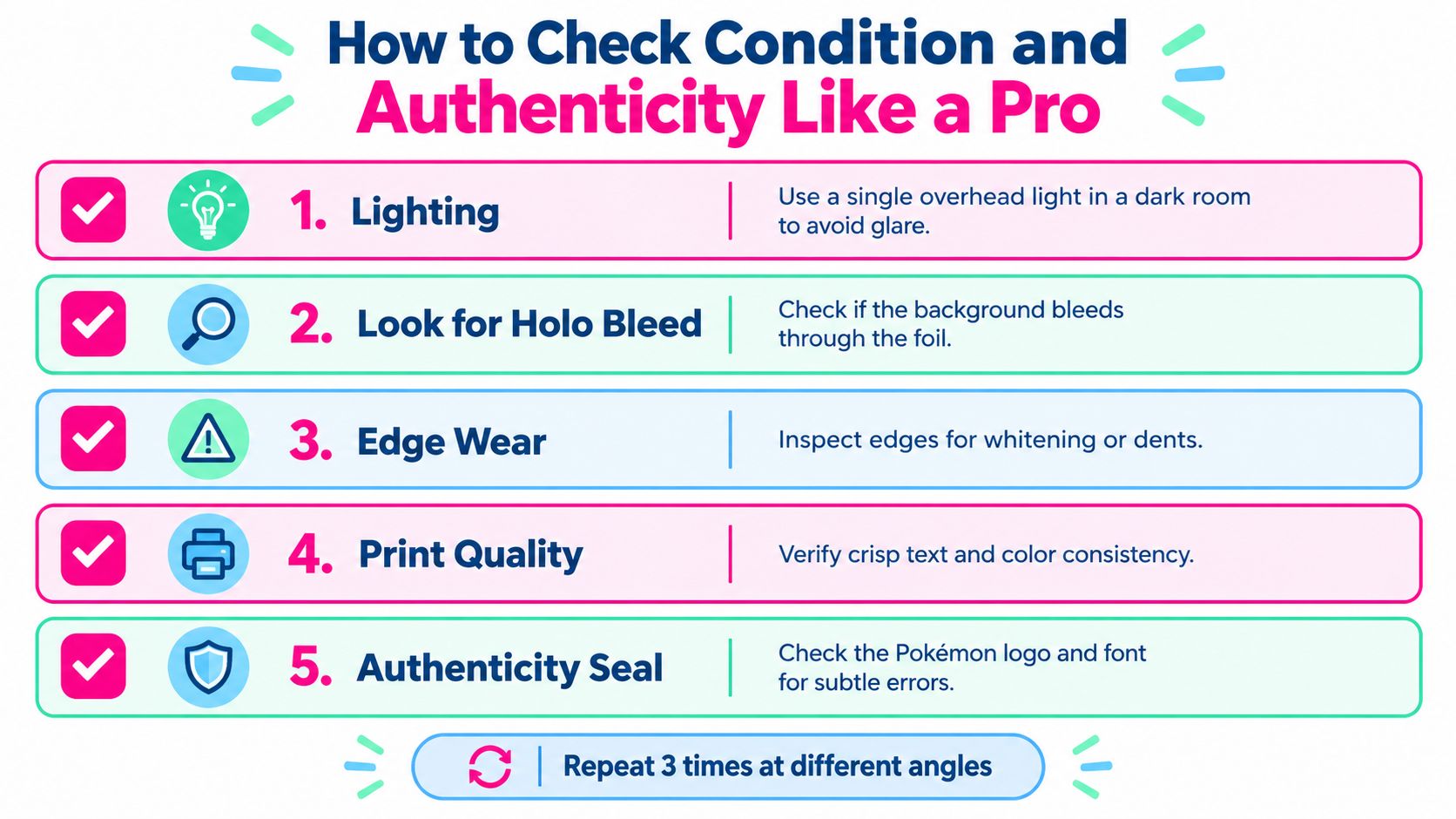
Condition inspection starts before you negotiate. Don't judge a raw card under dim room lighting, through a sleeve, or from a single front-facing photograph. A controlled inspection exposes the flaws that separate an ordinary copy from a premium one.
Use one light and inspect systematically
A practical method is to work in a dark room with one overhead light, then rotate the card under angled illumination. The Wintle's Workshop singles condition guide recommends close inspection of surfaces, edges, corners, centering, and print lines.
Follow the same order every time:
- Surface first: Tilt the card slowly. Look for scratches, dents, pressure marks, roller lines, and flaws hidden by the artwork or foil.
- Edges next: Check every edge for whitening, chipping, dents, and rough cuts.
- Corners: Examine all four corners from the front and back. Small whitening can materially change the card's grading prospects.
- Centering: Compare borders visually. Don't let attractive artwork distract you from uneven alignment.
- Structural damage: Look for bends, creases, impressions, and evidence of moisture or improper storage.
A seller's “near mint” label is not a grade. It's a starting point for your own inspection.
Test suspicious cards before paying
Authenticity checks require more than a logo glance. Examine typography, color consistency, set details, texture, and stock quality. A useful physical test is to inspect the card's black core layer and check whether light passes through unusually thin or counterfeit stock. Genuine card stock has a layered construction that behaves differently from many fakes.
Don't force a bend test on a valuable card. Use high-resolution images, seller history, certification checks, and a return policy first. If the card is already slabbed, inspect the holder, label, certification details, and signs of tampering. This guide to spotting a fake PSA slab covers the holder-level risks that raw-card checks can't address.
Paying for an authenticated slab makes the most sense when the grade spread is wide, the card is expensive, or your exit depends on buyers trusting the condition remotely. Raw cards can offer upside, but you're taking responsibility for centering, surface quality, authenticity, and future grading outcomes.
Use the visual inspection first, then watch the practical walkthrough below for another perspective on examining Pokémon singles.
Inspection habit: Never compare a raw card with a graded sale until you've accounted for every defect that could prevent the raw copy from reaching the target grade.
Timing Your Purchase and Managing Risk and Liquidity
The best entry price isn't always the lowest visible listing. It's the price you can defend using recent transactions, condition-adjusted comparisons, and a realistic exit route. Market dashboards expose trend, median price, country mix, and liquidity, so use those signals instead of anchoring to one optimistic seller.
Build an exit before you enter
Check how often the card sells and whether transactions occur in your region. A card may have global interest but still create friction through shipping, currency, fees, authentication, or buyer expectations. Country mix helps you understand whether the market is broad or concentrated in a buyer group you can't easily reach.
Median price is more useful than a single outlier. Compare like with like, including raw condition, grading company, language, centering quality, and visible flaws. If a Japanese PSA 10 trades at a premium, don't use that sale to justify a raw English copy.
The market tracker evidence described by CardTrack's Pokémon markets supports a transaction-first approach. Use the data to identify cards with enough turnover to exit, then inspect the actual listings and sold examples yourself.
Reduce the risks you can control
Position size matters even when you're confident. Don't let one character, one language, one modern set, or one speculative chase dominate your collecting budget. Spread purchases across eras and buyer types, while keeping enough liquidity for opportunities that appear when hype cools.
Avoid low-tier modern singles when their only appeal is that they're cheap. A low entry price doesn't compensate for weak turnover, heavy supply, or a narrow buyer pool. If the card has no compelling character demand, no meaningful rarity, and no reliable sales history, leave it alone.
Store every purchase with its cost, condition, certification, date, and intended exit. Organized tracking turns a pile of cards into a portfolio you can evaluate. Authenticated inventory, insured fulfillment, and a digital vault can also reduce operational problems, but they don't replace your own pricing judgment.
Use a simple purchase rule
Before buying, write down:
- The job: collection, hold, or flip.
- The evidence: recent comparable sales and transaction depth.
- The condition: raw defects or verified grade.
- The exit: likely buyer, marketplace, and acceptable selling price.
- The failure point: what would make you stop holding.
If you can't answer the exit question, you're collecting on impulse, not managing liquidity. That's fine for a personal favorite. It's a poor basis for an investment-sized purchase.
Your Next Smart Single and Final Takeaways
The best Pokémon single isn't a permanent top ten. It's the card that matches your job, survives condition scrutiny, and has enough buyer activity to give you options later.
Use this loop for every purchase:
- Define the purpose. Collection, long-term hold, or quick flip.
- Score the card. Popularity, competitive demand, rarity, and price stability.
- Choose the segment. Modern English for targeted upside, Japanese for selected high-grade niches, or vintage for history and condition scarcity.
- Verify the copy. Inspect raw cards under controlled lighting, or check slab and certification details.
- Confirm liquidity. Review recent sales, median pricing, and regional transaction depth.
- Record the decision. Save the purchase price, condition, grade, and exit plan.
The strongest buying decisions in 2026 come from grade spread and turnover, not popularity alone. Start with one high-liquidity target you understand thoroughly. A clean, authenticated card bought at a defensible price will teach you more than a stack of cheap singles selected from a hype list.
Lucardio Collectibles offers authenticated Pokémon singles, sealed products, and PSA-graded inventory, with collection organization through its Card Vault and insured, trackable fulfillment. Visit Lucardio Collectibles to compare verified cards and build your next purchase around condition visibility and a clear exit plan.