

A Secret Rare estimated at one in 216 packs works out to six 36-pack booster boxes per expected pull (pull-rate guide). That expectation is an average, not a guarantee: opening six boxes does not ensure the card appears. The ten EX cards and 25-card Radiant Collection occupy different pull tiers, so a single set-wide rate cannot describe every target.
The useful comparison is expected cost per card. Apply the pack odds to a 36-pack box, then compare the resulting expected number of boxes with the cost of buying the target as a single or choosing sealed product. Averages clarify the trade-off, but they do not predict an individual opening.
Table of Contents
- Legendary Treasures Set at a Glance
- Radiant Collection and How Its Numbers Work
- Notable Cards Collectors Chase
- Pull Rates and What a 36-Pack Box Holds
- Checking Authenticity and Condition Before You Buy
- Choosing Between Packs, Singles and Sealed Boxes
Legendary Treasures Set at a Glance
Black & White: Legendary Treasures closed the Black & White era as that block's final expansion, catalogued as BW11. Its shape is the first thing to get right, because the set isn't one checklist. A 113-card main set runs alongside a 25-card Radiant Collection subset, and the expansion brought back ten Pokémon-EX cards, among them Mewtwo-EX, Darkrai-EX and Keldeo-EX.
| Attribute | Detail |
|---|---|
| Set code | BW11 |
| Main set | 113 numbered cards |
| Radiant Collection subset | 25 cards |
| Pokémon-EX cards reintroduced | 10 |
| Booster box | 36 packs |
| Total checklist count | 138 (database count) or 140 (broader checklists) |
Two totals circulate for the same product, and both are defensible. Independent set databases report 138 cards, the 113 main plus the 25 subset. Broader collector checklists land on 140 once additional numbered cards are included. Neither figure is wrong; they answer different questions, and a listing that doesn't state which convention it uses is telling you something about how carefully it was built.
Sealed product arrives in the standard 36-pack booster box, which is the unit that turns per-pack odds into per-box expectations. That conversion is where the useful analysis lives, because a rate per pack is abstract while an expected count per box is a number you can hold against a price.
The takeaway is narrow but it compounds. Count the set as 113 plus 25, check which total a checklist or listing is quoting before you compare prices, and treat the 36-pack box as the standard unit for any odds math. Get those three right and every later comparison, one card against a full set, singles against sealed, runs on consistent numbers.
Radiant Collection and How Its Numbers Work
Say a collector works through the main checklist, ticks off 113 numbers and declares the set complete. The binder looks full. It is missing 25 cards, because the Radiant Collection inside Legendary Treasures is numbered as its own series rather than as numbers 114 to 138. The official Pokémon set page spells out the mechanics: separate numbering, a distinctive special coating, its own foil patterns and its own rarity scheme, which makes completion a different exercise from collecting cards numbered 1 to 113.
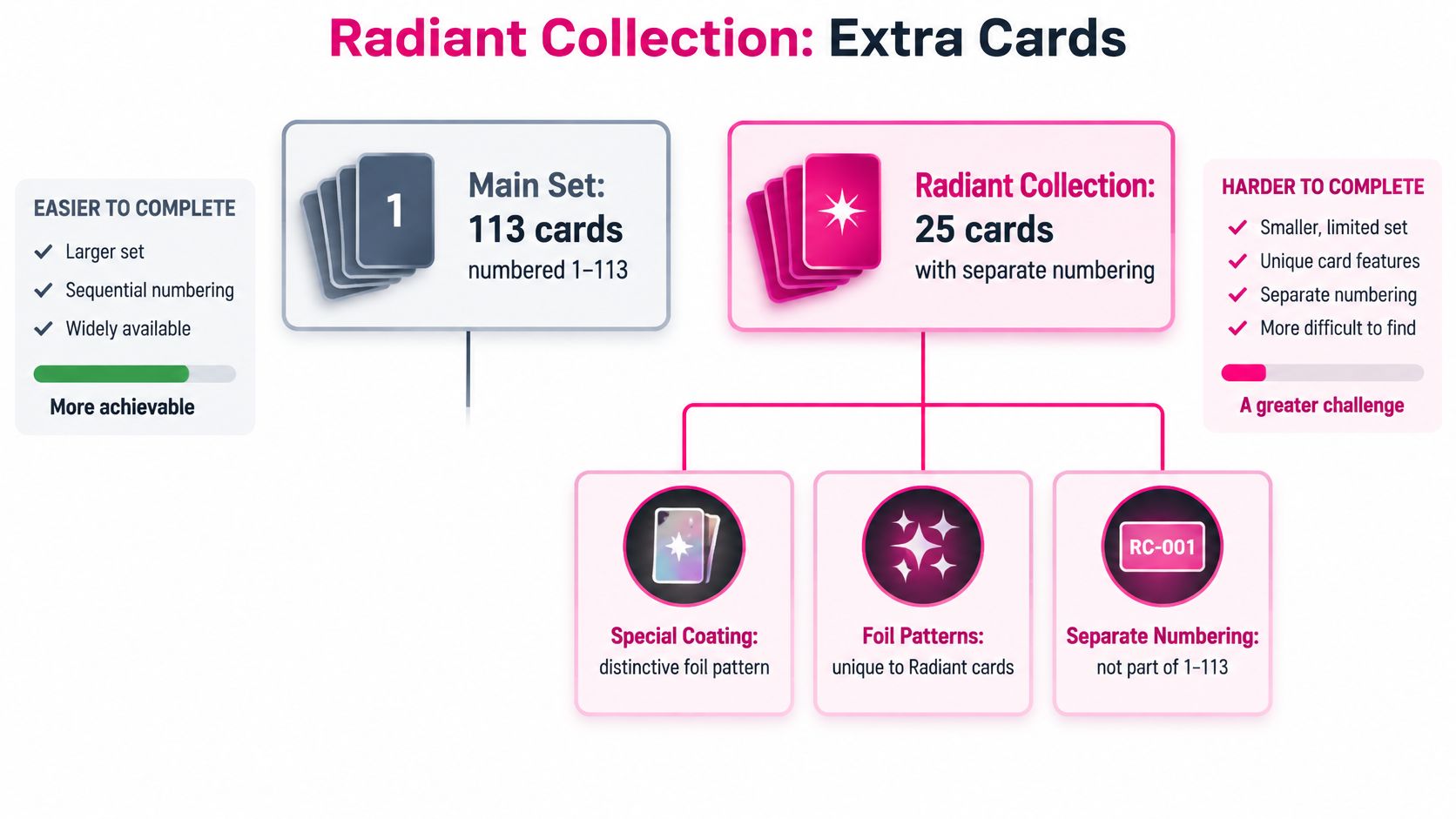
That structure is why the count lands at 138 in independent set databases and 140 on broader checklists once additional numbered cards are included. The subset isn't a bonus that sorts itself. It has to be tracked as a parallel column, because a Radiant card sitting in the main-set section of a binder or a listing reads as missing inventory from the other side of the checklist.
What a Complete Record Includes
A listing or inventory row for any single in this set should carry five fields, and skipping any one of them creates the errors that show up later as valuation disputes:
- Expansion number: the number printed on the card, which tells you which checklist it belongs to before anything else.
- Subset designation: Radiant Collection versus main set, recorded explicitly rather than inferred from the artwork.
- Finish: the coating and surface treatment, which is where Radiant cards separate themselves from the main-set print run.
- Holofoil pattern: the specific foil layout, since two cards with the same name can present differently.
- EX or secret-rarity classification: the tier marker that drives both demand and authentication scrutiny.
The EX cards create a concentrated high-value segment inside the expansion, and that concentration cuts both ways. It makes premium singles worth grading and worth verifying at the point of sale, and it makes a vague listing expensive to get wrong.
The fix is administrative, not technical. Build a tracking sheet with a main-set column running 1 to 113 and a second Radiant column, record each card's subset, finish and foil pattern as you file it, and recount against the database total before you value the set. A collection measured against 140 takes ten minutes longer to audit and holds its price far better than one measured against a hopeful memory of a full binder.
Notable Cards Collectors Chase
The chase list combines named cards with broader rarity categories, but those levels of evidence are not interchangeable. Lugia-EX #102 stands out among the named targets: the published chase information estimates its pull rate at about one in 72 packs. That estimate helps compare opening packs with buying a single, but it does not guarantee when a particular card will appear.
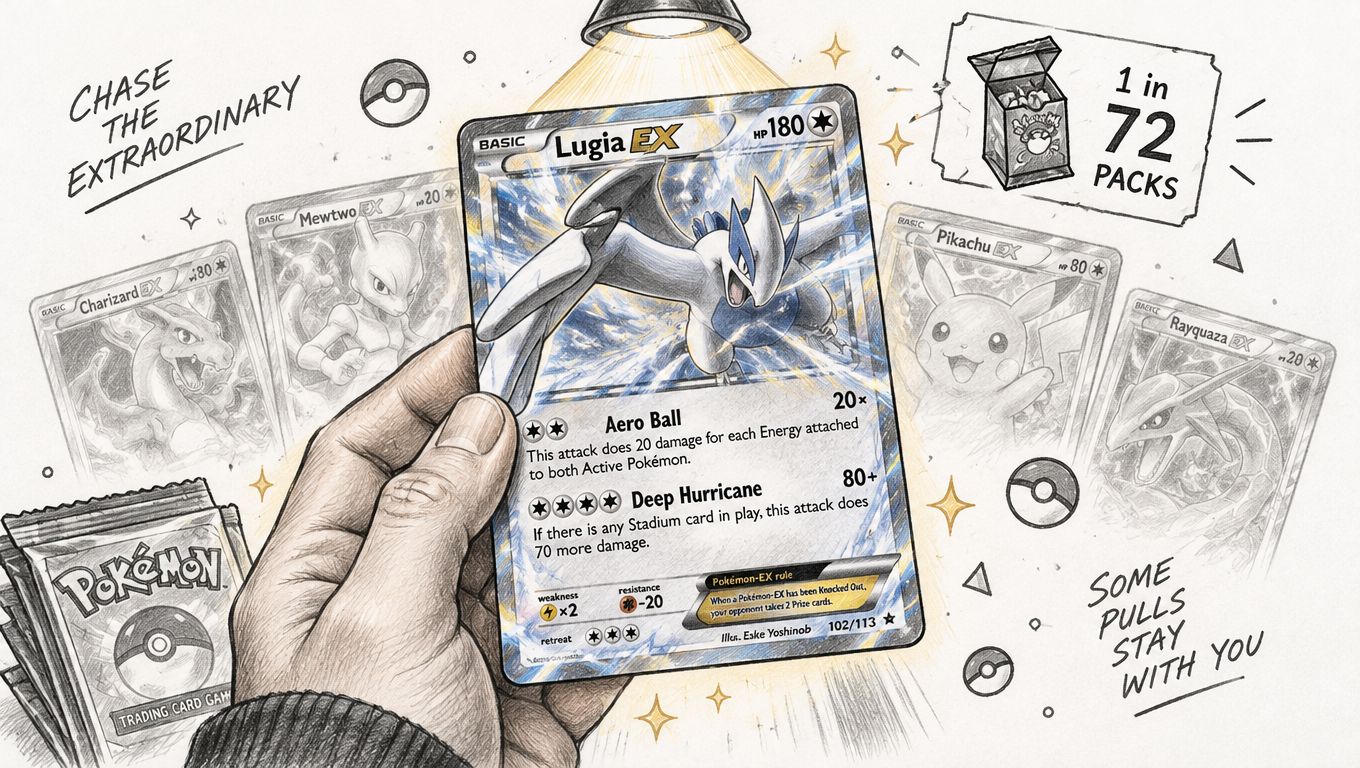
A specific Secret Rare is estimated at about one in 216 packs, according to the published pull-rate estimates for Legendary Treasures. That makes sealed product a highly uncertain route to any one Secret Rare. Buying a single avoids the pull-rate uncertainty, although its condition and authenticity still need consideration.
| Card | Why collectors watch it | Estimated pull odds |
|---|---|---|
| Lugia-EX #102 | Named individual chase card on the published list | About 1 in 72 packs |
| Specific Secret Rare | Single-card odds for one secret rare | About 1 in 216 packs |
| Mewtwo-EX | Reintroduced EX card | Not published separately from the EX tier |
| Darkrai-EX | Reintroduced EX card | Not published separately from the EX tier |
| Keldeo-EX | Reintroduced EX card | Not published separately from the EX tier |
| Any Ultra Rare | High-rarity hit category | About 1 in 4 packs |
Where the Odds Are Published and Where They Aren't
The table distinguishes named-card estimates from category-level rates. Published figures cover Ultra Rares, Rare Holo EX cards, Rare Holos and Secret Rares, while named-card estimates are available for Lugia-EX and a specific Secret Rare. No separate probability is given for Mewtwo-EX, Darkrai-EX or Keldeo-EX. A precise figure for any of those three would therefore be an estimate, not a published rate.
That distinction matters when comparing routes to a target. Category odds can describe the expected frequency of a type of pull, but they do not establish the chance of getting a particular card within that category. For a named card without a published individual rate, collectors cannot calculate a supported expected pack cost from the category figure alone. The odds help frame the uncertainty; they do not remove it.
EX status identifies a subset of the cards collectors may target, but it does not make each card equally likely to pull. Premium singles also warrant careful checking of authenticity and condition before purchase. Collectors interested in newer full-art releases can apply the same target-first approach to full-art Mew ex cards, while keeping the older set's published odds separate from any assumptions about individual cards.
Practical rule: choose the target before choosing the buying route. A named-card pull estimate can inform the expected cost of opening packs; where no individual rate is published, compare singles and sealed product without treating category odds as a card-specific guarantee.
For a closer look at how the chase cards and their finishes present:
Pull Rates and What a 36-Pack Box Holds
The pull-rate model compiled for the set works at the rarity-category level, which is the right altitude for planning. It estimates approximately one Ultra Rare every four packs, one Rare Holo EX every six packs, one Rare Holo every two packs, and one Secret Rare every 108 packs.
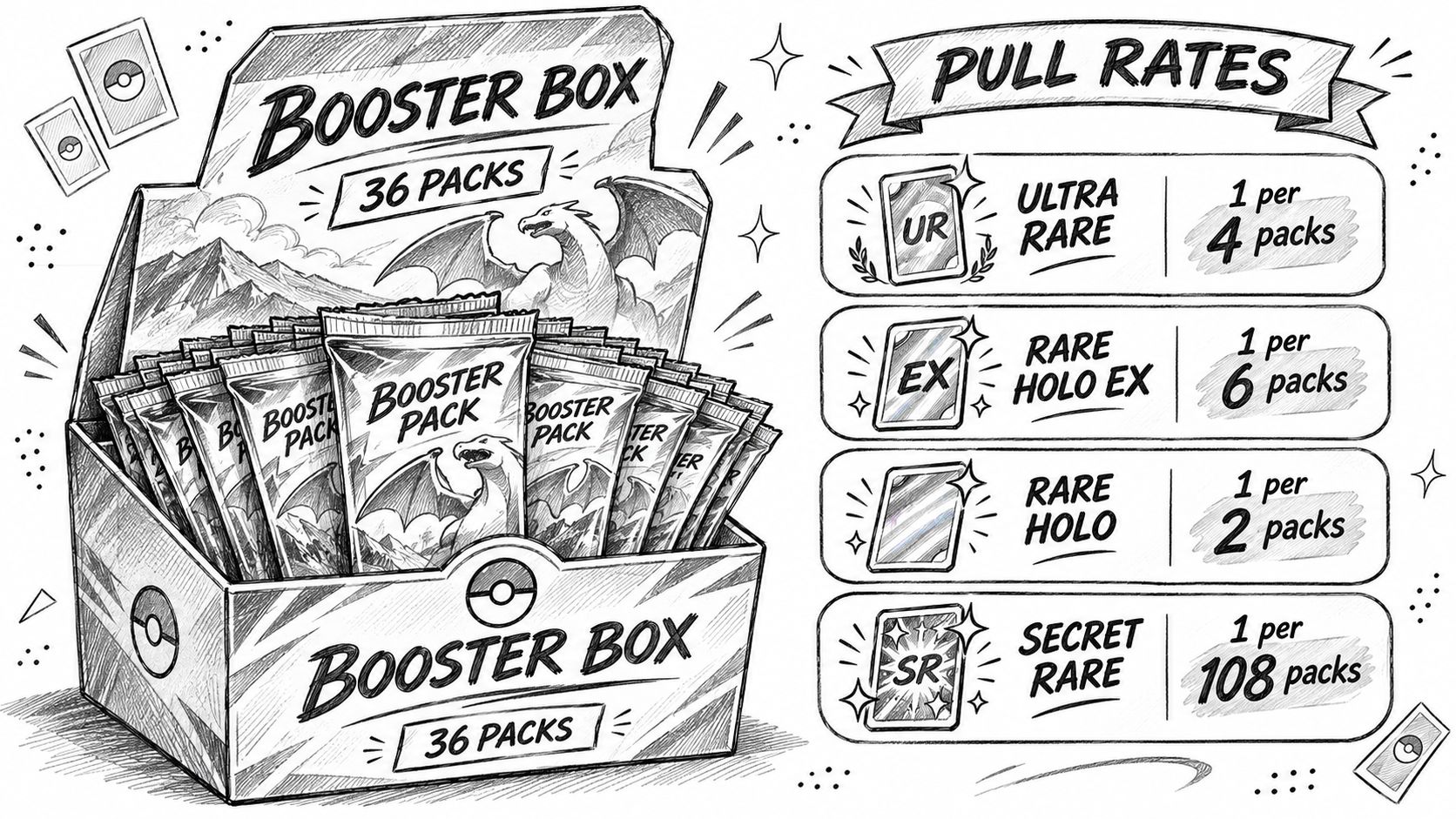
Divide those rates into a 36-pack box and the expectations fall out cleanly.
| Rarity category | Estimated frequency | Expected per 36-pack box |
|---|---|---|
| Ultra Rare | About 1 per 4 packs | About 9 |
| Rare Holo EX | About 1 per 6 packs | About 6 |
| Rare Holo | About 1 per 2 packs | About 18 |
| Secret Rare (category) | About 1 per 108 packs | About 0.3 |
| Specific Secret Rare (one named card) | About 1 per 216 packs | About 0.17 |
Read the bottom two rows together and the structure of this set becomes obvious. A box is a strong source of Ultra Rares and Rare Holos. It is a weak source of Secret Rares in general and a very weak source of any one Secret Rare in particular, at roughly a sixth of a copy per box.
Averages, Not Allocations
Expected counts are averages across many boxes, not contents printed on the box. Pack outcomes are independent, and clusters happen in both directions, so one box can return several hits while the next returns almost nothing. Neither result contradicts the model.
The caveat that matters: a box that produces no Secret Rare hasn't beaten the odds and hasn't been tampered with. It's one trial, and one trial tells you almost nothing about a distribution.
The practical use of the table is expectation-setting before you buy, not forecasting after you open. If the plan is to chase a specific Secret Rare, the expected count per box tells you how many boxes that chase implies, and the answer is usually higher than people assume. If the plan is a broad spread of playable and collectible cards, a box delivers a steady supply of Ultra Rares and Rare Holos by design.
Tier names cause their own confusion here, especially for collectors arriving from later eras with different rarity structures. This explainer on Pokémon card rarity walks through how the categories stack.
Use the expected counts to set a realistic baseline before a purchase and to decide whether a box fits your collection goal. A box bought for hit density is a reasonable buy. A box bought as a cheap route to one named card is a lottery ticket with a known price.
Checking Authenticity and Condition Before You Buy
A scarcity premium holds only when the item is genuine and its condition can be verified. Everything below takes minutes, costs nothing, and applies on any platform, from a live break to a private sale.
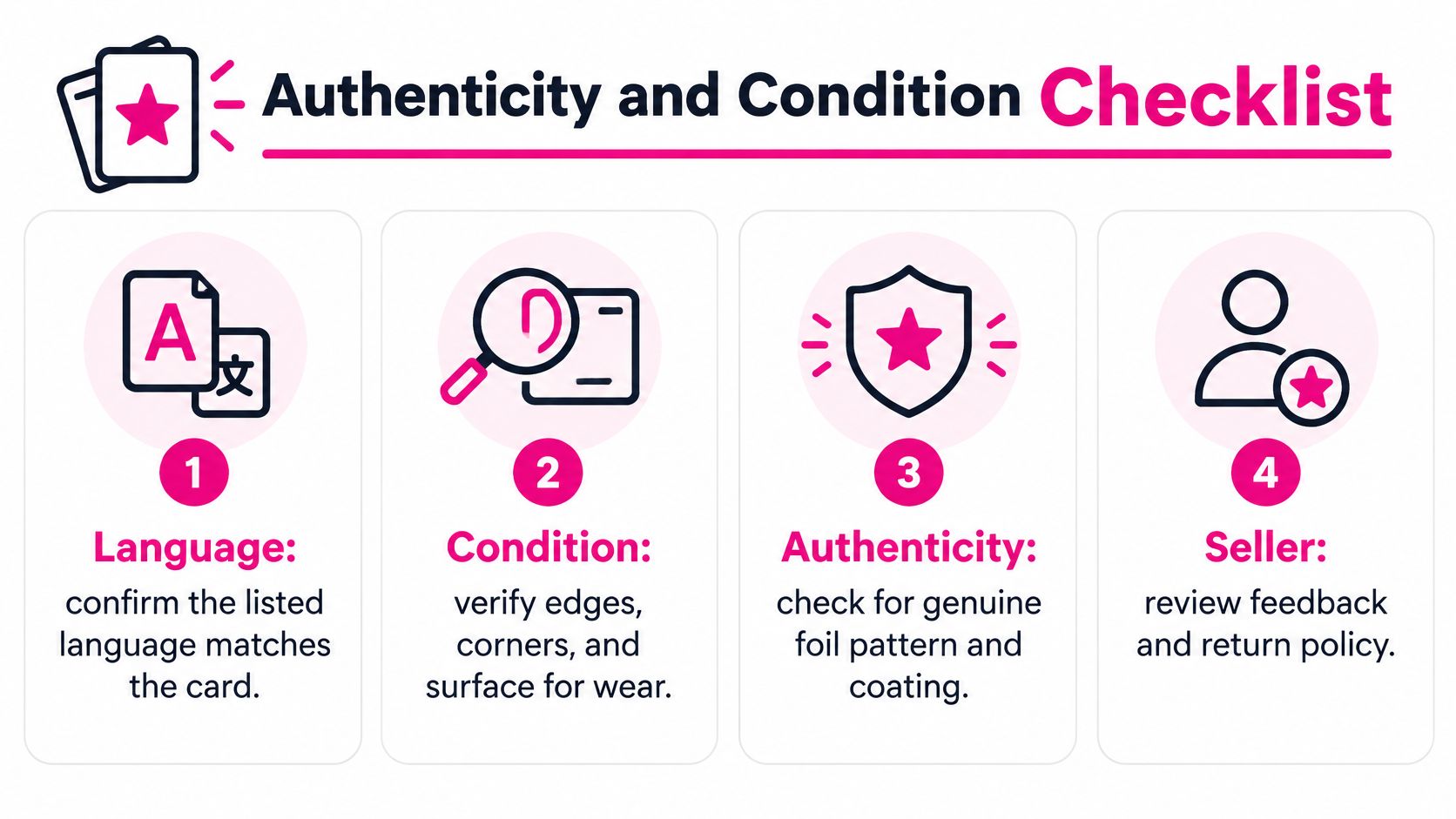
- Language: confirm the listed language matches the product you're buying, because language affects both collectibility and resale value within the same card.
- Seal: check for intact shrink wrap and look for wrinkles, tape residue or a reflated edge that suggests a box or pack has been opened and resealed.
- Box condition: inspect for compression or crushing, since a squashed corner can hide damage to the packs inside.
- Singles: ask for clear photos and check centering, edge whitening and surface scratching, which are the three defects that move a grade.
- Graded slabs: match the PSA grade and certificate number against the listing and the slab itself, not just the seller's description.
- Provenance: a listing should name the set, the subset and the finish, and say where the item came from. Vague descriptions are harder to verify and harder to resell.
Provenance sounds abstract until you see what it does to price. Recovery estimates commonly place the value of material recovered from the Nuestra Señora de Atocha, a Spanish galleon that sank in 1622, at roughly $400 million, and much of that rests on each piece connecting to a named vessel and a dated sinking rather than on the metal in it. A card listing works the same way at smaller scale: set, subset, finish and source are what make the item checkable.
Every card we sell at Lucardio Collectibles is guaranteed to be authentic, and orders ship with insured delivery so a lost or damaged parcel doesn't become your problem to absorb. For the condition side of the checklist, our Pokémon card condition guide covers centering, whitening and surface assessment in detail.
Choosing Between Packs, Singles and Sealed Boxes
Start with the card, not the product. A target of Lugia-EX #102, a target of one specific Secret Rare, and a target of an enjoyable evening with 36 packs are three different purchases, and only one of them is well served by a sealed box. The pull-rate guide for the set reports approximately one secret rare per 108 packs, one ultra rare per four packs, one specific secret rare at roughly one in 216 packs, and Lugia-EX at about one in 72, which is enough detail to price all three routes against each other.
| Route | Best for | Main risk | Cost measure |
|---|---|---|---|
| Open packs | Entertainment and hit excitement | Chase cards at roughly 1 in 72 to 1 in 216 packs | Expected packs per target card |
| Buy singles | Targeting one named card | Authenticity and condition checks | Listed price per card |
| Buy sealed box | Hit density and sealed collecting | No guaranteed contents per box | Box price divided by expected hits |
Cost per Target Card, Route by Route
Opening packs has clean arithmetic once you accept the average. A specific Secret Rare at one pack in 216 needs 216 packs on average, which is six 36-pack boxes. Lugia-EX at one in 72 needs 72 packs, or two boxes. Put a hypothetical $100 box price on those figures and a specific Secret Rare works out to about $600 of sealed product per expected copy, while Lugia-EX lands near $200. Those totals ignore everything you pull along the way, which is the honest reason opening still appeals.
Buying singles replaces that distribution with one number: the listed price of the card you want. The comparison becomes direct. If a Lugia-EX single lists below what two boxes would cost, the single is the cheaper route to that card and you skip the variance entirely. What you take on instead is verification, since the premium depends on the card being exactly what the listing claims.
Sealed boxes serve a different goal. Divide the box price by the expected hits in the tiers you care about and you get a cost per expected hit, which is the number a box has to beat. That math favors a box when the goal is hit density, a sealed collection or a break, and it works against a box when the goal is one named card.
Worked comparison: at a hypothetical $100 per box and 0.17 copies of a specific Secret Rare per box, you're paying about $600 per expected copy of that card. Two boxes, about $200, return one Lugia-EX on average. If the single lists under those numbers, packs are entertainment rather than procurement.
The odds also leave out factors that change the actual cost. Duplicates, off-center cards, edge whitening, grading fees, shipping, and the resale value of non-hit cards all sit outside a pull-rate table, and for a set with this much bulk, the non-hit pile is where a lot of the practical value ends up.
Averages aren't guarantees, and entertainment is a legitimate reason to open packs. The mistake is paying entertainment prices while telling yourself you're acquiring a specific card. At Lucardio Collectibles we sell trading cards, sealed booster boxes and PSA graded cards, so the three routes can be compared against one target list instead of across three sites.
The next step is a written target list. Name the cards, work out the expected cost per card for packs and for a box, put the single's listed price beside it, and buy from whichever column wins. That one page of arithmetic will settle more purchases than any odds table on its own.
Whether you're chasing a Lugia-EX, filling the 25-card Radiant Collection, or hunting sealed Legendary Treasures boxes to keep sealed, Lucardio Collectibles is building a single destination for authenticated singles, sealed inventory and PSA graded cards, backed by a full authenticity guarantee and insured delivery. Weekly drops include authenticated slabs, and subscribing is free, with early access to new drops and collector updates. Visit Lucardio Collectibles to compare routes on your own target list before the next drop closes.