

Fewer than 100 PSA Gem Mint copies of the English Charizard Gold Star were reported in 2026 by ComicBook.com. That's a more useful starting point than the card's biggest auction headline. The central valuation question isn't whether this Charizard is scarce, but which condition tier is scarce, when someone counted it, and what buyers paid for comparable copies.
A population report records grading activity, not an immutable supply of unique cards. To value Charizard Gold Star responsibly, identify the printing first, audit the population claim, and then compare transactions without confusing an exceptional result with an executable selling price.
Table of Contents
- Identifying the English Gold Star Charizard
- Where This Card Fits in Charizard's History
- Why Population Counts Drive the Price
- How to Audit a Population Report Before Trusting It
- What Grade Gaps Mean for Value
- Condition Factors That Move the Price
- Avoid Fakes and Confirm the Card Before You Buy or Sell
Identifying the English Gold Star Charizard
Identifying details of the English Charizard Gold Star
The historical identifiers below follow Dimers' Gold Star history, which identifies the English card as 100/101 from EX Dragon Frontiers, released in November 2006; the printed specifications follow the TCGCharts card record, including Darkness typing, 90 HP, Water weakness of ×2, and a three-Energy retreat cost.
| Attribute | English Gold Star value | Why it matters |
|---|---|---|
| Set | EX Dragon Frontiers | Confirms the expansion |
| Card number | 100/101 | Separates it from other Dragon Frontiers prints |
| Release | November 2006 | Places it in the EX era |
| Rarity marker | Gold star beside the name | Identifies the Gold Star variant |
| Type and HP | Darkness, 90 HP | Matches the Delta Species design |
| Weakness and retreat | Water ×2, three-Energy retreat | Confirms the printed stats |
| Artist | Masakazu Fukuda | Cross-checks the artwork credit |
| Artwork | Dark teal-black Charizard with orange wing details | Separates it from the orange standard Charizard |
| Language | English | Excludes other-language printings |
Start with the printed identifiers, not the seller's title. Match the collector number and expansion attribution, then inspect the gold star beside the name and the Delta Species styling. A listing that says only “rare black Charizard” hasn't established which card it offers.
The artwork provides a useful visual cross-check: the dark body and contrasting wing details distinguish this design from the familiar orange Charizard. However, a matching illustration alone doesn't authenticate the physical card. A counterfeit can reproduce an image, so agreement across the name, stats, symbols, language, and collector information matters more than resemblance.
Check the attack text too
TCGCharts records Rotating Claws at 20 damage, with an Energy-recovery effect, and Dark Swirl requiring four Energy for 150 damage, followed by discarding Charizard's attached Energy and the opponent's top three deck cards. Those effects help distinguish the printing while explaining its resource-intensive design: the larger attack requires rebuilding after use.
Use this quick identification check before discussing price:
- Number: Does the collector number match the table exactly?
- Expansion: Does the card's set identity agree with EX Dragon Frontiers?
- Marker: Is the gold star beside Charizard's name?
Passing these checks establishes the intended printing. It doesn't, by itself, establish authenticity or condition.
Where This Card Fits in Charizard's History
The English Gold Star Charizard belongs to the EX-era Delta Species storyline, rather than to the original Base Set tradition. Its significance comes from the intersection of Gold Star rarity, an alternate visual treatment, and a deliberately unusual Pokémon type.
The timeline places that release within the broader Charizard collecting story.
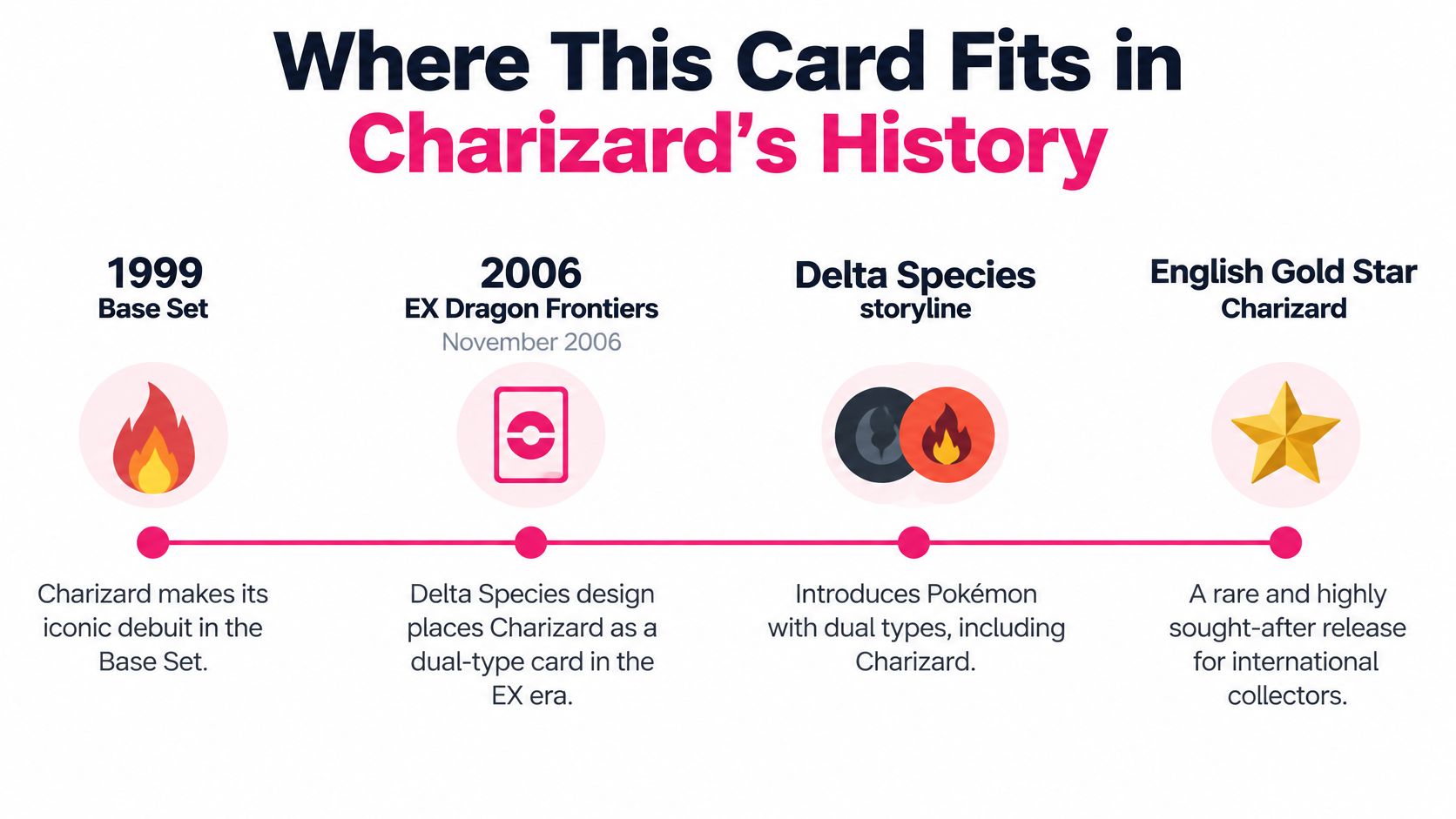
The important distinction is between appearance and typing. The dark coloration is a visual attribute; Delta Species is the design framework that lets the card reinterpret Charizard's usual identity. Don't infer the printed type from the illustration, or assume that every Delta Species card is dual-type.
For a collector assembling a Charizard collection, this card can therefore fill a different role from a conventional orange Charizard. It represents a particular design experiment and the closing phase of the EX-era Delta Species arc, not merely another illustration of the same character.
Historical importance isn't a production census
The available historical records identify this as the English Gold Star Charizard printing. That makes precise cataloging important, particularly when sellers use abbreviated names that blur language, set, or rarity distinctions.
However, no confirmed original print-run total is available in the historical reference. Neither its position near the end of the set nor its historical importance establishes how many copies were manufactured.
A card's place in Pokémon history can explain collector interest. It cannot substitute for a count of surviving copies or a record of completed sales.
For buyers, the release era supplies context for the collecting category. The identifying attributes establish which object belongs in that category, and condition determines which comparable transactions deserve attention.
Why Population Counts Drive the Price
About 1.7% of the reported PSA population reached PSA 10 in LastSold's English Charizard population breakdown: 98 of 5,648 reported copies. Its grade distribution below shows why overall graded availability and gem-mint scarcity are different questions.
PSA population of the English Charizard Gold Star by grade
| Grade band | Reported copies | Share of reported total |
|---|---|---|
| PSA 10 | 98 | About 1.7% |
| PSA 9 | 554 | About 9.8% |
| PSA 8 | 570 | About 10.1% |
| PSA 7 or lower | 4,426 | About 78.4% |
| Total reported | 5,648 | 100% |
The chart isolates the small top-grade segment within that reported population.
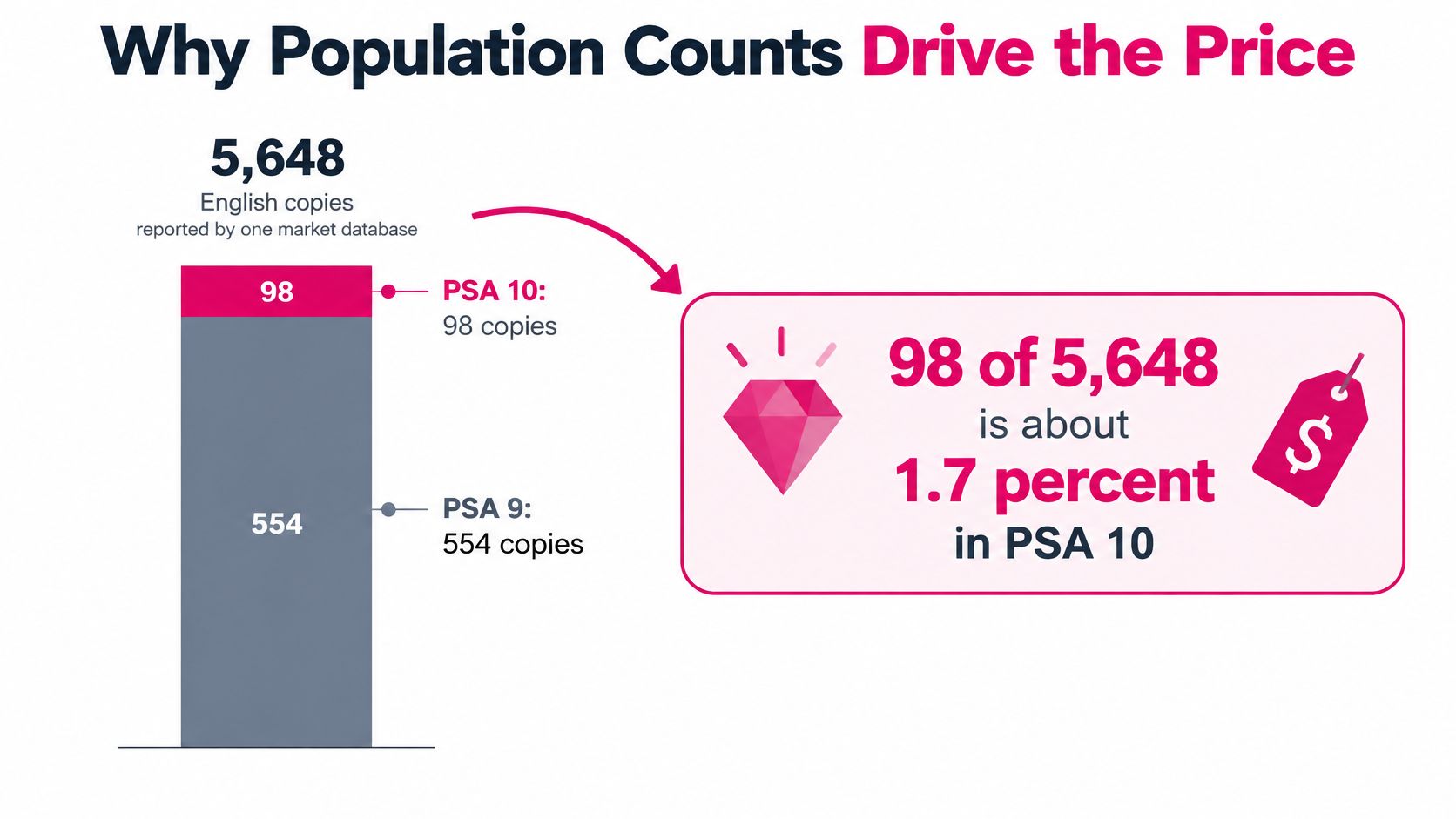
A buyer seeking any authenticated example faces a different supply question from a buyer insisting on the highest grade. The latter isn't choosing from the entire graded population. They're competing within a much narrower condition category, and even that category isn't necessarily available for sale.
Supply isn't the same as inventory
A population report doesn't tell you how many owners will sell, what they'll accept, or whether the same copy has recently changed hands. A small census can help explain a premium, but it cannot calculate that premium on its own.
Nor does this distribution give a raw card a simple probability of earning the highest grade. Submitted cards aren't a random sample of every surviving copy, and owners make different decisions about which cards are worth grading.
The embedded video offers additional viewing alongside the population analysis.
Treat the table as a snapshot without a stated capture date, not a live census. Before attaching a valuation to it, verify the current report and distinguish the date of the population observation from the date of the sale.
Our guide to graded-card prices provides a broader framework for considering certification alongside transaction evidence. The useful conclusion here is narrower: condition scarcity gives buyers a reason to distinguish grades, but it doesn't make every copy within a grade equally desirable.
How to Audit a Population Report Before Trusting It
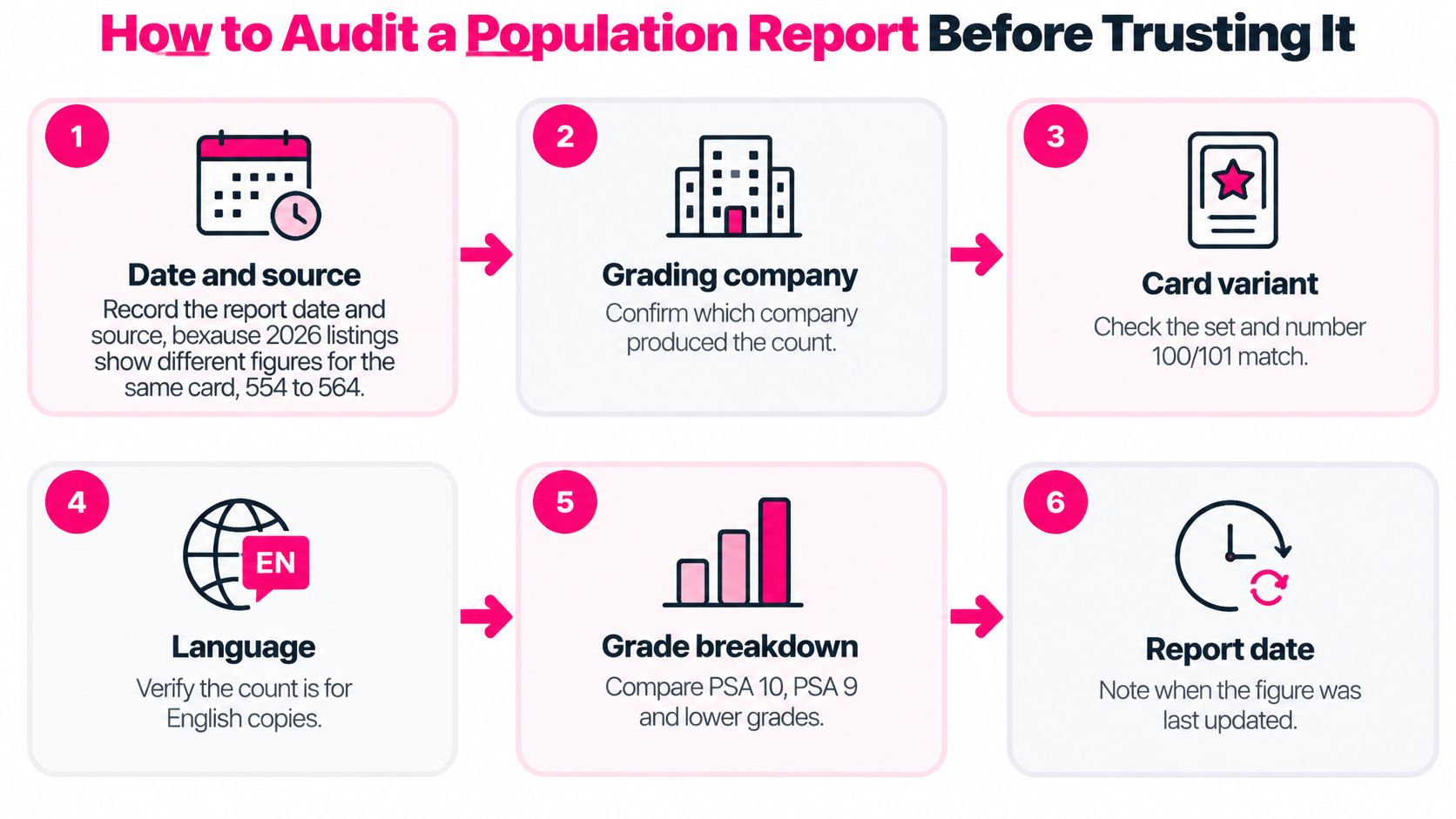
Auction population figures can disagree without either listing being fraudulent. The Fanatics Collect auction record and its population context document differing figures across 2026 listings, including 554 to 564 PSA 8 copies and approximately 554 to 555 PSA 9 copies.
A useful audit preserves those differences instead of selecting whichever count makes the strongest scarcity claim.
Build a reproducible record
Record the date and source. Save the report's update date separately from the date you accessed it. If the source doesn't disclose an update date, label that omission rather than treating your access date as proof of freshness.
Separate the grade tiers. Keep conflicting counts in separate entries with their original labels. Averaging them would create a number that neither source reported.
Identify the reporting context. An auction house may preserve the population shown when a lot was posted, rather than continuously update an old listing. Check whether you're reading an archived sale description or a current grading-company report.
Distinguish records from physical cards. Consider resubmissions, crossover grading, and possible duplicate records before interpreting a census as a count of unique objects. Don't invent a correction factor if you can't establish which records overlap.
Compare within the same grading system. Confirm the grading company, English-language designation, set, and variant. A smaller count elsewhere may reflect different submission patterns rather than a smaller surviving supply.
Save evidence that another buyer can recheck. Retain the population screenshot, certification number, slab photographs, and purchase provenance together. Keep an older snapshot when you add a newer one, so the history remains visible.
Audit rule: If someone can't reproduce the population claim from your saved evidence, don't use it as the main justification for your asking price.
The result should be an evidence file, not a scarcity badge. For example, if an archived auction and a current report disagree, preserve both and use the current report for a present-day comparison while retaining the older figure as historical context.
A population audit also sets a limit on your conclusion. You can establish what a grading census reported at a particular time; you usually can't establish the total number of surviving raw copies from that census.
What Grade Gaps Mean for Value
A PSA 8 can look cheap beside a PSA 9 until the two transactions are normalized. Grade gaps mark what bidders paid for particular slabs at particular times; they behave like negotiation ranges that can widen or compress as population reports, fees, and copy quality change.
Card Ladder's Charizard Gold Star record reports PSA 8 results of $17,400, $24,000, and $34,200, alongside PSA 9 results around $49,200 to $58,507. Separate public accounts describe much higher top-grade outcomes, but grade confirmation, sale timing, venue, and fee treatment are not consistent enough to set a dependable PSA 10 range from them.
Reported sale prices by PSA grade
| PSA grade | Reported sales | Reported range | What to note |
|---|---|---|---|
| PSA 10 | High results are described in public accounts, but grade confirmation is inconsistent | No confirmed PSA 10 range can be set from those accounts | Require certification, timing, venue, and fee context before using as a comparable |
| PSA 9 | Results reported around $49,200 and $58,507 | $49,200 to $58,507 | Check fees, timing, and eye appeal |
| PSA 8 | $17,400, $24,000, $34,200 | $17,400 to $34,200 | Wide spread within one grade |
The usable conclusion is dispersion. A single grade can contain a weak-borderline copy and a strong example with cleaner presentation, while a higher label can still carry timing risk if the sale happened before supply or demand shifted. A grade premium observed when top grades looked thinner can also compress after new submissions, even when collector interest has not changed.
Compare the transaction, not just the label
Normalize currency and determine whether the result includes the buyer's premium. Match the sale window, venue, certification context, and visible condition before using a transaction as a comparable.
A premium-grade purchase may suit a collector who prioritizes the label. A visually appealing mid-grade copy may better suit someone who prioritizes display quality, but neither preference guarantees an attractive resale outcome.
Liquidity deserves separate treatment. A less expensive copy may fit more buyers' budgets, yet finding a willing buyer during a slowdown can still take time or require a concession.
Build a small set of closely matched completed sales, preserve the low and high results, and place the card within that range using documented condition differences. Avoid mechanically multiplying a lower-grade price to estimate a higher-grade card.
Condition Factors That Move the Price
Condition explains differences that the grade label compresses. TCGFish's Charizard Gold Star record highlights centering, whitening, holo scratches, surface dents, and print defects as the practical features to document when assessing a raw or graded copy.
Condition factors and what to check
| Factor | What to check | Why it moves value |
|---|---|---|
| Centering | Balance of borders left-right and top-bottom | Off-center borders can reduce grade and eye appeal |
| Whitening | White showing on edges and corners | Visible edge wear affects condition and presentation |
| Holo scratches | Scratches on the foil under angled light | Surface damage can affect grade and buyer preference |
| Dents and creases | Pressure marks or indentations | Structural damage can materially limit grade |
| Print defects | Misaligned print, ink lines, or spots | Manufacturing flaws need assessment separately from wear |
Photograph what buyers need to judge
Begin with straight-on photographs of the front and back. Keep the camera parallel to the card so perspective doesn't make balanced borders look uneven, then add corner and edge close-ups.
For centering, compare opposing borders rather than judging only the artwork's position. For whitening, use a contrasting background and avoid blown-out lighting that hides pale edge wear.
Tilt the card under a fixed light to reveal holo scratches. With a slabbed copy, change the angle and focus to help distinguish marks on the holder from marks on the card.
Use low, angled light for dents and creases, which may disappear in a flat photograph. Document suspected print defects separately, without assuming that a factory-origin flaw is irrelevant to grading or buyer preference.
A clean-looking photograph isn't evidence of a clean surface if the lighting conceals the area a buyer needs to inspect.
Our Pokémon card condition guide can help organize the inspection. Keep descriptions observational: identify the location and appearance of a flaw rather than promising what grade a company will assign.
Apply those observations to comparable copies with similar presentation. A conspicuous flaw can make a card less attractive than another example carrying the same grade, but there's no defensible universal discount for every scratch or white corner.
Avoid Fakes and Confirm the Card Before You Buy or Sell
A generic Charizard listing that omits the set and collector information leaves the object unidentified. Don't negotiate from its headline price before the seller establishes the printing, language, and Gold Star marker.
For a graded card, the next task is to connect the physical slab, its label, and the grading-company record. A certification lookup is necessary, but a matching number alone shouldn't end the inspection.
Use clear photographs to examine the card and holder together.

Verify the evidence behind the listing
Ask for dated photographs of the front, back, label, and holder edges. Compare the certification record's card description and grade with the photographed label, and compare any available grading-company images with the offered card.
Look for unexplained holder damage or signs that the case may have been opened. A disclosed reholdering history isn't automatically evidence of wrongdoing, but unexplained differences between photographs and records require clarification.
Our guide on how to tell if a Pokémon card is fake provides additional inspection guidance. For a high-value transaction, don't rely on destructive tests or a single visual shortcut.
Use this decision checklist:
Establish the object. Match the expansion, collector number, English text, and Gold Star marker against the identifying details. Resolve any disagreement between the listing title and the photographed card before proceeding.
Verify the certification. Look up the number through the grading company's own record and confirm the description and grade. For an ungraded card, require sufficiently clear photographs and an appropriate authentication route instead of a nonexistent slab number.
Assemble transaction evidence. Save a dated population snapshot and completed-sale records with currency and fee treatment recorded. Exclude asking prices from the completed-sale comparison.
Review the actual copy. Request missing surface, edge, or corner photographs and document the visible differences from comparable cards. Don't let a desirable label excuse incomplete images.
Set a defensible range. Record the evidence supporting your limit and recheck it before committing. A seller's reference to an exceptional auction result isn't a substitute for comparables.
Know when to pause
If a graded-card seller can't provide the collector information, certification number, and clear slab photographs, treat the listing as unverified. Incomplete evidence isn't proof of fraud, but it's sufficient reason not to commit funds.
Keep the receipt, listing screenshots, seller correspondence, and any disclosed ownership history. Provenance supports later review without replacing authentication.
At Lucardio Collectibles, all cards we sell are guaranteed authentic, and we offer secure shipping with insured delivery. We describe the platform as launching soon, so check current availability and terms before relying on a purchase route.
Before your next buying or selling decision, refresh the population snapshot and transaction evidence. The defensible price is the one supported by the card and records available at that decision point, not by a scarcity label copied from an older listing.
We offer trading cards, sealed booster boxes, and PSA-graded cards, with an authenticity guarantee and insured delivery. Visit Lucardio Collectibles to check launch updates and current availability, and bring a documented condition assessment and comparable-sale range to your next Charizard Gold Star decision.