
The popular advice is simple: buy any sealed Charizard tin because Charizard always wins. That advice is too lazy for anyone spending real money. A Charizard tin box can be a smart sealed purchase, a reasonable display collectible, or an overpriced fan tax. The difference depends on the release, the contents, the seller, and the evidence that the product is genuinely factory sealed.
Treat the tin as a product with measurable components, not as a guaranteed investment. Charizard branding creates demand, but it doesn't automatically justify a secondary-market premium. Before you buy, identify the release, separate the value of the packs and promo from the value of the metal box, then verify that the seal and packaging deserve your money.
Table of Contents
- What a Charizard Tin Box Actually Is
- What's Inside a Charizard Tin
- Major Charizard Tin Releases Compared
- From Hidden Fates to Mega Charizard
- Is a Charizard Tin Worth the Premium
- How to Verify a Sealed Charizard Tin
- Buying a Charizard Tin Without Getting Burned
What a Charizard Tin Box Actually Is
A Charizard tin box isn't just a shiny container with a popular Pokémon on the lid. It's a release-specific sealed product, tied to a particular product wave, promo card, pack assortment, and release date. That identity matters because two tins can feature Charizard while belonging to completely different points in the Pokémon TCG product timeline.
The 2019 Hidden Fates Charizard Tin, for example, released on September 6, 2019. It contained one Charizard-GX promo card, four Hidden Fates booster packs, and one code card for the online game, as documented in the Hidden Fates Charizard Tin product listing. Those details do more work than the artwork alone. They identify the version, establish what should be inside, and give collectors a reliable way to compare sealed listings.
Read the product as a fixed formula
When you evaluate a tin, break it into five visible or expected elements:
- Exterior artwork: The lithographed metal shell identifies the character and product line.
- Interior structure: The tray or cardboard insert holds the promo, packs, and code card in their intended positions.
- Promo card: This is the fixed card that usually gives the tin its strongest identity.
- Booster pack assortment: The host set or pack pool determines what sealed opening opportunity the buyer receives.
- Code card: This supports the digital game and completes the expected contents.
Don't judge those components in isolation. The release date should make sense alongside the promo design, pack artwork, product branding, and code card format. A mismatch between those layers deserves scrutiny, especially when a seller can't provide clear photographs of the actual tin.
Practical rule: Before comparing prices, write down the release date, promo identity, pack count, and expected contents. If the listing doesn't make those details clear, you aren't comparing products. You're guessing.
A future Charizard tin can be evaluated with the same template. The artwork may change, the promo may move from GX to VSTAR or Mega Charizard ex, and the host set may be different, but the collector's job stays the same. Identify the exact product first, then assess condition and price.
What's Inside a Charizard Tin
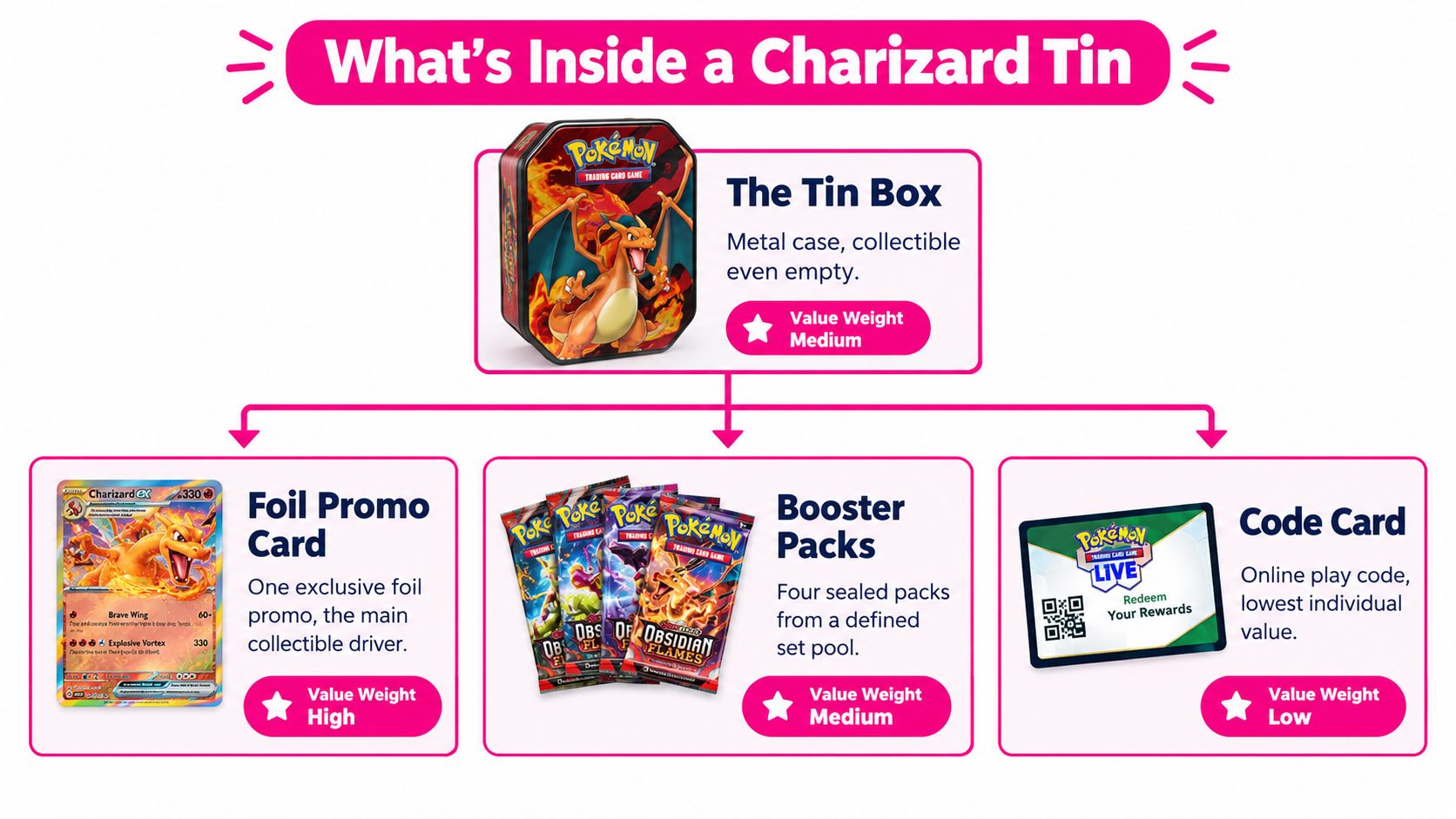
The Mega Charizard Tin is a useful working example because its contents follow the familiar Charizard tin structure. Each tin contains one foil promo card featuring Mega Charizard X ex or Mega Charizard Y ex, four booster packs, and one Pokémon TCG Live code card, according to the Mega Charizard Tin case listing.
The promo is the headline
The promo card is fixed rather than randomized. That makes it easy to identify and gives collectors a clear reason to seek the exact tin instead of buying an arbitrary sealed product. A Charizard promo can also remain relevant after the host product stops being widely available, but its individual value still depends on demand, condition, supply, and the specific card itself.
Don't assume the promo alone justifies the sealed premium. A buyer can compare the price of the loose promo with the cost of the sealed tin, but that comparison only becomes useful after accounting for the packs and the condition of the metal shell.
Packs provide the opening value
The Mega Charizard Tin includes four booster packs, and the full case format contains six tins, or 24 booster packs before counting promos and code cards, as reported in the same case-quantity product data. Pack count is useful, but set identity matters just as much. Four packs from a heavily available set don't carry the same appeal as four packs from a sought-after older release.
A sealed buyer should therefore record the pack assortment, not merely the number printed on the listing. If you open the tin, the packs become separate products. If you keep it sealed, their presence supports the product's completeness and display appeal.
The empty tin still has a role
The metal shell is the third value layer. Collectors may want the full sealed presentation, while other buyers may display an empty tin after opening it. Product dimensions also matter for storage and shipping. One retail listing reports the Mega Charizard Tin at approximately 3.00 x 7.00 x 6.00 inches, with an internal fit context suited to standard trading-card dimensions, according to Micro Center's Mega Charizard Tin listing.
For card storage, use protection that matches the card rather than forcing a promo into an unsuitable holder. A guide to rigid card holders is relevant if you're opening the product and preserving the promo separately.
The code card usually carries the least collector value, but it still matters for completeness. In a sealed tin, it confirms the expected formula. In an opened tin, it may be used, expired, or difficult to resell. Price the promo, packs, code card, and tin as separate line items before deciding whether sealed condition deserves a premium.
Major Charizard Tin Releases Compared
A Charizard logo does not make every tin a strong sealed purchase. The branding can create a fan premium, but pack assortment, promo identity, release timing, and product format determine whether that premium has a foundation. Compare those details before paying a secondary-market markup.
The 2019 Hidden Fates Charizard-GX Tin provides the clearest historical baseline. The 2026 Mega Charizard Tin carries the same broad tin formula into a newer release. The 2023 Charizard Collector's Chest Tin Set shows why sellers' use of “tin” requires caution. It is a larger collection product, not another four-pack Charizard tin.
Major Charizard Tin Releases at a Glance
| Release | Year | Promo | Pack Count | Host Set |
|---|---|---|---|---|
| Hidden Fates Charizard Tin | 2019 | 1 Charizard-GX promo | 4 | Hidden Fates |
| Charizard Collector's Chest Tin Set | 2023 | 3 foil cards | 6 | Ask the seller |
| Mega Charizard Tin | Product year 2025, released 2026 | 1 foil promo featuring Mega Charizard X ex or Mega Charizard Y ex | 4 | Ask the seller |
The 2019 tin released on September 6, 2019. The Mega Charizard Tin launched on February 20, 2026. That gap helps collectors place each product in the sealed-product timeline without relying on artwork memory. Treat the Mega Charizard product year and release date as separate fields. Listings may describe it as a 2025 product even though the release occurred in 2026.
The 2023 Collector's Chest follows a different product plan. It included six booster packs, three foil cards, one coin, four sticker sheets, one mini portfolio, and one code card. Its larger contents make direct price comparisons with a compact four-pack tin misleading. Confirm the full contents before treating a listing as a standard Charizard tin.
What Drives the Comparison
Use four checks before accepting a premium:
- Promo identity: A named Charizard promo is easier to track than a vague “Charizard card.”
- Pack assortment: The host set affects opening appeal and sealed demand. Ask sellers to identify every pack set rather than accepting a generic pack count.
- Release date: This places the product within the broader sealed-product timeline.
- Product format: A compact four-pack tin should not be valued like a larger collection set.
Case information matters for inventory and wholesale comparisons. The Mega Charizard format is sold in a six-tin case, but a case quantity does not prove that individual tins will appreciate. Ask the seller for the host set, case size, and a photograph of the sealed packaging when those details are absent. Pay the Charizard premium only when the promo, packs, and format justify it. Otherwise, you are paying a fan tax.
From Hidden Fates to Mega Charizard
Charizard branding creates recognition, not automatic value. The useful comparison is the product format behind the artwork. The 2019 Hidden Fates Charizard-GX Tin established a familiar package: a Charizard-focused metal box, one fixed promo, four booster packs, and one online code card. The Hidden Fates Charizard Tin reference records those contents and the September 6, 2019 release date.
The Mega Charizard Tin follows the same basic product architecture and launched on February 20, 2026. It contains one Charizard-related foil promo, four booster packs, and one Pokémon TCG Live code card, according to the Mega Charizard Tin case details.
What stayed consistent
The lid artwork is only the sales hook. Collectors should classify each release by its underlying components:
- A metal collectible box
- A fixed Charizard-themed promo
- A defined booster-pack allocation
- A digital code card
- A product designed to remain sealed or be opened
That continuity helps you compare releases without relying on visual memory. Record the release date, promo identity, pack count, and packaging condition before comparing prices. A familiar Charizard image cannot confirm that a listing contains the expected contents.
What changed
The character form and promo identity shifted between generations. Hidden Fates used Charizard-GX. The Mega Charizard Tin uses a foil promo featuring Mega Charizard X ex or Mega Charizard Y ex. Its packs also come from a different product era, so the tins are not interchangeable because both carry Charizard branding.
That distinction matters on the secondary market. A newer tin can command a premium because it is current or visually appealing, while an older tin may attract collectors for its era and promo. Neither factor guarantees appreciation. Sellers can also inflate prices with incomplete descriptions or unverified seals.
Use the lineage as a buying filter. Confirm the exact promo, inspect the packaging, identify the pack assortment, and compare the sealed price with the contents. Pay extra for the Charizard name only when those fundamentals support it. Otherwise, the markup is a fan tax.
Is a Charizard Tin Worth the Premium
A sealed Charizard tin isn't automatically a safe hold. Late-September 2026 completed sales for Mega Charizard tins were around the mid-$30s to mid-$40s, while comparable Charizard VSTAR tins had prior coverage with a $19.99 MSRP, according to the Mega Charizard Y Tin sales reference. That spread is enough to prove demand, but not enough to make every secondary-market purchase attractive.
The right question is simple: what are you paying for after the packs and promo are accounted for? If the sealed price is only modestly above the combined value of the contents and the clean empty tin, the premium may be defensible. If most of the price is attached to the word “Charizard,” you're paying a fan tax.
Charizard Tin Premium Breakdown
| Tin | MSRP | Late-2026 Sale Range | Estimated Pack + Promo Floor | Implied Tin Tax |
|---|---|---|---|---|
| Comparable Charizard VSTAR tin in prior coverage | $19.99 | Not provided for this exact product | Not provided in verified data | Cannot be calculated from verified data |
| Mega Charizard Tin | Not provided in verified data | Mid-$30s to mid-$40s | Not provided in verified data | Cannot be calculated from verified data |
The table exposes the problem with overly confident investment advice. The verified data doesn't provide current single-pack values, promo prices, or a complete cost basis for the Mega Charizard Tin. Anyone presenting a precise “tin tax” from those missing inputs is inventing certainty.
Use a three-part price test
First, identify the value of the booster packs based on their actual set. Pack count alone isn't enough. Second, check the loose promo price in the same condition as the card inside the sealed product. Third, assign a restrained value to the clean metal tin as a display object.
If the sealed premium remains after those checks, ask whether you want sealed presentation and resale liquidity. If the premium disappears, buy the loose promo and packs instead, or skip the product. The Charizard name can create a deep buyer pool, but it can also encourage sellers to charge for nostalgia that the underlying contents don't support.
My recommendation is direct. Buy at retail when you want the product. Pay secondary prices only when the release is specifically important to your collection and the seller has credible proof. Don't call a modest resale spread an investment thesis.
How to Verify a Sealed Charizard Tin
A sealed tin deserves more scrutiny than its low-risk reputation suggests. Independent coverage warns that fake reproductions and resealed tins exist, with warning signs that include shrink-wrap problems, bent seams, loose packs, and off-brand printing details. The same guide to Pokémon tin risks also makes the important point that no single photograph can prove authenticity for every sealed product.
Start with the seal and shell
Look closely at the shrink-wrap around the corners, lid, and seams. Loose wrinkles, unusual pooling, damage that doesn't match ordinary shelf wear, or a seal that appears disturbed should reduce your offer to zero. Don't let a seller explain away obvious tampering as “normal factory variation” without supporting evidence.
Inspect the metal edges for pry marks, dents around the lid, or scuffs concentrated near an opening point. A dented tin isn't automatically fake, but damage around the closure deserves more attention than a small cosmetic mark on the back.
Compare printing and labels
Put the listing photographs beside a reliable image of the same release. Check the Charizard artwork, Pokémon branding, set logos, barcode area, and copyright text. Soft printing, strange color registration, incorrect spacing, or a label that looks copied from another product should stop the transaction.
The Charizard tin box guide from Lucardio Collectibles can help frame the wider sealed-product inspection, but no guide replaces photographs of the actual item. Stock images prove nothing about the specific tin in a seller's possession.
Ask for photographs from several angles, including the bottom label and every sealed edge. If the seller refuses, move on. A legitimate seller who wants a secondary-market premium should understand why a buyer needs evidence.
Treat weight and sound as screening tools
A tin that feels unusually light or contains an odd internal rattle may have missing, swapped, or poorly secured contents. Those observations can justify further questions, but they aren't authentication by themselves. Packaging materials, product variations, and shipping damage can affect what you hear or feel.
Use this short inspection sequence before paying:
- View the actual tin: Reject stock-only listings for expensive purchases.
- Study the shrink-wrap: Look for uniform tension and signs of resealing.
- Inspect the shell: Check the lid, edges, seams, and corners for opening damage.
- Compare printing: Confirm sharp artwork, correct branding, and a plausible bottom label.
- Request proof: Ask for additional photographs or a short verification video.
No single check is conclusive. Several consistent details are useful. One suspicious detail is enough to walk away.
The following video can provide additional visual context for sealed Pokémon product checks.
Buying a Charizard Tin Without Getting Burned
Use a strict decision rule.
Retail or skip. If the tin is available through a reputable retail channel at its intended price, buy it because you like the product or because the contents make sense. Target, Walmart, Pokémon Center restocks, and local game stores can all be reasonable places to check, but availability and seller conditions vary. Don't chase a tin across the secondary market just because a listing uses urgent language.
Secondary only with proof. Use completed sales to judge the market, then compare the listing against that evidence. TCGplayer and eBay can provide useful transaction context, while specialist marketplaces such as Goldin or PWCC may suit buyers who prefer a more formal collectible environment. Whatever the platform, require actual photographs, a clear description, and a seller history you can evaluate.
Walk away when neither test passes. A stock photo, refusal to provide a short verification video, suspicious shrink-wrap, or an unexplained premium is enough to end the deal. A cheap fake is still a bad purchase.
For a smaller collecting budget, prioritize a clean retail tin or a verified loose promo rather than an expensive sealed listing. For a larger budget, spread purchases across authenticated singles, sealed products, or graded cards instead of concentrating everything in one Charizard tin. A sealed-product marketplace such as Lucardio Collectibles is one option to consider when authenticated inventory and condition visibility matter.
The buyer who wins isn't the person who finds the most dramatic Charizard artwork. It's the person who knows the exact release, verifies the packaging, and refuses to pay a premium that the contents can't support.
Lucardio Collectibles offers authenticated singles, sealed Pokémon inventory, PSA-graded items, live breaks, auctions, and collection-management tools for collectors and sellers. Visit Lucardio Collectibles to review available sealed products and follow upcoming drops.