

If you're treating Chilling Reign Pokémon cards as a simple “pull it, grade it, profit” set, the PSA population data should change your approach. A September 2026 report lists 110,459 graded cards across 336 cards, with 67,262 PSA 10s, producing a 60.9% gem rate among graded examples (PSA population data for Chilling Reign). That's a deep supply of top grades, so the key question isn't whether a card can receive a PSA 10. It's whether the card has enough demand and raw-to-slab value separation to justify grading.
Table of Contents
- Why Chilling Reign Still Matters in 2026
- Rarity Tiers Explained in Plain English
- The Chase Cards That Actually Move Value
- Pull Rates and What They Mean for Box Buyers
- Why PSA 10 Alone Is Not Enough
- Buying and Authenticating Sealed and Graded Product
- A Practical Game Plan for Collectors and Sellers
Why Chilling Reign Still Matters in 2026
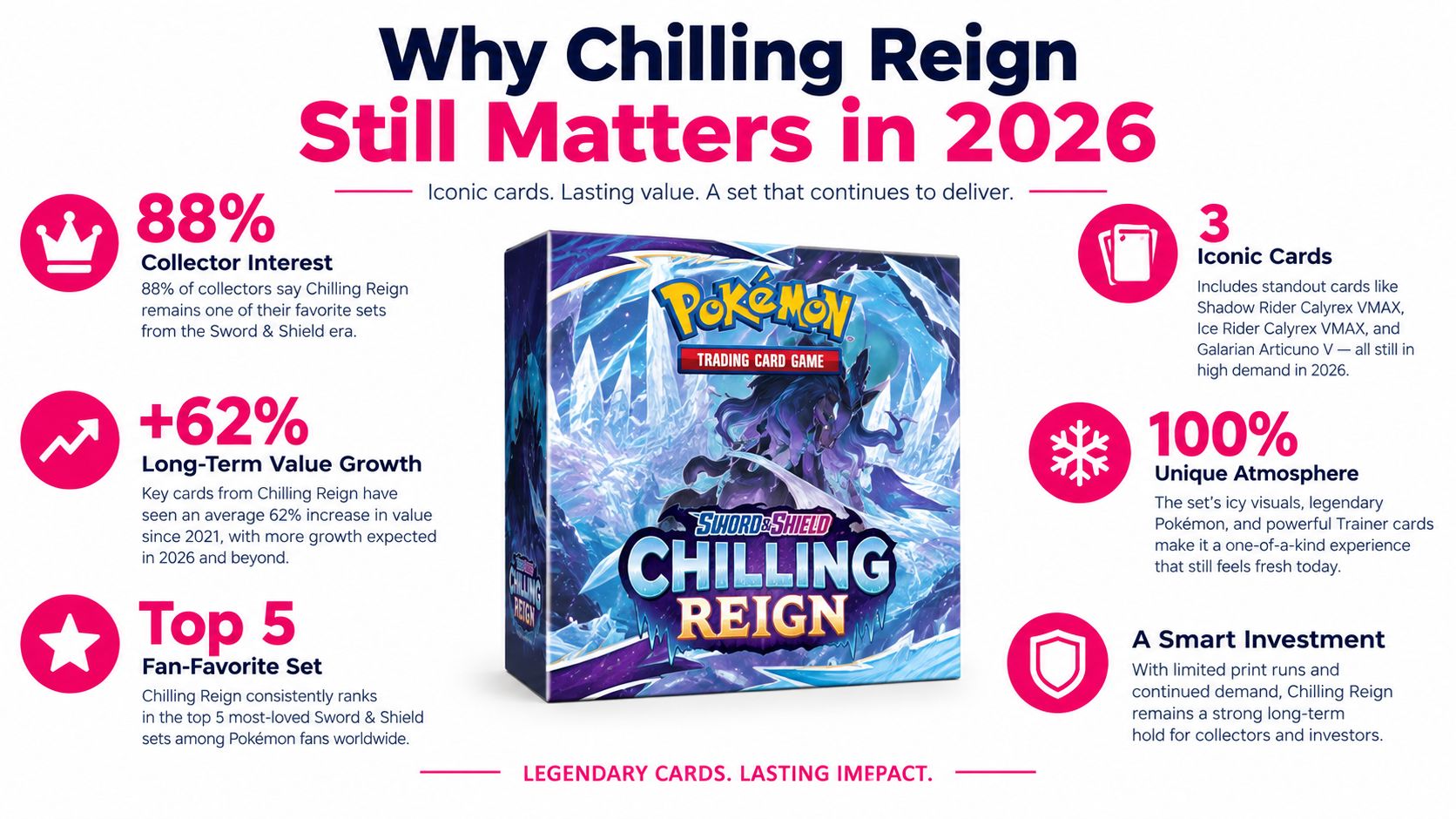
Chilling Reign Pokémon is a mature Sword & Shield expansion with a 233-card set, including 198 numbered cards and 35 secret rares, released on June 18, 2021 (Chilling Reign set history and checklist). That structure gives collectors two targets: completing the numbered set and pursuing the secret-rare gallery, where the strongest demand remains concentrated.
Maturity improves decision-making. Buyers can compare sealed boxes, raw cards, graded copies, and population data instead of guessing how a new release will settle. Market tracking estimates Chilling Reign at approximately $420.5 million, with sealed booster boxes around $479.51 and an unlimited print run of 120,000,000 packs (Chilling Reign market tracking). The market is broad enough to offer accessible singles, while the hardest chase cards still command premium attention.
The set's five useful angles
If you are choosing between a Chilling Reign booster box and a newer expansion such as Stellar Crown or Surging Sparks, judge the purchase through five practical filters:
- Rarity: Identify true chase cards rather than routine hits.
- Demand: Favor alternate-art cards with lasting character or collector appeal.
- Pull rates: Accept that box value depends heavily on low-frequency premium pulls.
- Grading: Grade only clean cards with a realistic raw-to-slab value gap.
- Sealed buying: Check wrap quality, seller history, and product provenance.
Selective grading matters more here than a simple “PSA 10 equals profit” approach. With a 60.9% PSA 10 gem rate across 110,000+ graded cards, top grades are plentiful. A common modern hit may look impressive in a slab yet add too little value to cover grading, shipping, and selling costs. Reserve grading for cards where scarcity, demand, and condition can support a meaningful premium.
Chilling Reign's large graded population also gives buyers useful price references. It makes copy-to-copy comparisons easier, although it does not make every card a sound investment. For broader sealed-product comparisons, use this guide to the best Pokémon booster boxes.
Rarity Tiers Explained in Plain English
A 60.9% PSA 10 gem rate across 110,000+ graded cards makes Chilling Reign an unusual modern set. Top grades are attainable, so rarity alone does not justify grading. The key question is whether a clean raw card can gain enough value in a slab to cover grading, shipping, and selling costs.
The set's rarity ladder still helps separate routine hits from serious targets. Holo rares fill binders, regular Pokémon V and VMAX cards sit in the middle, and secret rares provide much of the chase appeal. Rare Holo V cards appear at approximately 1 in 12.7 packs, Rare Holo VMAX cards at about 1 in 23.7 packs, Ultra Rares at roughly 1 in 25 packs, Rainbow Rares near 1 in 96.2 packs, and Secret Rares near 1 in 100 packs (Chilling Reign pull-rate model).
A practical rarity ladder
| Rarity Tier | Approx. Pull Window | Example Hits |
|---|---|---|
| Holo rare | About 1 in 5 packs | Regular holographic Pokémon |
| Rare Holo V | About 1 in 12.7 packs | Regular Pokémon V |
| Rare Holo VMAX | About 1 in 23.7 packs | Regular Pokémon VMAX |
| Ultra Rare | About 1 in 25 packs | Full-art Pokémon and related hits |
| Rainbow Rare | About 1 in 96.2 packs | Rainbow-style secret cards |
| Secret Rare | About 1 in 100 packs | Alternate-art and gold-style chase cards |
A filler pull can look exciting during opening but add little to pack or box value. A regular V may suit a player's collection, yet it rarely makes a sealed box memorable. A chase card has stronger collector demand, especially when it combines scarce artwork with a popular Pokémon. In Chilling Reign, Blaziken VMAX and the alternate-art Galarian Moltres V, Galarian Articuno V, and Galarian Zapdos V belong in that category.
Treat labels such as Rainbow Rare, Gold Rare, Full Art, and alternate art as starting points, not final judgments. Check the Pokémon's appeal, the artwork, competitive relevance, and the likely raw-to-slab price gap. Use this guide to Pokémon cards worth money when building a buying or grading shortlist.
Collector rule: Rarity gets attention. Demand determines whether the card moves.
The Chase Cards That Actually Move Value
Chilling Reign's value is concentrated in a small group of alternate-art cards. Blaziken VMAX leads the set, with an estimated $720 in PSA 10 versus approximately $369.42 raw (Chilling Reign grading and return comparison). That spread makes condition inspection worthwhile. It does not make grading automatic. Submit copies with strong centering, a clean surface, sharp corners, and no whitening. Leave borderline copies raw.
The Galarian birds form the next major tier. Galarian Moltres V, Galarian Articuno V, and Galarian Zapdos V combine recognizable Pokémon with artwork collectors actively seek. Galarian Moltres V #177/198 has a PSA 10 population of 7,458, so the grade carries demand without making the card scarce on population alone (Chilling Reign PSA population report).
Raw and slab decisions
| Card | Raw Price | PSA 10 Price | Grade? |
|---|---|---|---|
| Blaziken VMAX alternate art | About $369.42 | About $720 | Usually, if centering and surface are excellent |
| Galarian Moltres V alternate art | Varies by market | Strong PSA 10 demand | Grade only when the copy is clean |
| Galarian Articuno V alternate art | Varies by market | Strong PSA 10 demand | Selective grading |
| Galarian Zapdos V alternate art | Varies by market | Strong PSA 10 demand | Selective grading |
| Galarian Slowking V alternate art | Varies by market | Premium graded demand | Inspect carefully before submitting |
| Full-art Trainer cards | Varies by card | Premium depends on character demand | Grade only with a clear spread |
| Regular V and VMAX cards | Often modest | Usually modest | Keep raw unless condition and demand are exceptional |
Use the table as a decision filter, not a promise of current sale prices. Markets change, and a raw quote means little without a comparable slab value. Calculate expected slab value minus the card's raw value, grading fee, shipping, selling fees, and the risk of receiving a lower grade. If the remaining spread is thin, keep the card in a sleeve.
Competitive relevance creates a separate source of demand. Inteleon VMAX and Single Strike Urshifu VMAX can sell more easily raw because players and collectors recognize them, even though their artwork does not command the same attention as the alternate arts. That liquidity rarely justifies grading by default.
Trainer cards can strengthen a box break when collectors want recognizable character art. They should not distract from the main calculation. Without a premium alternate art, scarce secret rare, or especially desirable full-art card, several exciting pulls may still produce a weak financial result. Review this guide to the best Pokémon singles to buy before committing your singles budget.
Pull Rates and What They Mean for Box Buyers
A Chilling Reign booster box can contain plenty of hits and still miss the cards that make the opening financially successful. Commons, uncommons, reverse holos, and ordinary rares build volume. Holo rares and regular Pokémon V provide visible excitement. The meaningful upside sits in the narrow premium tier above them.
A box model estimates roughly 1.5 secret rares, 1.5 VMAX hits, 2.8 V hits, and 6.4 holo rares per booster box (Chilling Reign booster-box pull model). Treat those figures as averages across many boxes, not a promise about the one on your desk. You can open a satisfying mix of regular hits and still miss the card that supports break-even.
Pull tiers and value concentration
| Rarity Tier | Approx. Pull Rate | Typical Value Contribution |
|---|---|---|
| Holo rare | About 6.4 per box in the model | Low to modest, mainly collection or play value |
| Pokémon V | About 2.8 per box in the model | Modest, with stronger results for playable cards |
| VMAX | About 1.5 per box in the model | Moderate, higher for popular or useful cards |
| Secret Rare | About 1.5 per box in the model | Main source of upside, but card quality varies |
| Alternate-art or premium secret rare | Included within the premium tiers | Can determine whether the box is a winner |
Do not buy a box assuming it contains a chase. Pull-rate averages describe distribution across many openings. They do not promise a Blaziken VMAX, one of the Galarian birds, or another premium card in your box.
The sealed-product gamble is concentrated in the upper tier. If you want one specific card, buy the single. Open sealed product when the experience and variance are part of what you are paying for.
That calculation matters more as the expansion matures. One market snapshot places tracked card values between $0.02 and $382.02, showing the distance between bulk-level cards and premium hits (Chilling Reign market snapshot). A box buyer should set a loss limit before opening and judge the purchase against the chance of pulling a top-tier card, not the theoretical average contents.
The practical recommendation is simple. Open sealed product for enjoyment or genuine tolerance for variance. Buy singles for targeted collecting. If you pull a premium alternate art, inspect centering, corners, edges, and surface before considering grading. Ordinary hits belong in sleeves unless their raw demand and condition create a clear margin after all costs.
Why PSA 10 Alone Is Not Enough
A 60.9% PSA 10 gem rate across 110,459 graded cards makes the point clearly: Chilling Reign has a large supply of gem-mint slabs (Chilling Reign PSA population data). PSA 10 still matters, but the label earns its strongest premium on cards with proven collector demand, scarce artwork, and a meaningful gap between raw and graded prices.
The grading equation
Run this calculation before submitting:
Expected slab value minus raw value minus grading cost minus selling costs equals potential grading margin.
Blaziken VMAX shows why selective grading matters. A PSA 10 is about $720, while the raw card is approximately $369.42 (Chilling Reign grading comparison). That spread looks attractive, but it assumes a PSA 10. Subtract grading, shipping, insurance, marketplace fees, and the risk of receiving a lower grade before deciding.
A PSA 9 can be a strong collectible and still be a poor submission result. If buyers reserve most of the premium for PSA 10 copies, the lower-grade slab may not recover its creation and selling costs. For Chilling Reign, I would grade a clean Blaziken VMAX alternate art, inspect each Galarian bird alternate art on its own merits, and keep ordinary V cards in sleeves unless the goal is personal collection protection.
My decision rule
- Grade it: The card is a premium alternate art or sought-after full-art Trainer, the surface is clean, centering looks strong, and the PSA 10 spread remains meaningful after fees.
- Sleeve it: Raw demand is modest, the PSA 10 population is already substantial, or the likely slab premium barely exceeds submission and selling costs.
- Keep it raw for play: Players, rather than slab collectors, form the main buyer pool.
Inspect modern holos under bright, angled light. Look for print lines, scratches, dents, and cloudy patches across the front. Check centering as well, especially on alternate-art cards that may print slightly off-center. Strong corners and attractive artwork cannot compensate for a visible surface defect, so condition should decide the submission before optimism does.
Buying and Authenticating Sealed and Graded Product
A good Chilling Reign purchase starts with the seller, not the card. Look for a consistent feedback history, a clear return policy, detailed photographs, and a purchase trail that makes sense. A distributor receipt isn't proof by itself, but a seller who refuses basic provenance questions gives you no reason to accept avoidable risk.
Sealed product checks
For booster boxes and other unopened products, inspect:
- Shrink-wrap tension: Loose, cloudy, or uneven wrap deserves caution.
- Seam placement: Factory seams should look consistent rather than melted or reworked.
- Crimp patterns: Compare the pack crimps and box presentation with known genuine examples.
- Surface tampering: Watch for excess glue, punctures, heat marks, or areas where wrap appears replaced.
- Seller photographs: Request sharp images of every side, especially the ends and seals.
Don't treat weight as a standalone authentication method. A weight check can add information, but it can't prove that a box hasn't been opened and resealed. Seller history and physical inspection carry more weight than a single measurement.
Graded and raw cards
A graded card should have a clean, legible label, consistent edge spacing, clear plastic, and no signs that the slab has been opened or resealed. Cross-reference the certification number in the PSA database, then compare the returned card details with the actual slab. A matching number is useful, but it isn't a substitute for checking the label, case, and card image together.
For raw alternate arts, ask for extra photographs before buying. Use bright, angled light to inspect the entire surface, then check whitening on the back edges and corners. The front can look perfect in a flat marketplace image while a surface line appears immediately when the card is tilted.
CGC and BGS can make sense for collectors who prefer their grading presentation or want a second recognized grading option. Choose the service based on the buyer you expect to sell to, your comfort with the holder, and the card's condition. Don't send a marginal card to another grader just because PSA didn't fit the economics.
Practical buying rule: If the seller won't provide clear photographs of the seal, slab, or card surface, walk away. Chilling Reign has enough available inventory that you don't need to force a questionable purchase.
A Practical Game Plan for Collectors and Sellers
Your best Chilling Reign strategy depends on what you want the card to do after you buy it. A long-term collector can prioritize a premium alternate-art card or sealed booster box and accept that the holding period is about enjoyment and scarcity rather than guaranteed appreciation. A player should focus on playable raw Pokémon V and VMAX cards, where condition is good enough for a binder or deck and slab premiums don't matter.
A seller needs a sharper filter. Grade only cards with visible demand, strong condition, and a plausible PSA 10 outcome. Raw cards with modest value are often better sold in sleeves, grouped into themed lots, or used to build a broader collection. The large graded population makes careless submissions especially easy to regret.
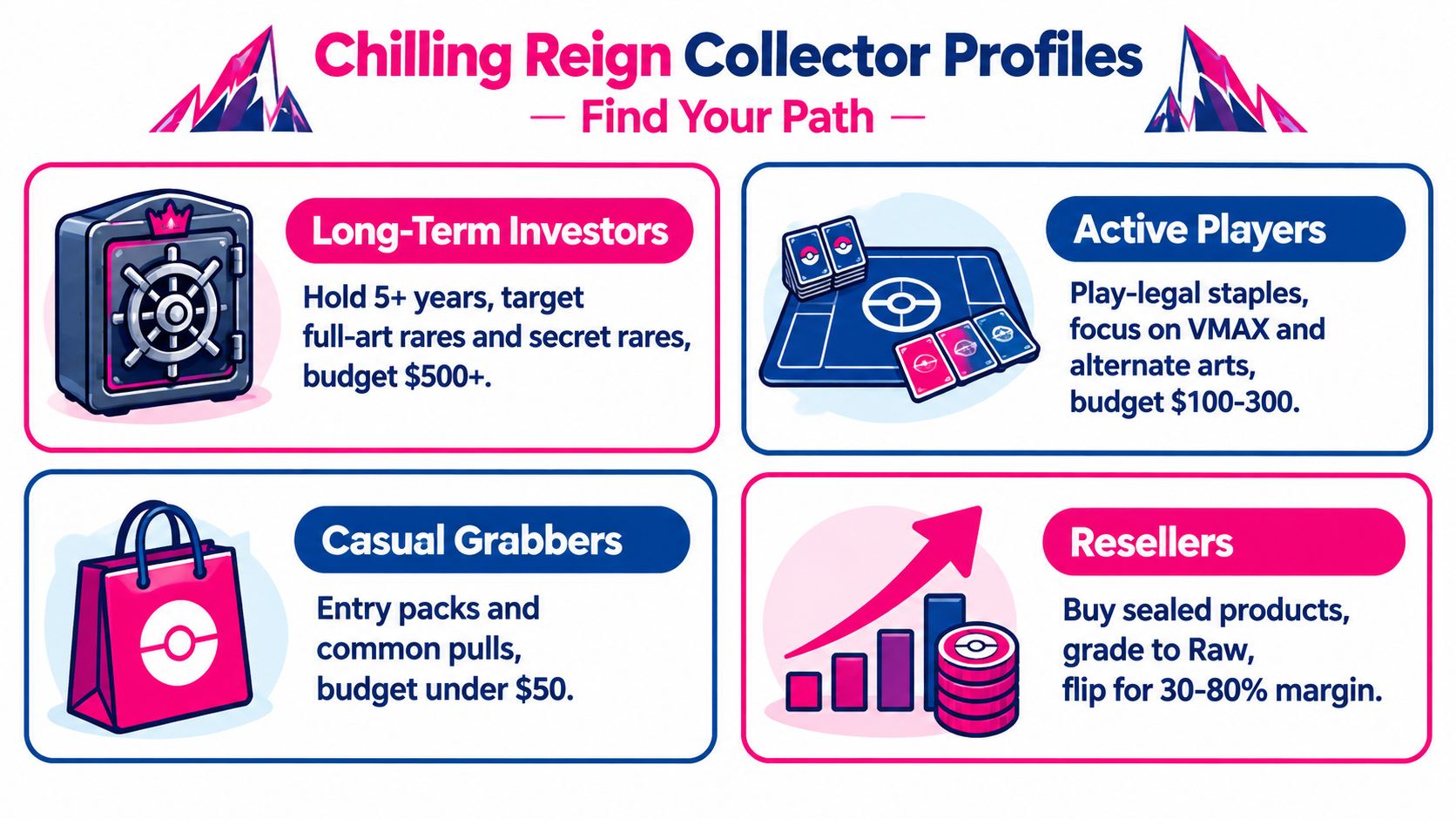
Match the route to your collecting goal
| Collector Type | Best Focus | Avoid |
|---|---|---|
| Long-term collector | Premium alternate arts, carefully stored sealed product | Buying every high-rarity card automatically |
| Active player | Raw playable V and VMAX cards | Paying slab premiums for cards you'll play |
| Casual collector | Affordable singles, binder pages, selected packs | Chasing a complete secret-rare gallery impulsively |
| Reseller | Clean raw chase cards, authenticated sealed product | Grading cards without a fee-adjusted margin |
For sealed product, verify the seller before comparing price. For alternate-art cards, inspect surface and centering before imagining a PSA 10. For existing slabs, verify the certification and examine the holder. Those three checks prevent most avoidable mistakes.
The decision rules are simple:
- Skip grading when the likely premium won't comfortably cover submission, shipping, insurance, and selling costs.
- Buy the single when you want one specific chase card and don't value the opening experience.
- Open sealed product only when you accept variance and can afford a box that misses the premium tier.
- Reject questionable sealed inventory when the seller lacks credible history or won't show the wrap clearly.
- Use character and play demand together when deciding whether a raw card deserves a place in your sell pile.
The set rewards selectivity. Chilling Reign Pokémon cards can be excellent collectibles, but the winners aren't created by the PSA label alone. Buy the card you want, grade the copy that earns it, and leave the rest safely sleeved.
Lucardio Collectibles brings authenticated Pokémon singles, sealed products, and PSA-graded items together with live breaks, auctions, collection storage, and selling tools. If you're comparing a raw Chilling Reign hit with a slab or looking for verified sealed inventory, visit Lucardio Collectibles to explore the platform and follow its upcoming launch updates.