
The most popular advice for pricing a binder is also the easiest way to overvalue it: look up each card, add the prices, and call the total your collection's worth. That total might help you understand what replacing the cards would cost. It doesn't tell you what a buyer will offer, how long selling will take, or how much money you'll keep.
A useful valuation starts with replacement value, rapid-sale value, and expected net proceeds. Keep those amounts separate, and you can decide whether to list a standout card, accept a dealer offer, or sell the remaining binder as a lot without mistaking catalog prices for cash.
Table of Contents
- Three Prices Behind Collection Cards Value
- What Actually Moves a Card Price
- Condition Bands and Population Reports
- Record Cards and the Grade Gap
- How to Match Recent Sales
- Grade It Keep It Raw or Sell Sealed
- Decide What the Collection Can Fetch
Three Prices Behind Collection Cards Value
Collection cards value isn't a single number. A collector replacing a favorite card, a dealer buying inventory, and a seller clearing a binder are solving different money problems. Their prices don't have to match for each to be reasonable.
Replacement value estimates what you'd spend to buy equivalent cards. Match the exact set, card number, variant, language, and condition, then use recent transactions or credible retail availability. A price guide belongs in this column as a starting point, not as a promise of payment.
Rapid-sale value is an actionable offer within your selling deadline. Net proceeds are what you retain from whichever selling route you choose after the applicable expenses. Market commentary from AxioBench's sports-card industry overview identifies liquidity and consistent transaction records as important to whether cards can move at quoted prices, especially when comparable sales are scarce.
Three numbers for one collection
| Value type | What it measures | Who typically pays | Use it when |
|---|---|---|---|
| Replacement value | Cost to buy the same card at recent sold or retail prices | Another collector | Insuring, trading, or comparing a buy |
| Rapid-sale value | Cash offered for a fast exit, often a discount to replacement | Dealer or instant buyer | The seller needs funds soon |
| Net proceeds | Cash left after fees, shipping, insurance, grading, and applicable tax | The seller's account receives this amount | Deciding whether a sale is worth doing |
| Lot or bulk value | Discounted price for many low-dollar cards sold together | Bulk buyer | Singles would cost more to list than they return |
The bulk row isn't an extra valuation target. It's a selling method that feeds your rapid-sale estimate and net-proceeds calculation.
Why a mixed binder needs different selling methods
Say your binder contains a sought-after Pokémon card, some attractive older cards, and a thick stack of ordinary duplicates. The sought-after card has frequent matching sales, so you can support a relatively narrow replacement range. A buyer can also judge its resale prospects without much guesswork.
The duplicates create a different problem. Photographing, describing, packing, and answering questions about each card might consume more effort than the individual sales justify. Selling them together can produce less gross revenue but a better return for your time.
Set a minimum listing threshold using your own costs. Below that threshold, group cards by set, character, team, or another useful theme. Don't use a universal minimum copied from another seller, because your postage, packaging, and available time may differ.
Practical rule: Compare selling routes by the money you keep and the work you accept, not by the largest advertised total.
Bulk buyers need room for sorting, unsold inventory, and resale expenses. Meanwhile, a scarce vintage card might have an impressive historical sale but no ready buyer today. Both situations can create a wide gap between replacement and rapid-sale value for different reasons.
Before looking up individual cards, create the three valuation columns on a spreadsheet. Leave them blank until you have evidence, add a selling deadline beside them, and record time separately rather than pretending every hour spent listing is free.
What Actually Moves a Card Price
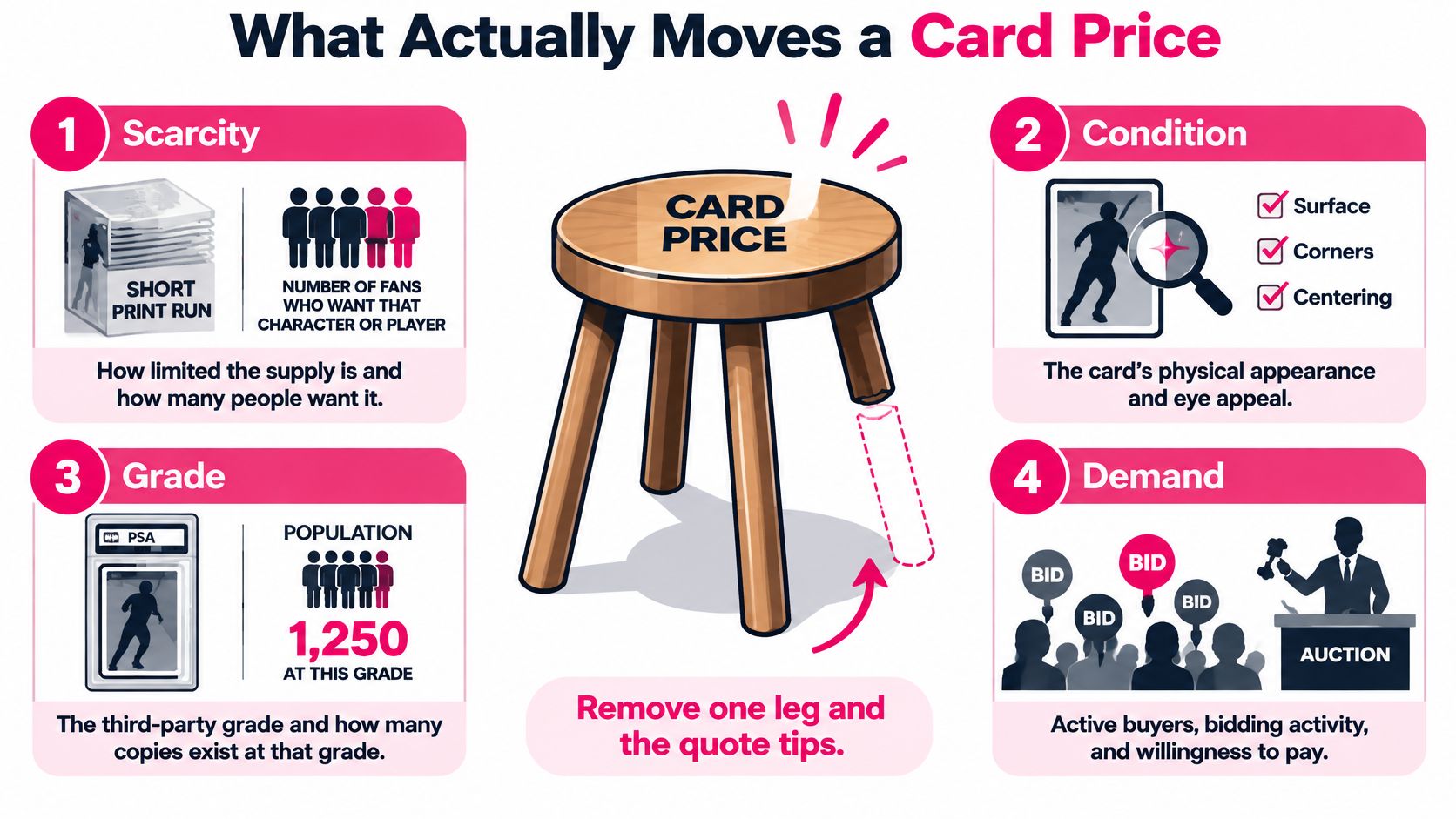
A card price works like a four-legged stool: scarcity relative to demand, condition, authentication, and documented sales. Remove one leg and the quote wobbles. A rare card with few interested buyers can sit unsold while a common card that collectors chase every week moves quickly.
Consider a Charizard card with familiar artwork. The character is famous, but that alone does not establish scarcity. You still need the set symbol, printing, finish, and whether buyers want that exact version rather than any Charizard.
What the buyer needs to believe
Condition is what the next buyer can inspect: corners, edges, borders, surface, and overall presentation. Authentication answers a different question, whether the card is genuine and unaltered. A sharp-looking copy with doubts about authenticity is not interchangeable with a verified example.
Documented sales turn those qualities into money. A price guide is a menu; completed sales are receipts. Sellers can ask almost anything, but a matching transaction shows that a real buyer accepted that price for that card in that condition.
For a Pokémon-specific explanation of character appeal, supply, and collector interest, our guide to why Pokémon cards are so expensive helps separate broad popularity from demand for an exact printing.
Market growth is context, not a quote
Boom periods can pull more collectors, breakers, and dealers into the hobby. That wider crowd can lift liquidity for cards that already have demand, but it does not set a price for your binder or turn an ordinary copy into a trophy card.
Use market heat to decide how often to refresh estimates. The cash answer still comes after the evidence: matching sales set the replacement idea, then fees, selling time, and buyer uncertainty decide what a seller can keep.
Condition Bands and Population Reports
Sort notable cards by condition before opening a sold-listings page. Otherwise, the highest sale can become an anchor, and you may start overlooking flaws that would disqualify your copy from that comparison.
Use a clean workspace, good lighting, and a plain background. Hold cards by their edges and inspect the front and back without rubbing the surface or trying to remove marks. Cleaning can alter the card rather than improve it.
Read the card before the label
Centering describes how evenly the printed design sits within the borders. Compare left with right and top with bottom, checking the back as well as the front. Uneven borders can remain noticeable even when the corners look sharp.
Surface condition includes scratches, dents, print lines, staining, and other defects visible as you tilt the card under a light. Eye appeal is the overall presentation, including qualities buyers may prefer between cards carrying the same certified grade.
Our Pokémon card condition guide can help you describe these features consistently. Record what you can see rather than calling every recently opened card mint.
Condition bands used to pick comps
These are working sorting bands, not grading guarantees. The numeric labels help organize a lookup; a professional grader determines the actual grade.
| Band | Typical PSA range | What you see | How it changes price |
|---|---|---|---|
| Gem mint candidate | 10 as a submission target, not a promised result | Sharp corners, clean surface, strong centering | Compare top-grade sales only as a possible outcome |
| Mint | 9 as a working comparison | A small corner, edge, or surface flaw may be present | Check whether buyers pay a meaningful premium over raw |
| Near mint to excellent | Match the grader's published condition description | Several small flaws, still presentable in a binder | Use middle-condition comps and allow for eye appeal |
| Played | 1–6 as a broad sorting bucket | Whitening, creases, or substantial edge wear | Compare similarly worn copies rather than clean examples |
| Raw, ungraded | No certified grade | Condition remains the seller's assessment | Buyers must allow for inspection uncertainty |
A holder documents an assessment; it doesn't repair damage. Likewise, equal grades don't guarantee identical prices when one copy has more attractive centering or a less distracting flaw.
Put population counts in context
A population report records how many examples a grading company has certified at particular grades. Read it for the exact card and variant, not just the character's name. A population count isn't the same as the total surviving supply, because unsubmitted cards remain outside it.
A small top-grade population can matter when buyers compete for that grade. It means much less without demonstrated demand, and it doesn't guarantee that another attractive copy won't be submitted later.
Separate likely high-grade candidates, middle-condition cards, played copies, and bulk. Record the set, number, variant, language, and certification number where applicable. The condition band tells you which comparisons to inspect, not what cash a buyer must offer.
Record Cards and the Grade Gap
Different copies of the same famous card can represent very different purchases. The Pikachu Illustrator provides a striking example, but its lesson isn't that every grade increase deserves a fixed multiplier.
According to Guinness World Records, a PSA Grade 7 Pikachu Illustrator sold for $900,000 at Goldin Auctions on February 23, 2022, then an auction record, while a separate PSA Gem Mint 10 copy changed hands privately for $5.275 million on July 22, 2021.
Those transactions involved different copies, dates, and selling channels. You can observe a substantial price gap, but you can't isolate how much came from grade alone.
What the comparison proves
The comparison shows why card identity must include more than the printed name. Grade, certification, provenance, and sale circumstances help define the asset a buyer is evaluating.
The visual makes that separation easy to see.
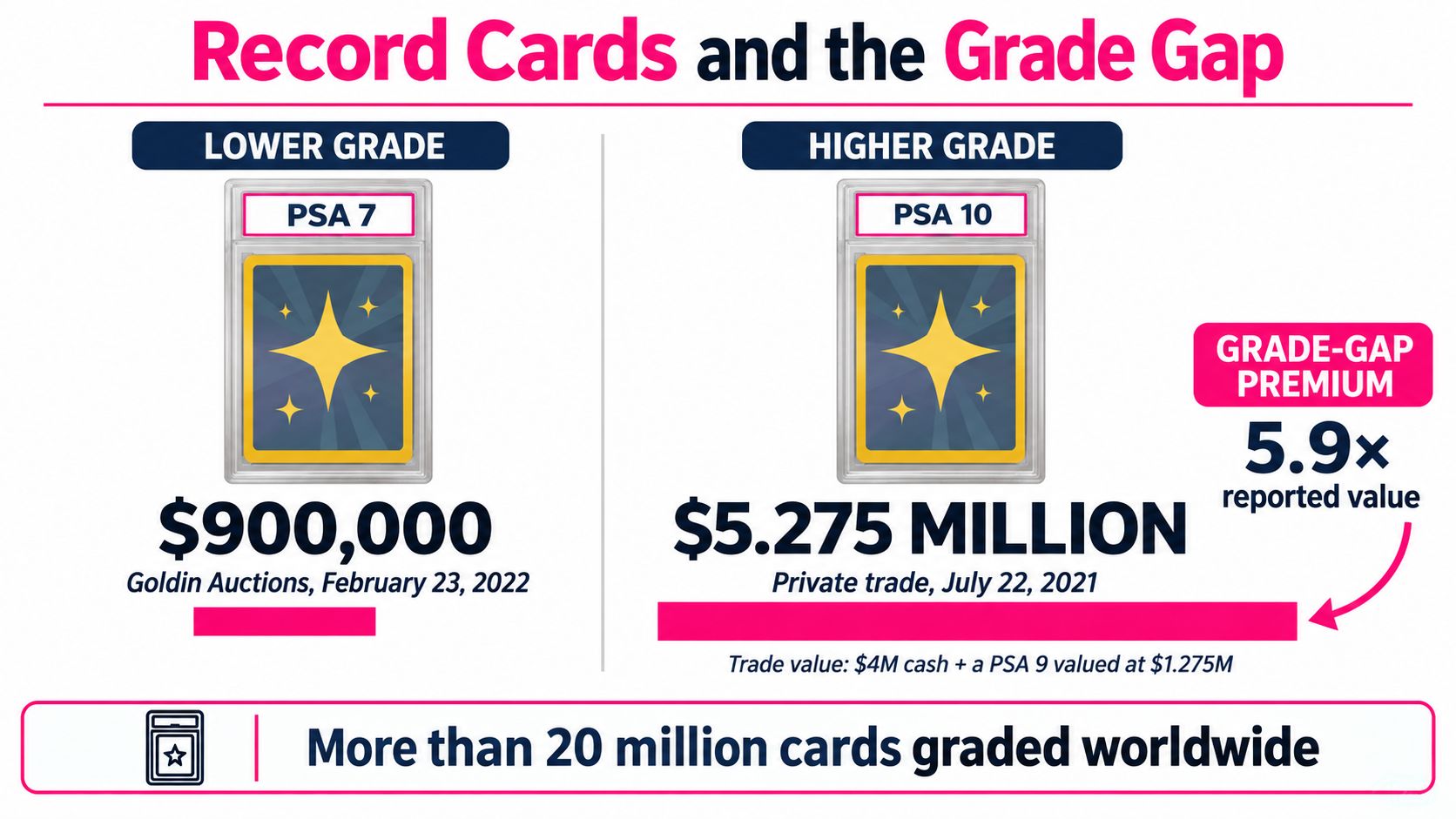
A private buyer might have a particular reason to pursue a particular copy. An auction result reflects the bidders who participated under that auction's terms. Neither transaction establishes an automatic conversion rate between grades.
A record sale proves that a particular buyer paid for a particular copy. It isn't a standing offer for yours.
Bring the lesson back to an ordinary binder
Suppose you own a visibly worn version of a desirable card and find a headline about a pristine certified example. Entering that headline into your replacement column gives you a misleading starting point before you've even considered selling costs.
Instead, search for worn raw copies or the relevant certified grade. If the matching evidence is sparse, write a wider estimate rather than borrowing confidence from a better card.
Keep records that let another buyer verify your example: clear front and back photographs, the certification number, purchase documentation where available, and a precise description. For valuable cards, preserve those records through packing and delivery so the item received can be connected to the item sold.
Ask which cards have enough matching transactions to support a tight range. Mark the others as thinly traded, especially when the only visible receipt comes from a trophy sale with unusual attention.
How to Match Recent Sales
Price a single recognizable card before tackling the whole binder. That lets you build a repeatable method and catch identity mistakes before they spread across your spreadsheet.
Use eBay's sold-listing filters and relevant auction archives. Keep the transaction page or a saved record with your notes so you can check the description and photographs later.
A lookup you can repeat
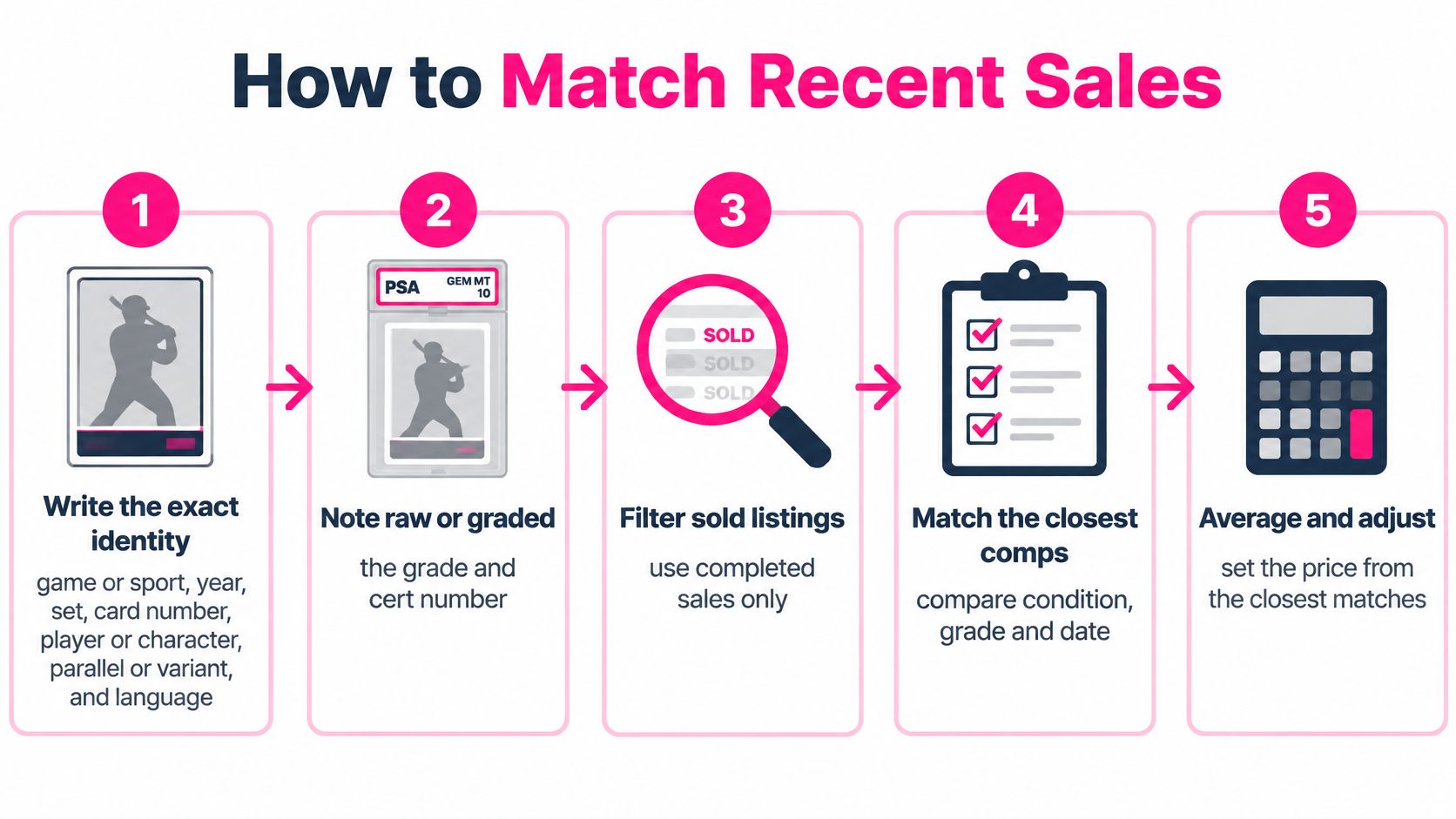
Write the exact identity. Record the game or sport, year or release, set, card number, player or character, parallel or variant, and language. English and Japanese printings aren't interchangeable just because the artwork matches.
Record its certification status. Note raw or graded, the grading company, grade, and certification number. Don't mix different grading companies into one average without investigating how buyers price each.
Search sold transactions. Start with recent completed sales when the card trades frequently. An active asking price describes a seller's ambition, while an unsold completed listing provides no proof that a buyer accepted it.
Remove mismatches. Exclude the wrong finish, variant, language, grade, or condition. Check whether a listing contains a single card or a bundle, and discard auctions that didn't meet their reserve.
The simplified visual shows the core lookup sequence.
Turn matches into a defensible estimate
Prefer a cluster over an outlier. Compare several similar transactions instead of selecting the highest result. If evidence is limited, mark the estimate as uncertain rather than presenting an exact-looking average.
Account for the venue. A specialist auction and a general marketplace can attract different buyers. Check whether the reported amount includes a buyer's premium and whether shipping is included before comparing totals.
Calculate the selling route. Apply the actual fee schedule and fulfillment expenses you'd face. A marketplace result is a reference for gross selling price, not a deposit forecast for your account.
Date your note. Save the lookup date and the dates of the matching transactions. Refresh the estimate before listing or accepting an offer rather than treating a saved figure as permanent.
A best-offer screenshot without a verifiable transaction date is weak evidence. So is an average built from asking prices or a search result that mixes damaged copies with clean ones.
Comp note template: Exact card and variant | language | raw condition or certified grade | matching sold records and dates | venue | replacement range | rapid-sale offer | expected net proceeds.
Save a short explanation whenever you exclude an apparently relevant result. That habit prevents a tempting but unsuitable sale from finding its way back into your calculation later.
Grade It Keep It Raw or Sell Sealed
Don't grade a card because it might be valuable. Submit it when the likely certified outcome offers a better net result than selling it as it is. A disappointing grade can leave you with a clearer description and less money.
The choice is between selling routes, not between a good card and a bad one.

Test the likely result, not the dream result
The market figures summarized by Business Research Insights indicate that more than 20 million cards were graded globally in 2024 and over 26 million in 2025. Greater slab supply is a reason to examine the exact grade's availability rather than assuming a holder alone creates scarcity.
Build your break-even calculation from current quotes:
Expected graded net = likely graded sale price − submission cost − shipping both ways − insurance − selling expenses − applicable tax.
Compare that with your expected raw net. Use plausible lower and higher grading outcomes, not just the best possible result, and include the waiting period in your decision.
If raw transactions already sit close to the likely slab price, grading may add expense without enough additional revenue. Authentication can still address doubts about genuineness, but that benefit isn't a promise of appreciation.
Grade, raw, or sealed
| Path | Wins when | Main cost | 2024–2026 signal |
|---|---|---|---|
| Submit for grading | Likely grade and matching sales clear all costs by a wide margin | Submission, shipping, insurance, later seller fee | Expanding slab supply makes grade-specific demand important |
| Sell raw | Grade is uncertain or raw sales already sit near slab prices | Buyer allowance for condition uncertainty | A common certified grade shouldn't be treated as automatically scarce |
| Keep or sell sealed | Box sales beat a cautious estimate of opening proceeds | Giving up the chance to pull a sought-after card | Compare the product's own transactions, not a broad category's performance |
A grading walkthrough can help you inspect a candidate before committing to submission.
Opening sealed product exchanges a known sellable item for uncertain contents. Unless you can support the expected pull values and account for selling the ordinary cards, don't justify opening a box using only its most desirable possible hit.
Write grade, raw, or sealed beside each relevant item. If your grading case works only when everything goes perfectly, keep the raw route available.
Decide What the Collection Can Fetch
Turn the spreadsheet into a physical decision. You don't need to sell every card the same way, and you don't need to defend the catalog total to make a sensible exit.
Use your deadline and the amounts you'd retain to divide the collection.
Make the piles match your goal
- Hold. Keep cards you still want, provided you're comfortable leaving the money tied up. Repeated matching transactions make the estimate easier to defend, but they don't guarantee future appreciation.
- Sell individually. Choose cards where the expected extra return justifies photography, listing, buyer communication, and fulfillment. An acceptable firm offer can be better for your circumstances than a higher but uncertain listing target.
- Lot the remainder. Group low-return cards sensibly and describe the contents accurately. Don't hide damage or imply that unsorted bulk contains valuable discoveries.
For selling-channel choices, use our guide to where you can sell your card collection. Compare the route's expected net result with your calendar, not just its potential headline price.
Keep the evidence with the valuable cards
Retain certification details, front and back photographs, and dated sale comparisons. Before shipping a valuable slab, check the carrier's collectibles coverage and exclusions, use suitable protective packaging, and choose tracking and appropriate insurance.
At Lucardio Collectibles, we sell trading cards, sealed booster boxes, and PSA graded cards. Every card we sell is guaranteed authentic, and we offer secure shipping with insured delivery.
Finish with one sheet covering your notable cards and the remaining bulk lot. Write replacement value, rapid-sale value, expected net proceeds, and the chosen route beside each entry, then act on the pile that fits your deadline.
Visit Lucardio Collectibles to explore trading cards, sealed booster boxes, and PSA graded cards with an authenticity guarantee and insured delivery. Use your valuation sheet to compare like-for-like items and decide whether a raw card, certified copy, or sealed product fits your collecting budget.