

A PSA 10 Frank Thomas rookie card can trade at roughly 10.8 times the value of its PSA 9 counterpart, so grading can create far more than a modest upgrade. The profitable question is whether that premium survives grading fees, shipping, insurance, waiting time, and the risk of receiving a PSA 9 instead.
That gap changes how you should read graded card prices. A slab doesn't automatically create profit. The grade, population, buyer demand, service tier, and eventual selling costs all determine whether a raw card has a viable path to a profitable submission.
The market is large enough to demand this level of discipline. Independent research estimated the global sports card grading market at about USD 0.7 billion in 2025 and USD 0.8 billion in 2026 (market summary reported by Bleacher Nation). That growth reflects demand for authenticated, condition-certified collectibles, but a growing market can still contain weak individual purchases. Investors need card-level math, not broad optimism.
Table of Contents
- The Economics of Graded Card Valuation
- Decoding the Drivers of Price
- Actual Cost of Grading and Breaking Even
- How to Read Population Reports and Trends
- Real-World Application on Lucardio Collectibles
- Strategic Buying and Selling Tips
- FAQs About Graded Card Valuation
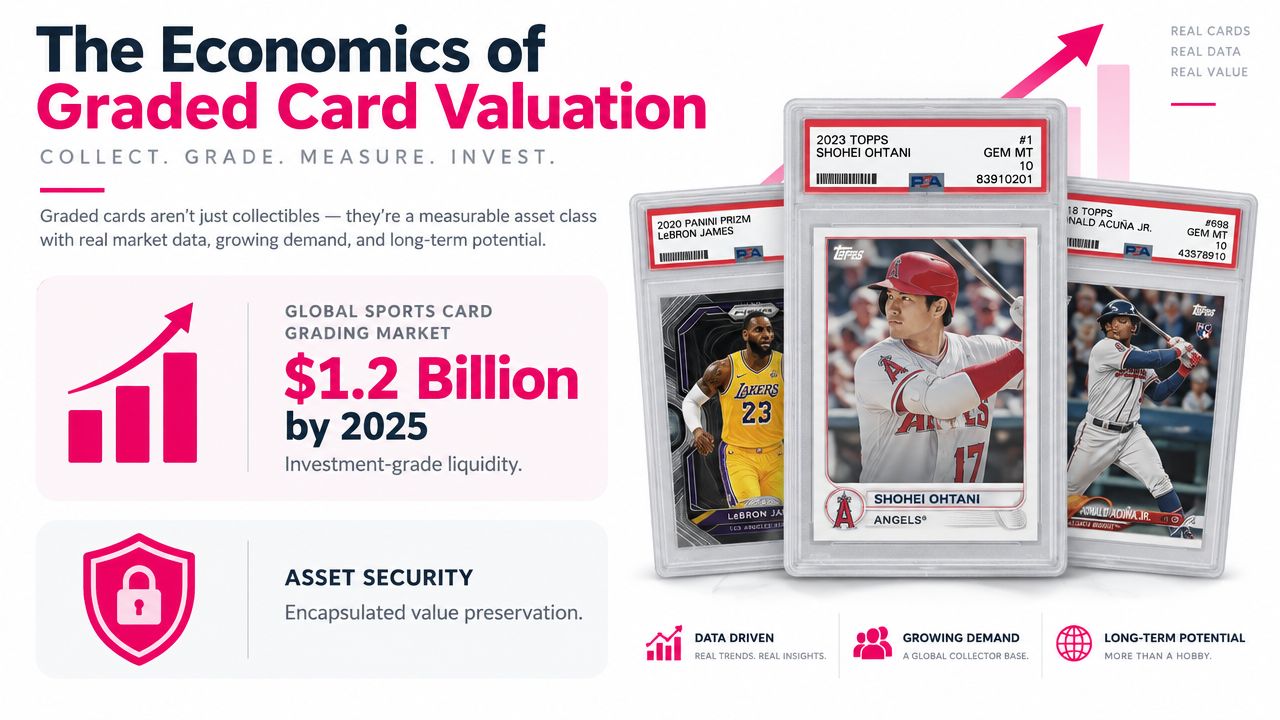
The Economics of Graded Card Valuation
A graded card becomes a standardized product rather than an item each buyer must judge independently. The holder records a condition assessment, authentication status, and protective format. That consistency reduces uncertainty around centering, edges, corners, and surface defects, while giving sellers a recognized condition signal during resale.
Standardization does not guarantee a premium. It creates a clearer comparison between raw cards that appear similar in photographs but may have very different outcomes after professional evaluation. Rarity, condition, authentication, and liquidity intersect inside the holder, and the strongest prices usually occur when all four reinforce one another.
Why authentication matters
Certification gives the next buyer a more consistent basis for comparison than an ungraded copy. It addresses concerns about counterfeits, trimming, alteration, and condition disputes, although buyers should still verify the certification and inspect the individual card.
The holder protects the card and keeps the assigned grade visible during resale. That combination creates a separate market from raw cards, where buyers must price both authenticity risk and condition uncertainty.
Practical rule: Treat the slab as a pricing mechanism, not as proof that the submission was financially sensible.
Market evidence supports a more precise conclusion than the general claim that graded cards are valuable. A recent summary reported a benchmark basket of 100 important graded cards rising 7.1% in one month and 23% over six months, while WOTC-era Pokémon cards in PSA 10 reached $4,061,818 across 423 cards, up 33% over six months (Bleacher Nation market report). Those results indicate broad strength, yet they do not settle the economics of an individual submission.
The hidden arbitrage sits in the spread between the grading cost and the price difference created by certification. A profitable decision depends on the likely grade, the relevant population, buyer demand, and all costs before and after sale. Broad market optimism is insufficient; investors need card-level math instead. The useful question is why a buyer pays more for one grade, one population, or one authentication standard, and whether that difference exceeds the complete cost of acquiring or grading the card.
Decoding the Drivers of Price
Three variables explain much of the movement in graded card prices: grade, population scarcity, and demand for the specific card. Provenance and authentication strengthen buyer confidence, but the most dramatic price changes often occur when a card crosses from PSA 9 to PSA 10.
CAIA described this as a “perfection premium,” linking the effect to supply and demand at the highest grade. Its analysis found that the average PSA Gem Mint 10 sold for about 1,487% more than the same card in PSA Mint 9 condition, with observed premiums ranging from roughly 869% to 1,487% across card populations (CAIA analysis of collectible trading cards).
That isn't a universal multiplier. It shows that pricing is nonlinear. A small visible difference in centering or an edge can determine whether a card receives a 9 or a 10, while the market may assign a much larger difference between those labels than the physical defect appears to justify.
The main pricing variables
| Factor | Impact on Price |
|---|---|
| Grade | Higher grades can produce disproportionate premiums, particularly at PSA 10. |
| Population | A smaller top-grade population can support scarcity, while new submissions can weaken it. |
| Card demand | Iconic players, sets, and chase cards attract deeper buyer interest. |
| Authentication | Certification reduces uncertainty around genuineness and condition. |
| Liquidity | Widely recognized slabs are easier for buyers to compare and resell. |
A Frank Thomas example makes the mechanism concrete. The cited market summary placed a PSA 9 rookie card at about $40 and a PSA 10 around $430, a roughly 10.8× difference for one grade step (Frank Thomas graded-card market summary). The same source reported a PSA 10 three-month low of $154.50, an average of $251.73 across 29 transactions, and a late-August sale at $430. The spread illustrates both the grade premium and the volatility of individual sales histories.
Collectors researching a specific Pokémon card should compare raw, PSA 9, and PSA 10 sales rather than relying on a headline estimate. A guide such as this analysis of Charizard holographic card value can help frame the comparison, but recent sold listings and population data should decide the submission threshold.
Actual Cost of Grading and Breaking Even
Grading produces an arbitrage opportunity only when the expected value of the graded card exceeds the full cost of converting a raw copy into a saleable slab. Include the grading fee, outbound and return shipping, insurance, selling fees, applicable taxes, and the value of capital tied up while the card is away.
PSA's February 2026 update shows why fee structure matters. Bulk and value entry prices rose to $24.99, $32.99, $49.99, $64.99, and $79.99. Super Express reached $349 per card, with premium services costing substantially more (PSA grading services update).
Build the threshold before submitting
Use an expected-value model:
Expected net value after grading = probability of each grade × expected sale price, minus all submission and selling costs.
Estimate separate outcomes for a PSA 10, PSA 9, and any lower grade that remains saleable. The relevant benchmark is the weighted average across these outcomes, adjusted for the card's realistic gem probability. A PSA 10 price alone overstates the opportunity when the card has a meaningful chance of receiving a lower grade.
A 2026 sample found PSA 9 cards trading at roughly the same price as raw Near Mint copies, while PSA 10 premiums ranged from about 2.9× to 6.3× raw, depending on the card (Massive Pokémon card market data). The spread creates two different economic outcomes. A PSA 9 may preserve the card's underlying value without recovering the grading process, while the PSA 10 must cover submission and transaction costs before generating a return.
Margin test: If a PSA 9 leaves you near the raw price, the submission depends mainly on the PSA 10 outcome.
Why turnaround belongs in the math
PSA listed turnaround times of 95 days for Value Bulk and 75 days for Value in the cited 2026 coverage (Massive market data and grading analysis). During that period, the raw card cannot be sold, used to respond to a market spike, or exchanged for another opportunity.
The opportunity cost may exceed the visible grading fee when a card category moves quickly. A long turnaround can still suit a scarce vintage card intended for long-term ownership. Choose the service level according to the card's value, expected premium, urgency, and downside if the grade misses.
Use this submission screen:
- Gem probability: Do the centering, surface, corners, and edges support a credible PSA 10 case?
- Grade spread: Can the PSA 10 premium absorb the PSA 9 outcome?
- All-in cost: Have you included shipping, insurance, selling fees, taxes where applicable, and time?
- Exit liquidity: Are there recent buyers for this exact card and grade?
- Capital lock-up: Can you hold the card through the stated turnaround without needing the funds?
A submission that requires a perfect grade and an unusually high sale has fragile economics. Stronger candidates offer several plausible routes to a reasonable return, including outcomes below PSA 10.
How to Read Population Reports and Trends
A population report measures graded supply, not future value. It records how many cards a grading company has entered at each grade, while leaving demand, selling intent, and unsubmitted copies outside the count. That distinction matters when grading fees make a submission profitable only at the top grade.
Begin with exact identification. Match the set, card number, language, parallel, variation, and authentication details to every sales comparison. A population total for a similar-looking card can create a false scarcity signal and distort the expected break-even calculation.
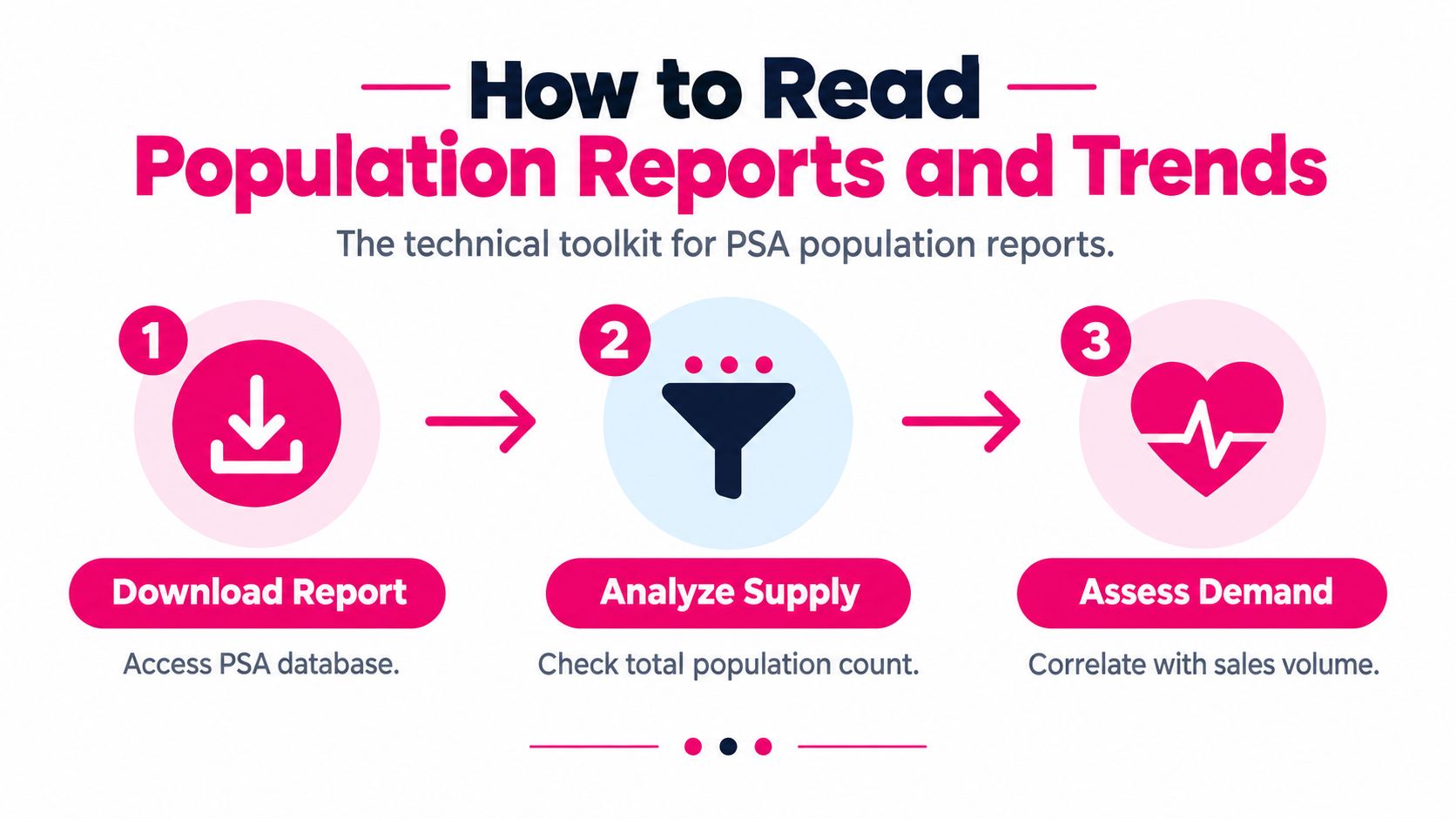
A three-part reading method
First, record total population and grade distribution. A small PSA 10 count may look attractive, but the relationship between PSA 10, PSA 9, and lower grades provides better context. A low total can reflect limited submissions rather than genuine rarity. Compare that distribution with the price spread used in your grading decision.
Next, measure the direction of supply. Compare reports across dates and track how quickly new PSA 10s appear. One 2026 analysis described modern card populations rising from about 5,000 to 8,000 to 12,000 within a year, weakening scarcity expectations and pressuring prices (Misprint market trends analysis). A rising count matters most when the added supply reaches the market faster than demand absorbs it.
Finally, connect supply to completed sales. A growing population can coexist with firm prices if buyer demand expands faster. A low population can still produce unstable pricing when transactions are infrequent and apparent value rests on isolated sales.
What the trend can reveal
Modern chase cards face greater population risk because collectors continue submitting raw copies after release. A slab that appears scarce can become common as grading backlogs clear and reports update. Older cards may have a different supply profile, shaped more by surviving condition and established demand.
Track the exact card identifier, report date, grade counts, recent sold prices, and transaction frequency. Watch whether PSA 10 prices hold as the population rises. Buyers continuing to pay the grade premium as supply expands is the key signal. That persistence determines whether the premium can cover grading, selling costs, and the risk of a lower grade.
For collection comparisons, PSA-graded cards for sale provide buying context. Listed prices remain asking prices until completed transactions confirm them.
Real-World Application on Lucardio Collectibles
A collector applying this framework starts with an inventory, not a shopping impulse. They separate raw cards from authenticated singles and graded items, record the exact card variants, and then compare current sales evidence with the likely grade outcome. The purpose is to identify which cards deserve a submission, which should remain raw, and which are better sold before more supply reaches the market.
On Lucardio Collectibles, the Card Vault is designed to organize and showcase owned items online. That kind of record can support valuation work by keeping a collection's card identity and status visible instead of forcing the owner to reconstruct the inventory from scattered listings, photos, and spreadsheets.
Turning valuation into an exit decision
Suppose a seller has several cards that look promising but don't all justify grading. The seller can compare each card's raw market, estimated PSA 9 outcome, PSA 10 upside, and full submission cost. Cards with weak gem probability stay out of the grading queue, while cards with stronger expected value can move forward.
The platform's sell-your-collection flow is relevant when speed matters more than extracting the maximum possible price from each individual listing. A valuation and instant cash-out route can reduce the time between deciding to sell and receiving funds, although the seller still needs to compare the offered amount with realistic net proceeds from other channels.
Lucardio Collectibles also combines authenticated singles, sealed products, PSA-graded inventory, live breaks, real-time auctions, prize draws, insured fulfillment, and collection management tools. Those formats serve different objectives. An auction may expose a scarce slab to competitive bidding, while a direct collection sale prioritizes convenience and speed.
The analytical principle remains unchanged across the platform. A PSA label can improve trust and comparability, but the seller should still validate the card, grade, population, and recent market before assigning a value. Convenience has an economic value, and a fast exit can be rational when it prevents further grading expense, holding time, or exposure to population growth.
Strategic Buying and Selling Tips
A profitable grading decision depends on the gap between acquisition cost, grading expense, expected sale value, and the probability of each grade. Sellers should target cards with both a credible path to the top grade and enough buyer demand to support the exit. Buyers should test whether a premium reflects lasting scarcity or a temporary shortage of graded supply.
For sellers
- Pre-screen condition: Reject cards with visible centering, surface, corner, or edge issues before paying a grading fee.
- Use expected value: Model PSA 10, PSA 9, and lower-grade outcomes separately. The highest recent sale is only one possible result.
- Choose service by margin: A faster tier works when its added cost is covered by expected value, urgency, or a defensible timing advantage.
- Set an exit price: Establish the minimum net amount that justifies selling after marketplace and fulfillment costs.
The break-even point should include every fee. If a card needs a PSA 10 to recover the raw purchase price, grading charge, shipping, insurance, and selling costs, its expected value may be negative even when the headline PSA 10 price looks attractive.
For buyers
- Measure population velocity: A rising PSA 10 count can narrow the scarcity premium as new supply reaches the market.
- Compare completed sales: An ambitious listing price provides no evidence that buyers will pay it.
- Favor durable demand: Iconic sets and established collector categories can support a stronger scarcity case than newly released cards receiving expanding submissions.
- Price the downside: Estimate the card's value if the premium fades. The purchase should still make sense at its underlying raw or lower-grade value.
Modern cards are not automatically poor buys, and vintage cards are not automatically good grading candidates. The decision rests on supply growth, buyer depth, condition, and total cost.
The central rule is simple: buy the spread only when you understand what creates it. For collection decisions and alternative selling routes, where to sell a card collection helps frame the trade-off between individual listings and faster liquidation.
Category performance can remain strong even as individual modern cards face population pressure. The broader graded-card benchmark rose 23% over six months, and WOTC-era Pokémon PSA 10 values rose 33% over six months, but those gains do not guarantee the same result for every card (Misprint market trends analysis).
The video below provides another visual perspective on evaluating trading cards and market decisions.
FAQs About Graded Card Valuation
Is a graded card always worth more than a raw card?
No. Authentication and condition certification can improve buyer confidence, but the fee and selling costs may exceed the added value. A PSA 9 can trade near a raw Near Mint card for some modern examples, so the premium often depends on reaching PSA 10.
Should I grade every card that looks clean?
No. Pre-screen centering, surface, corners, and edges, then compare the expected grade outcomes with the full cost. A card that needs a perfect result to break even is a speculative submission, not a guaranteed upgrade.
How should I use a population report?
Confirm the exact card first, then record total populations by grade, monitor new additions, and compare the trend with completed sales. Rising PSA 10 supply can weaken a premium if demand doesn't keep pace.
Is a fast sale always the best sale?
Not necessarily. Individual listings may produce more gross value, while a collection-buying route can reduce waiting, listing work, and uncertainty. Compare expected net proceeds with the value of receiving funds sooner.
Lucardio Collectibles offers authenticated singles, sealed products, PSA-graded inventory, live breaks, real-time auctions, collection management through Card Vault, and a sell-your-collection flow for valuation and cash-out decisions. Visit Lucardio Collectibles to compare graded inventory, organize your collection, or explore a practical exit route.