
The honest answer is a range, not a number. Across Pokémon cards with both raw and PSA 10 prices available, the median PSA 10 sold for 13.3 times the raw price, while modern cards commonly land around 2 to 5 times raw and vintage cards around 5 to 10 times raw, sometimes more.
You're probably holding a card in a sleeve, checking the centering under a kitchen light, and wondering whether the online listing you found is a real opportunity or pure fantasy. A Charizard, a vintage sports rookie, or a foil Magic card can look valuable at a glance, yet the actual sale price depends on which version you own, what condition it's in, what grade it might receive, and what buyers are paying now.
That's why “how much is my trading card worth?” is the wrong question on its own. Ask instead: What is this exact card worth in this condition, in the current market, after selling fees and grading risk?
The process is straightforward. Identify the exact variant, inspect the condition, compare recent matching sales, then decide whether grading, selling raw, or bundling gives you the best outcome. The result should be a defensible price band, not a number pulled from an active listing or a best-case PSA 10 result.
Table of Contents
- Why Your Card's Worth Is a Range, Not a Number
- Identify the Exact Card Variant Before You Price Anything
- Inspect Condition and Estimate Your Likely Grade
- How Grading Reshapes the Value of Trading Cards
- Find and Clean Comparable Sales That Actually Match
- Decide Whether to Grade, Sell Raw, or Bundle
- Your Valuation Checklist and Common Follow-Up Questions
Why Your Card's Worth Is a Range, Not a Number
A collector sees a familiar card and often wants one answer: “It's worth $300.” That answer is usually incomplete. A raw card, a PSA 9, and a PSA 10 are different products, even when they show the same character, player, or artwork.
Three variables create most of the spread:
- Raw versus graded status: A card without professional certification carries condition uncertainty. A graded card gives buyers a defined condition tier, although the grade still needs to match the comparable sales.
- Likely grade: The relevant question isn't “Could this card get a 10?” It's “What grade is most likely, and how likely are the other outcomes?” A card that is probably an 8, possibly a 9, and extremely unlikely to be a 10 shouldn't be priced like a 10.
- Exact variant: Edition, year, set, card number, language, foil treatment, parallel, promo status, and printing differences can separate near-identical cards into completely different markets.
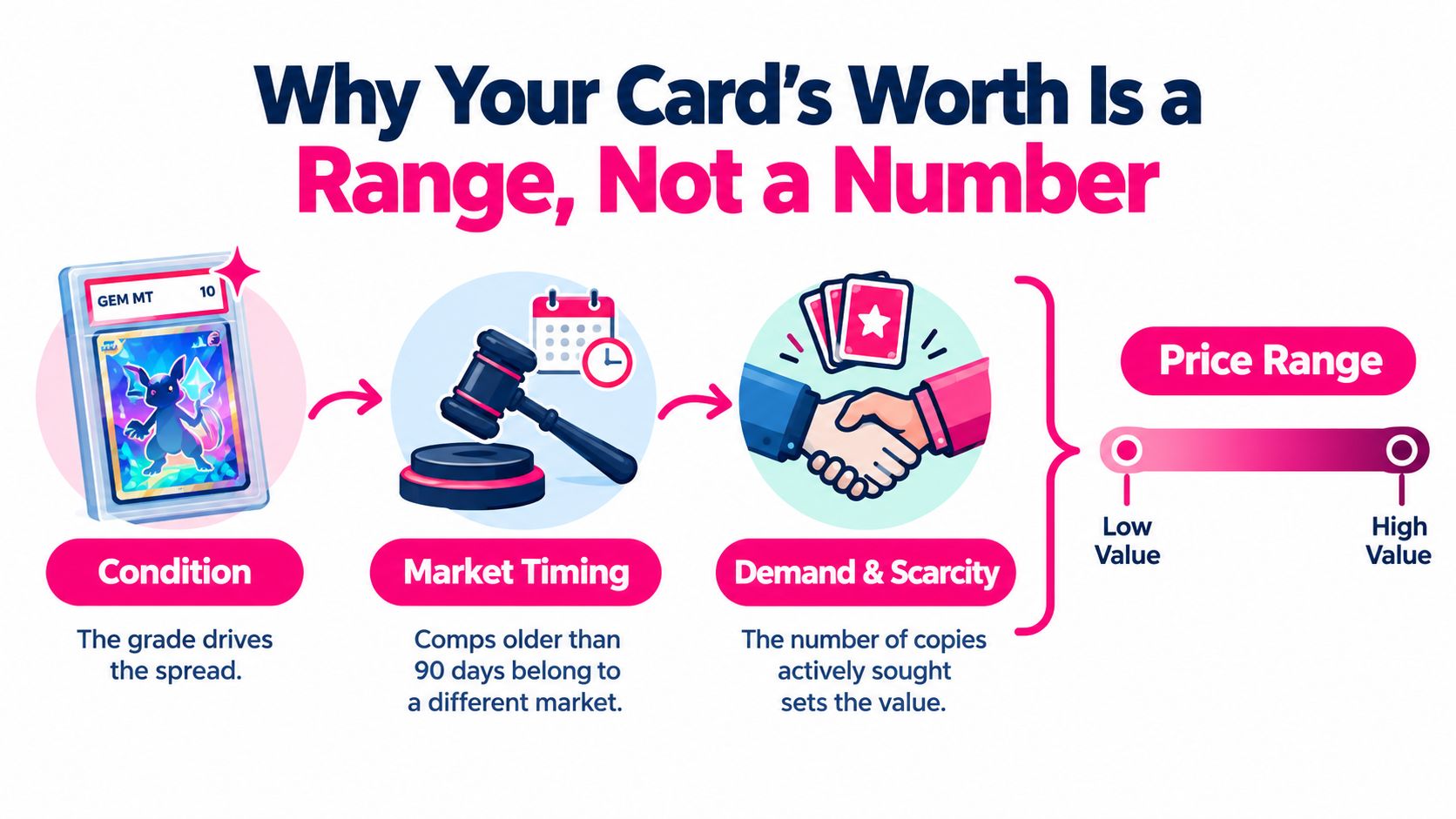
The four-stage valuation workflow
Identify the card before opening a price guide. Generic searches create generic answers, and generic answers are dangerous when several printings share the same name.
Inspect it under bright, angled light. Centering, corners, edges, and surface flaws determine whether the card belongs in a raw, mid-grade, or high-grade comparison set.
Compare realized sales from the same variant and grade. Active listings show what sellers hope to receive. Sold listings show what buyers accepted.
Decide based on net proceeds. A graded price is irrelevant if submission cost, selling fees, shipping, delay, and the probability of receiving that grade consume the difference.
Practical rule: Price the most likely outcome first. Treat the best-case grade as upside, not as your baseline valuation.
The result is a range with a realistic midpoint. Grading can widen that range because a small defect may remove a card from the top tier. Strong matching comps narrow it again. Fees and demand determine what the card is worth in your hands, not just what it appears to be worth on a price chart.
Identify the Exact Card Variant Before You Price Anything
Price research starts with the card's identity, not its character name. Search “Charizard card value” and you'll get a pile of unrelated results. Search the exact year, set, number, edition, language, and finish, and you have a marketable object to compare.
Check the card in this order:
- Set symbol and card number: Match the symbol and printed number against a checklist. A card number often separates a base version from a secret rare, reverse holo, parallel, or promo.
- Copyright year: The year on the card can distinguish visually similar releases. Don't assume the artwork identifies the release.
- Edition stamp: Look for a first-edition mark, limited stamp, or other print designation. Its absence can matter as much as its presence.
- Holo treatment: Confirm whether the card is holo, reverse holo, non-holo, foil, etched foil, or another finish. Lightly tilt the card because some foil patterns are easy to miss in a photograph.
- Language and region: English, Japanese, European-language, and other regional prints may have separate buyer pools and different prices.
- Printing details: Check logos, fonts, borders, copyright lines, texture, and known error or corrected-error markers.
A 1999 Base Set Charizard and a later Base Set Charizard can look almost interchangeable to a casual collector. A shadowless version and a standard unlimited version can also appear nearly identical in a binder. The same problem occurs with a Japanese card beside an English print. If you compare the wrong one, every sale you collect afterward is useless.
| Card Example | ID Marker to Check | Why It Matters |
|---|---|---|
| First Edition versus unlimited Pokémon | Edition stamp near the artwork or lower border | The stamp identifies a different print run and buyer market |
| Shadowless versus unlimited Base Set | Missing drop shadow behind the artwork window | Small design differences can separate variants that share the same name |
| Holo versus reverse holo | Foil placement and pattern across the card | The finish changes both collectability and the relevant sold comps |
| English versus Japanese print | Card language, layout, and set markings | Regional versions need matching language comps |
| Base card versus promo | Set symbol, numbering, and promotional markings | A promo may belong to a separate distribution and scarcity profile |
If the card is foil, use a focused guide such as Lucardio's explanation of foil trading cards to understand which surface treatment you're looking at. Don't move to pricing until the identity is written down in full.
Your research note should say something like: “English, 1999, Base Set, card number 4, holo, shadowless, raw.” That line is far more useful than “Charizard holo.” A wrong variant invalidates every comp step that follows.
Inspect Condition and Estimate Your Likely Grade
Condition isn't a feeling. It's an inspection. Put the card under bright, angled light, handle it by the edges, and use a loupe if you have one. The goal isn't to convince yourself that the card is exceptional. The goal is to find the flaw that a buyer or grader will find immediately.
Four pillars deserve separate attention:
- Centering: Compare the left and right borders, then the top and bottom borders. Uneven borders can cap the grade even when the rest of the card looks clean.
- Corners: Look for whitening, compression, dings, bends, and rounding. A corner can appear sharp from the front while showing damage on the back.
- Edges: Inspect the border for chipping, whitening, dents, and factory roughness. Dark borders make small whitening especially visible.
- Surface: Tilt the card slowly. Search for scratches, print lines, stains, dents, fingerprints, and damage in the holo area. Bright light reveals defects that disappear in a flat photograph.
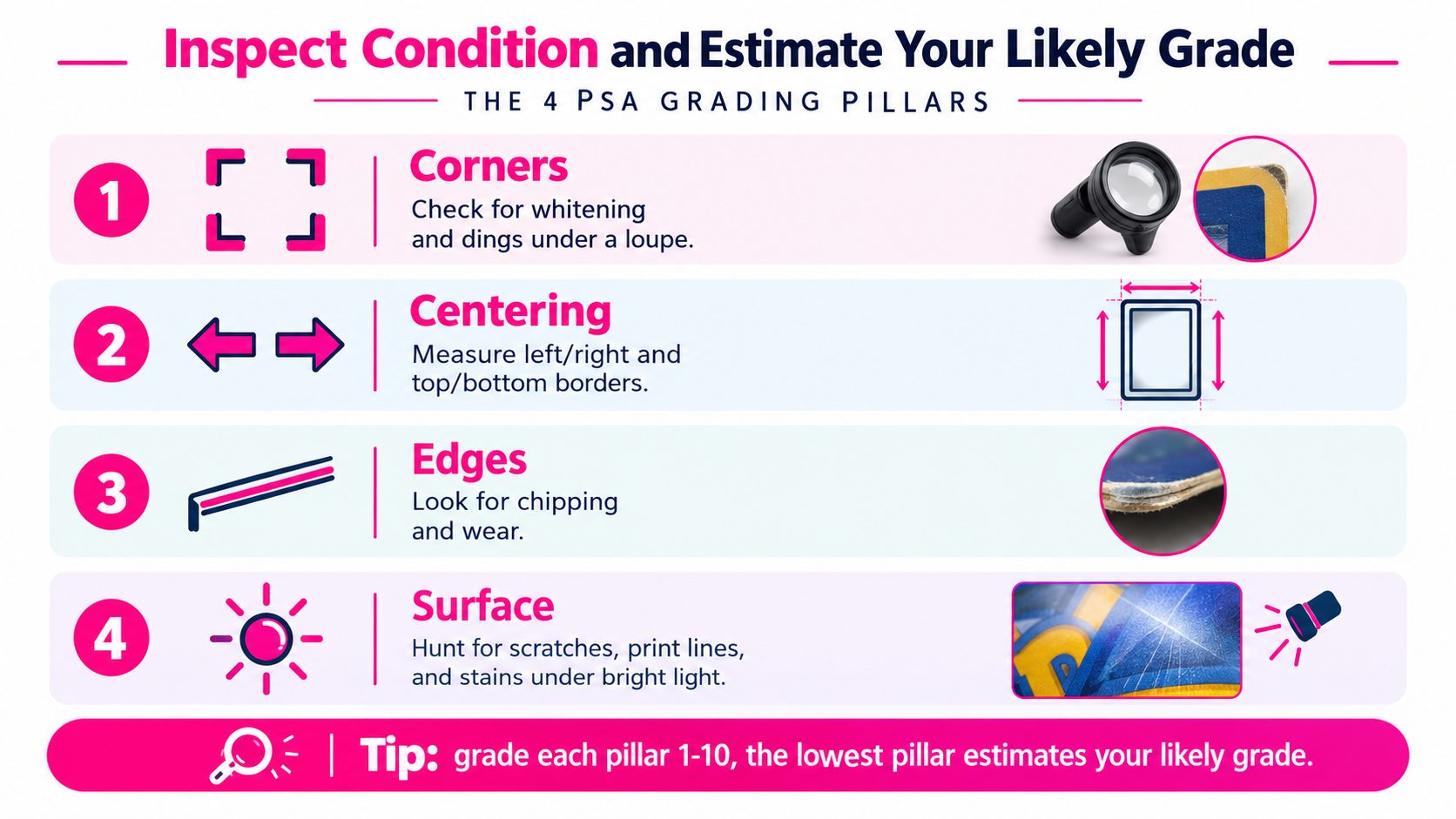
Turn inspection into a probability-weighted estimate
Don't write “PSA 10 potential” and stop there. Write a distribution in plain language:
- Most likely: PSA 8
- Possible: PSA 9
- Unlikely: PSA 10
Then explain why. Perhaps the surface is clean but the centering is visibly off. Perhaps the front looks excellent but the back corners have whitening. Perhaps the card has no obvious flaw until the holo catches a scratch under angled light.
That estimate matters because the market pays for the grade the card receives, not the grade you hoped to receive. A raw card with a credible PSA 9 profile can trade at roughly 50% to 70% of the PSA 9 comparable, while a raw card with genuine PSA 10 potential may trade around 30% to 50% of the PSA 10 comparable, according to raw versus graded card value guidance.
Grade your own card conservatively before paying for certification. Optimism is expensive when the slab comes back lower than expected.
Use a separate note for each pillar. If three areas look excellent but the surface has a deep scratch, the scratch isn't averaged away. The lowest-performing feature may define the realistic ceiling. That discipline keeps you from building a valuation around a grade your card is unlikely to achieve.
How Grading Reshapes the Value of Trading Cards
Grading changes the price by converting an uncertain condition into a recognized tier. The premium varies sharply by card. Modern cards usually face production and population pressure, while vintage cards often depend more heavily on scarcity, survival, and high-grade availability.
Across 22,137 Pokémon cards priced at $5 or more with both raw and PSA 10 prices available, the median PSA 10 sold for 13.3 times the raw price. Modern cards typically reached about 2 to 5 times raw, while vintage cards commonly reached about 5 to 10 times raw, sometimes more, according to Pokémon card price statistics. Use Lucardio's breakdown of graded card prices to compare how certification can affect different card categories.
| Card Category | Raw to PSA 10 Multiplier | Population Pressure | Grade Premium Outlook |
|---|---|---|---|
| Modern Pokémon | About 2x to 5x | Production and abundant high-grade copies can limit scarcity | Premium depends heavily on demand and population |
| Vintage Pokémon | About 5x to 10x, sometimes more | Fewer surviving high-grade examples can support a wider spread | Stronger upside when scarcity and demand align |
| Median tracked Pokémon comparison | 13.3x | The median masks major differences between individual cards | Exact variant and grade remain decisive |
A slab does not create scarcity. A PSA 10 with a large population may command less than beginners expect. Conversely, a lower grade on a historically important card can retain a deep buyer pool. A flawless modern card may still underperform when many equivalent copies are available.
Recent market coverage describes modern Pokémon premiums compressing from 25% to 30% down to 5% to 10%, and reports that about 26.8 million cards were graded across major companies in 2025, with Pokémon dominating submissions and TCG and non-sports cards exceeding sports cards in graded volume. Those figures appear in this 2026 guide to Pokémon slabs and grading companies. Grading isn't automatically profitable just because a card can receive a slab.
BGS 9.5, a Black Label, and PSA 9 are separate products in the eyes of buyers. Each needs matching sales evidence. Older holders can also receive different market treatment from newer holders carrying the same grade, so check the holder and label details before choosing a comparable.
Price grading by expected outcome, not fantasy outcome. Multiply each likely grade's sale value by its probability, then subtract grading, shipping, selling fees, and the cost of waiting. Compare that net figure with a raw sale today. The practical ceiling matters only if the card has a credible chance of reaching it.
Find and Clean Comparable Sales That Actually Match
Actual numbers live in completed transactions, not optimistic listings. Use eBay sold listings for broad coverage, 130point for sales data and accepted offers where available, and specialist marketplaces such as PWCC or Card Ladder when the card has enough activity to support a useful history.
Start with a narrow search. Enter the exact card number, set, language, finish, and grade. Add the edition or parallel designation. Then remove anything that isn't the same product. A raw copy doesn't comp a PSA 10. A Japanese copy doesn't comp an English copy. A current auction result shouldn't be blended casually with an old fixed-price listing.

Build a usable comp set
Use a recent window, ideally 30 to 90 days. Older sales can describe a different market, especially for character-driven releases, sports news, set launches, or sudden collector interest. Industry commentary has also noted that event-driven volatility can move card values 20% to 50% in weeks, which is why recent analysis of PSA labels and card values favors recent realized prices over stale guidebook figures.
Clean the results before calculating a midpoint:
- Remove wrong variants: Delete sales with a different language, edition, parallel, holo treatment, or card number.
- Separate condition tiers: Keep raw, PSA 9, PSA 10, BGS, and other grades in separate groups.
- Discard obvious outliers: With a small sample, remove the single highest and lowest sale. With enough sales, trim the top and bottom 10%.
- Prioritize completed sales: A listing sitting unsold at a high price is evidence of seller intent, not buyer demand.
- Adjust for seller context: A fast auction, a long fixed-price listing, and a dealer sale may reflect different levels of urgency and trust.
- Record the date: Note whether the comp comes from the recent window or requires a wider, less reliable search.
A $400 PSA 10 fixed-price listing that has sat for weeks is weaker evidence than a lower-priced copy that sold quickly. Likewise, a raw listing at $500 next to a PSA 10 sale at $900 doesn't prove the raw card is worth $500. The raw card may have poor centering, surface wear, or no credible path to the graded outcome.
A practical rule keeps you honest: if you can't find three matching comps within 90 days, the market is too thin to trust a single number. Use a wider range, explain the uncertainty, and avoid pretending that one unusual sale defines value.
The workflow is easier to repeat when you record the card identity, grade tier, sale date, realized price, and notes about the transaction. That small record prevents you from unconsciously selecting the highest result.
Decide Whether to Grade, Sell Raw, or Bundle
Grading has become a reflex, and that reflex costs collectors money. The right move depends on three questions, and none of them is “Would a PSA 10 look good in my collection?”
Question one asks whether raw buyers already want the card
If comparable raw copies sell quickly at a stable price, certification may add delay without adding enough net value. Sell raw when buyers accept the current condition and the graded spread is narrow.
If raw copies sit unsold, grading won't automatically rescue the card. It may just turn an unpopular raw card into an unpopular slab. Demand comes first.
Question two asks for the realistic grade distribution
Price the likely outcomes, not the fantasy. A card with a strong chance of PSA 9 and only a small chance of PSA 10 should be valued around the PSA 9 path. The PSA 10 outcome is upside, not the foundation of the decision.
Use this simple calculation:
Expected graded proceeds = the value of each grade multiplied by its probability, added together, minus submission and selling costs.
For example, assign probabilities to PSA 8, PSA 9, PSA 10, and a possible lower result. Multiply each by its matching net sale value. Then compare the total with what the card could produce raw today. If the expected result barely exceeds the raw option, grading is a poor use of capital and time.
Question three asks whether the spread survives costs and delay
Submission fees, shipping, insurance, marketplace fees, and the risk of a changing market all reduce the apparent premium. A card can have a higher slab price and still produce less money for you.
Modern Pokémon deserves extra skepticism. Recent guidance reports that PSA 10 premiums for modern Pokémon have compressed substantially, while grading volume has expanded across the hobby. That combination makes the median modern card a weak grading candidate unless demand and scarcity are already strong.
Vintage cards can justify a different approach when the exact variant is scarce, the raw copy has a credible high-grade profile, and matching graded sales show a meaningful gap. Even then, inspect the card first. Vintage flaws are common, and the lower-grade outcome can destroy the assumed margin.
Cards with low raw demand and modest upside should usually be bundled. A card worth only a few dollars alone may become useful as part of a themed lot, set-building group, or collection sale. If the buyer has to sort and list each card, your bundle needs a clear reason to exist.
For sellers who want an alternative to listing every item individually, Lucardio's collection-selling service is one option to investigate. The same decision rule still applies: understand whether you're accepting convenience in exchange for a lower net return.
Your Valuation Checklist and Common Follow-Up Questions
A reliable valuation fits on one page:
- Confirm the variant: Record year, set, number, edition, language, finish, and any parallel or promo designation.
- Inspect the four pillars: Check centering, corners, edges, and surface under bright light.
- Estimate the grade range: Write the most likely grade and the plausible higher and lower outcomes.
- Pull matching sold comps: Use recent sales for the same variant and grade, not active listings.
- Clean the sample: Remove wrong cards and outliers, then use a defensible midpoint.
- Choose the selling route: Compare net raw proceeds with the probability-weighted graded result and the bundle option.
Questions that come up after the first estimate
Why can't a raw listing comp a graded card? Because a raw listing carries unresolved condition risk. Two raw copies at the same asking price can have very different grade probabilities, and buyers price that uncertainty into their offers.
Does a first-edition stamp always create a premium? It identifies a different variant, but the stamp alone doesn't guarantee a high price. Demand, condition, language, and recent completed sales still decide the result.
When does population information matter? It matters when you're comparing cards in the same grade and trying to understand scarcity. A population report can add context, but it doesn't replace sold comps. A low population without active demand isn't a valuation by itself.
What does a flat price chart mean? It means the available data may show stability, thin activity, or mixed variants. Read the individual transactions and check whether the chart combines raw cards, different grades, or different versions.
Can fees erase the profit? Yes. Shipping, platform charges, payment processing, insurance, and grading costs all come out of proceeds. The price a buyer pays is not the amount you keep.
A final habit separates casual guessing from repeatable appraisal. Log the card, assumed grade, comp links, sale dates, estimated net proceeds, and final decision. Over time, your centering and surface judgments improve, your searches get faster, and you stop treating the highest visible listing as evidence of value.
Lucardio Collectibles offers authenticated singles, sealed products, PSA-graded items, live breaks and auctions, collection management through its Card Vault, and a sell-your-collection flow for valuation and cash-out options. If you want to compare your own research with a platform built around verified inventory and collection selling, visit Lucardio Collectibles.