
You've sold a Pokémon card, packed it quickly, and now you're staring at the mailer wondering whether a penny sleeve and bubble wrap are enough. That shortcut can work for a low-risk shipment, but it leaves too many failure points for valuable singles, graded slabs, sealed products, and mixed lots. Cards can bend, slide, scrape against rigid edges, or absorb moisture before the buyer ever opens the parcel.
The practical answer to how to package Pokémon cards for shipping is to build protection from the card outward. A sleeve protects the surface, a rigid holder supports the card, a sealed bag blocks moisture, cardboard controls bending, and the outer mailer or box absorbs the punishment of transit. The same logic applies to bulk orders, although bundles need a different approach to weight, void fill, and internal movement.
Table of Contents
- Why a Bent Card Is a Dealbreaker for Collectors
- The 2026 Five-Layer Packaging Standard
- Understanding the Shift to Moisture Barriers and Rigidity
- Packaging Lots, Sealed Products, and Bulk Orders
- Choosing the Right Shipping Service and Insurance
- Handling Damage Claims and Buyer Disputes
Why a Bent Card Is a Dealbreaker for Collectors
A collector opens the parcel expecting a clean card and finds a corner folded upward. The seller may have used a bubble mailer, but the card was loose inside it, with no rigid support around the holder. During sorting, the package was pressed beneath heavier mail, and the damage happened long before delivery.
That experience changes the transaction immediately. A buyer who ordered a collectible card isn't judging only the artwork. They're judging centering, edges, corners, surface condition, and whether the card matches the listing. A bend can turn an otherwise acceptable purchase into a return request, a dispute, or a permanent loss of trust.
A plain envelope is especially unforgiving. It offers little structural resistance, and a raw card can flex, slide, or suffer edge wear as the parcel moves through handling systems. The practical shipping baseline described in PCMag's Pokémon card shipping guidance moves outward in layers, starting with a penny sleeve and top loader, then adding painter's tape and cardboard for more valuable cards.
Practical rule: Packaging should protect the card from the most likely failure, not merely make the parcel look padded.
Condition is part of the product
A Pokémon card isn't separated from its condition by the shipping process. The buyer paid for the card in the condition shown or described, so a crease caused after the sale is still a fulfillment failure. That matters even more for authenticated and graded inventory, where buyers expect the physical item to arrive with the same presentation quality as the listing.
A top loader by itself prevents some bending, but it doesn't stop the holder from moving inside a mailer. Direct tape can leave residue on the plastic, and an unsealed holder leaves the card exposed to rain or humidity. Each shortcut solves one problem while creating another.
Trust is built before delivery
Good packaging also makes the seller's process visible. A buyer can see that the card was sleeved, stabilized, sealed, and packed with intention. That consistency supports fewer handling disagreements and gives sellers a repeatable workflow for individual orders and authenticated inventory.
For a useful example of protective storage thinking beyond shipping, see Lucardio Collectibles' Pokémon protection cube guide. The principle is the same: valuable cards need a controlled environment that limits movement, contact, and exposure.
The 2026 Five-Layer Packaging Standard
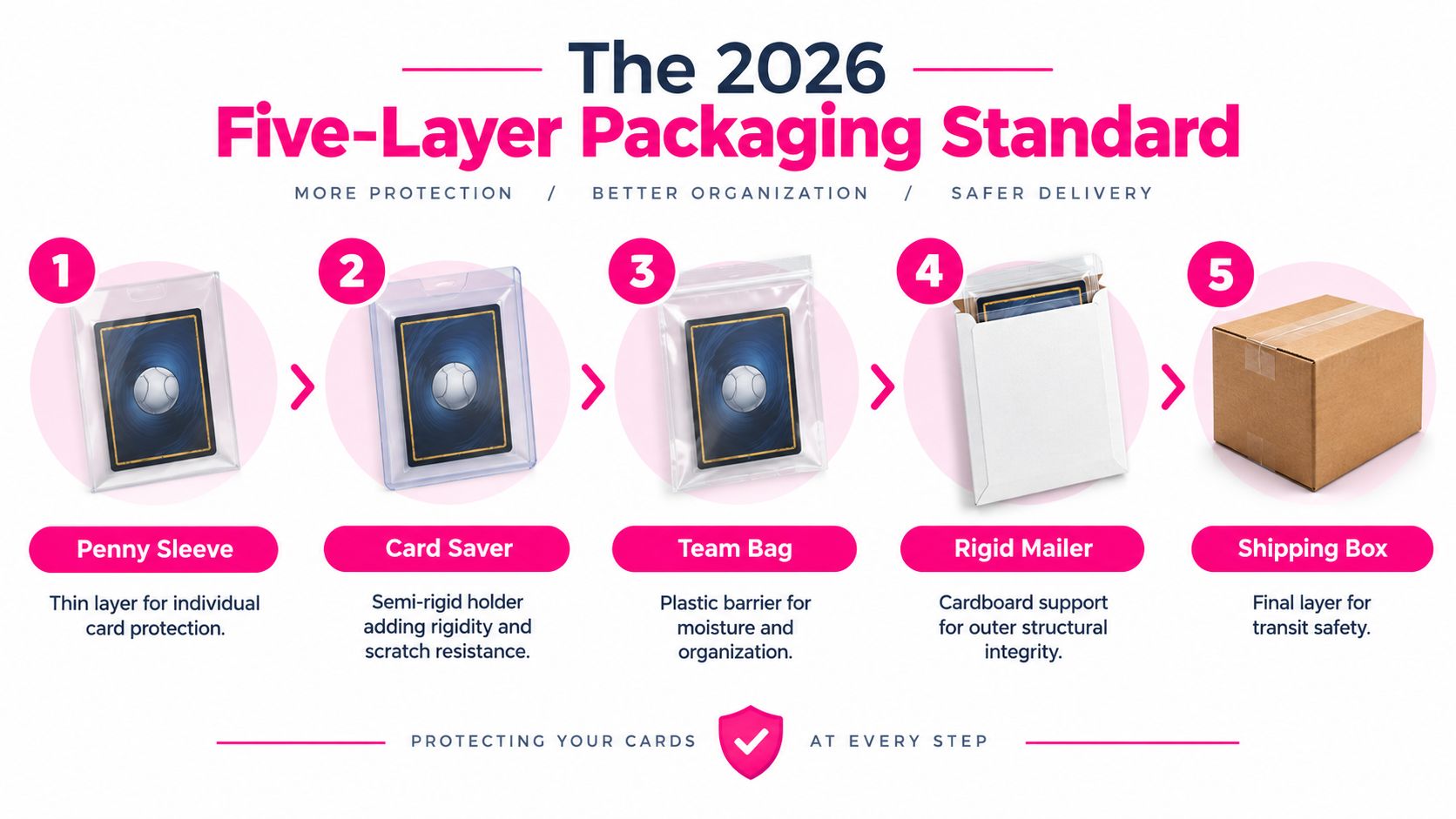
For a single Pokémon card, use this sequence:
- Penny sleeve
- Rigid top loader or card saver
- Sealed team bag
- Cardboard sandwich
- Padded bubble mailer or small box
This five-layer structure is supported by ParcelPath's trading-card packaging guide, which identifies the main transit risks as bending, corner crush, surface scuffing, and moisture.
Start with the card, not the envelope
1. Penny sleeve: Hold the Pokémon card by its edges and slide it into a clean sleeve without forcing the corners. The sleeve creates the first barrier against fingerprints, dust, and surface contact. Make sure the card isn't compressed or catching on the opening.
2. Top loader or card saver: Put the sleeved card into a holder that fits securely. The holder should support the card without leaving enough room for excessive sliding. If you use a top loader, keep the sleeve opening aligned with the holder opening so the card is less likely to work its way out.
3. Team bag: Place the loaded holder into a resealable team bag and close it fully. The bag gives the package a moisture barrier and keeps the holder grouped with the rest of the protective layers. Seal the bag with painter's tape if extra retention is needed. Tape the bag, never the top loader itself.
Finish with rigidity and controlled movement
4. Cardboard sandwich: Put the sealed holder between two clean pieces of cardboard that extend beyond the holder's edges. Secure the cardboard around the outside so the holder can't slide out, but don't apply adhesive where it could contact the card or holder opening.
5. Outer package: Use a padded mailer or a small box that fits the protected card without leaving a large empty cavity. A padded envelope alone isn't a substitute for the cardboard layer. The outer package cushions impact, while the cardboard supplies structural resistance.
Before sealing, perform a simple movement test. Shake the package gently. If the protected card shifts freely, add clean packing paper or another suitable filler. Don't use high-adhesive tape directly on the holder, and don't let loose materials rub against the card's exposed surfaces.
For a visual walkthrough of the finished method, the following video demonstrates card packaging in practice.
Understanding the Shift to Moisture Barriers and Rigidity
Older hobby habits often treated shipping as a simple bending problem. Put the card in a sleeve, add a top loader, and place it in an envelope. That approach doesn't account for the separate risks created by moisture, movement, and compression.
Current guidance has converged on a system that handles all three. After sleeving and top loading, the card goes into a resealable bag or team bag, then into cardboard or a rigid box so it can't shift inside the parcel. ValueMailers' high-value card guidance describes double boxing as the “golden rule” for expensive cards, with an inner cardboard box inside a larger shipping box and reinforced tape.
Moisture is a separate threat
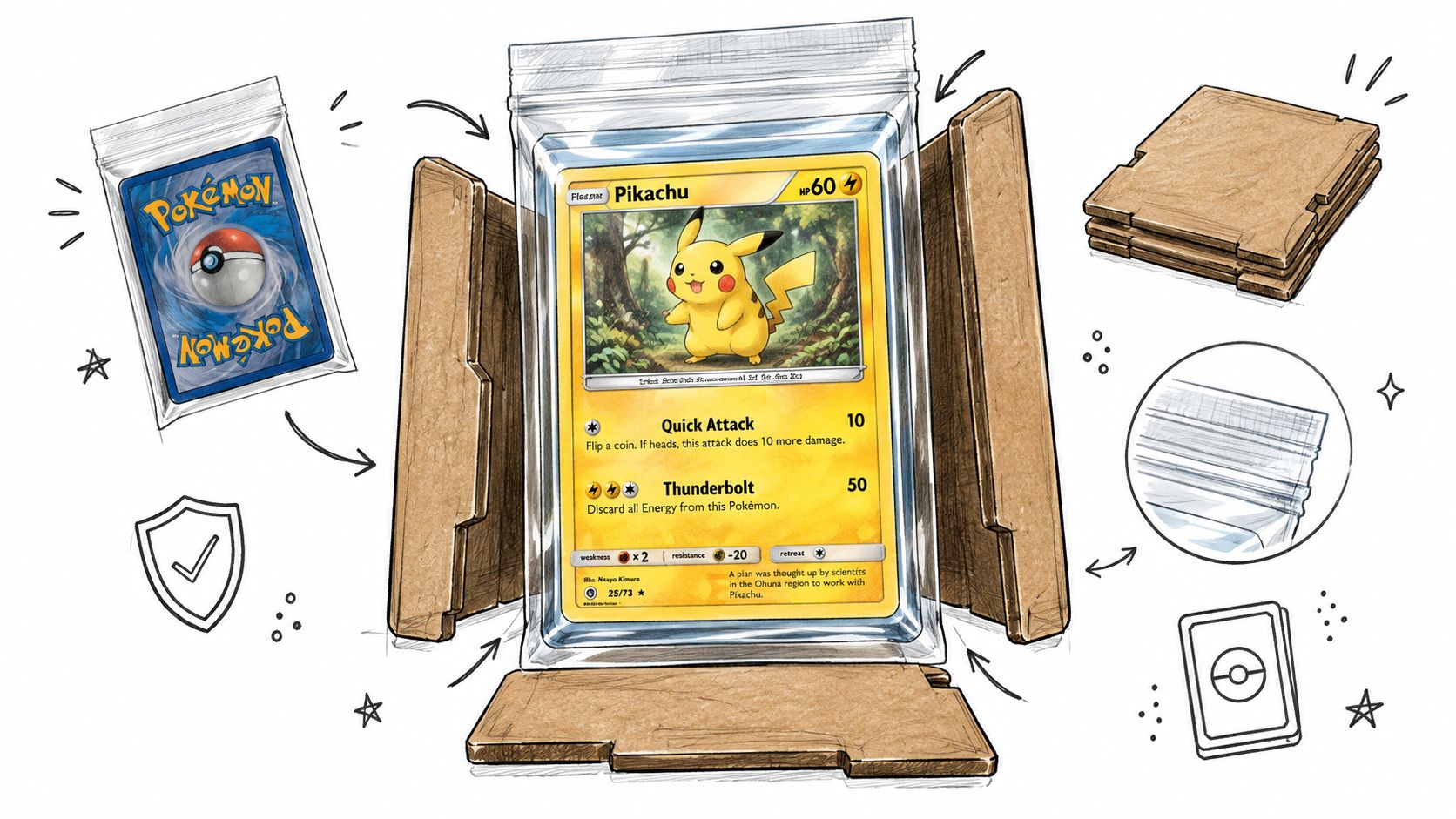
A rigid holder isn't waterproof. Its opening can allow rain, condensation, or humid air to reach the sleeve and card. A sealed team bag adds a dedicated moisture barrier, which becomes more important when parcels spend longer in transit or move through damp conditions.
The bag also helps with organization. It keeps the holder from rubbing directly against loose cardboard, and it provides a clean surface around which the next layer can be secured. Moisture control isn't a replacement for rigidity. It solves a different problem.
Rigidity needs a movement test
A rigid component only works when it stays in position. A top loader rattling around in a large mailer can strike the outer walls repeatedly. A slab moving inside a box can experience concentrated impact at its corners. The package should feel compact and stable rather than loose and hollow.
Use this check before sealing:
- Listen: Can you hear the holder moving?
- Feel: Does the contents slide when the parcel is tilted?
- Inspect: Are the corners supported on all sides?
- Repack: Can you add paper or padding without compressing the card?
For graded inventory, a fitted rigid card holder option from Lucardio Collectibles illustrates why sizing matters. A holder that is too large permits movement, while one that is too tight can place pressure on the card or slab.
The modern standard isn't “add more bubble wrap.” It's separate the risks and assign each layer a job. Sleeve for surface contact, holder for bending, team bag for moisture, cardboard for outer rigidity, and filler for movement.
Packaging Lots, Sealed Products, and Bulk Orders
A single card can follow a clean linear stack. A bulk order can't. Once several holders, packs, or products share one parcel, the main problem becomes internal movement and uneven weight.
For a small lot of individual cards, sleeve each card and group the protected holders inside a sealed team bag or another organized bundle. Add cardboard around the group so the edges don't press directly into the mailer. Keep the bundle snug. If it shifts, the cards can collide with one another even when every card has its own sleeve.
Match the package to the order
| Shipment type | Suitable approach | Main risk to control |
|---|---|---|
| Individual singles | Five-layer card stack in a padded mailer or small box | Bending, moisture, and holder movement |
| Small card lots | Sleeved and rigidly grouped cards with cardboard support | Edge contact and shifting between holders |
| Larger collections | Rows or sections inside a sturdy corrugated box with dividers | Uneven weight and compression |
| Sealed products | Box with corner protection and void fill | Crushed packaging and internal sliding |
| Mixed orders | Separate cards and sealed items into stable compartments | Heavy products pressing against cards |
For booster boxes and other sealed products, protect corners before filling the remaining space. The factory wrap can scratch or tear when it rubs against cardboard, loose accessories, or another sealed item. Use a small box rather than allowing a heavy product to move inside a large mailer.
Collections also benefit from division. Organize cards in sleeves, pockets, or grouped holders, then separate those groups with clean cardboard. Fill empty areas with packing paper, bubble wrap, or air pillows. The objective is not maximum volume. It's preventing the contents from shifting when the box is tilted or handled.
Avoid the cheap shortcut
An oversized box with loose cards is worse than a smaller, properly fitted package. Loose void allows momentum to build, and repeated movement can crush corners or split packaging. Packing peanuts are also a poor choice around exposed collectible surfaces because they can create static, shed fragments, and leave the shipment difficult to unpack.
For mixed-condition orders, separate raw cards, graded slabs, and sealed products rather than stacking them indiscriminately. A slab or boxed product shouldn't bear directly against raw cards. Give each category its own protective group, then stabilize the groups inside the outer box.
Choosing the Right Shipping Service and Insurance
Choose the carrier and service after you know what you're shipping, how much protection it needs, and whether the buyer requires tracking. A low-risk single card may fit a padded mailer, while a graded slab, sealed product, or substantial lot belongs in a box with documented value and movement control.
Start with a simple fulfillment routine:
- Confirm the order contents and condition. Match the card, set, language, grade, and visible condition to the listing.
- Photograph the protected package. Capture the card, holder, sealed bag, cardboard, and final parcel before closing it.
- Choose tracked delivery. Tracking creates a delivery record and gives both parties visibility.
- Insure for the shipment's actual value. Don't select coverage that would leave a major portion of the sale unrecoverable.
- Record the receipt and tracking number. Store them with the order details.
- Use signature confirmation when the shipment warrants direct handoff. This is especially sensible for expensive graded or authenticated inventory.
Carrier choice depends on destination, parcel size, service availability, and declared value. Compare postal and courier options rather than choosing purely by habit. For international shipments, account for customs handling, longer routes, and moisture exposure, then favor a box and stronger internal stabilization.
If your inventory includes authenticated Pokémon singles, sealed products, and PSA-graded items, Lucardio Collectibles' Pokémon singles for sale is an example of the type of collectible inventory where condition visibility and secure fulfillment matter together. The packaging record should support the same standard shown in the listing.
Handling Damage Claims and Buyer Disputes
Respond quickly and keep the conversation factual. Ask the buyer for clear photographs of the card, the outer mailer or box, the inner packaging, and any visible crushing, water exposure, or tears. Those images can show whether the damage occurred to the parcel, the protective layers, or the card itself.
Save your own evidence before filing anything:
- Order record: Keep the listing, sale confirmation, and stated condition.
- Packing photographs: Preserve images taken before sealing.
- Receipt and tracking: Store the carrier acceptance record.
- Damage photographs: Request wide and close views from the buyer.
- Packaging materials: Ask the buyer not to discard the parcel until the review is complete.
Don't accuse the buyer or promise a carrier decision you can't control. Explain the next step, whether that's a return, replacement review, refund assessment, or carrier claim. If the shipment was insured, submit the carrier's required proof of value, tracking, and damage documentation.
The best dispute prevention happens before shipping. Use consistent materials, label the order internally, photograph the final package, and tell the buyer how the card was protected. A repeatable process gives you a clear record when a parcel fails despite reasonable care.
Lucardio Collectibles offers authenticated singles, sealed Pokémon products, PSA-graded items, live breaks, auctions, and collection tools alongside insured, trackable fulfillment. If you care about condition from packing through delivery, visit Lucardio Collectibles to explore its upcoming marketplace and collectible inventory.