
PSA grading is worth it only when the expected graded sale clears the raw price plus grading fees, shipping, selling costs, and the multi-month wait. With a published lower-tier fee of $79.99 per card, submitting every attractive card isn't a sensible resale strategy.
The popular advice to grade anything clean confuses appearance with profit. A beautiful card can come back with a respectable grade and still leave you worse off than selling it raw.
The useful question isn't whether plastic makes a card more desirable. It's whether your specific copy, at realistic grade odds, produces more net dollars than a sale today.
Table of Contents
- When a PSA Grade Pays for Itself
- What the Slab and Population Report Prove
- How to Judge the Likely Grade
- How to Run the Break-Even Math
- What the Grading Wait Can Erase
- ROI Scenarios Hobby Sellers Actually Face
- Submit, Sell Raw, or Buy the Slab
When a PSA Grade Pays for Itself
Submit when the likely outcome pays, not when the best possible outcome looks exciting. A realistic high-grade sale, or a valuable sale that needs authentication, must beat the raw alternative after every expense.
Start with these filters before opening a submission form:
- Condition evidence: Inspect centering, corners, edges, and surface. Your target grade needs support from the actual card, not its pack-fresh history.
- A usable sold premium: Compare completed sales for the exact card, printing, language, and grade. Asking prices aren't proceeds.
- Durable demand: Choose cards buyers are likely to want when grading finishes, rather than cards whose appeal depends on today's excitement.
Know what the service charge covers
PSA's trading-card grading pricing lists the standard lower-tier service at $79.99 per card, with a $1,500 maximum insured value, while shipping, inbound insurance, taxes, and other applicable charges are additional.
The lookup below separates stated pricing from submission details you still need to verify. Turnaround entries are planning estimates, not delivery commitments.
PSA service cost and estimated turnaround
| Service level | Published fee per card | Maximum insured value | Estimated turnaround |
|---|---|---|---|
| Value | Confirm the current submission quote | Confirm the selected tier's ceiling | 90–100 business days |
| Standard lower tier | $79.99 | $1,500 | 70–80 business days |
| Priority | Confirm the current submission quote | Confirm the selected tier's ceiling | 50–60 business days |
Don't treat an unconfirmed fee as a cheap fee. Get the actual quote before deciding whether a card qualifies, and check that the service is available for your submission.
Reject thin margins early
An apparent raw-to-graded premium isn't profit. You still have to move the card safely, insure it appropriately, pay the seller's transaction costs, and wait for the money.
For inexpensive modern cards, that expense stack can consume the entire improvement in price. A visibly damaged copy is an even weaker submission candidate when buyers aren't paying a meaningful authentication premium.
Submission rule: If the ordinary outcome loses money and only the exceptional outcome pays, you're buying a gamble, not securing an upgrade.
Authentication can change the decision for valuable cards. A buyer may be more willing to complete a substantial purchase when an independent grader has assessed authenticity and condition, even when the card isn't a top-grade candidate.
Finally, choose the service around the card's plausible graded value. If that value exceeds the selected tier's insured ceiling, a more expensive service may be necessary. Recalculate before submitting, rather than discovering that the higher fee consumes your margin.
What the Slab and Population Report Prove
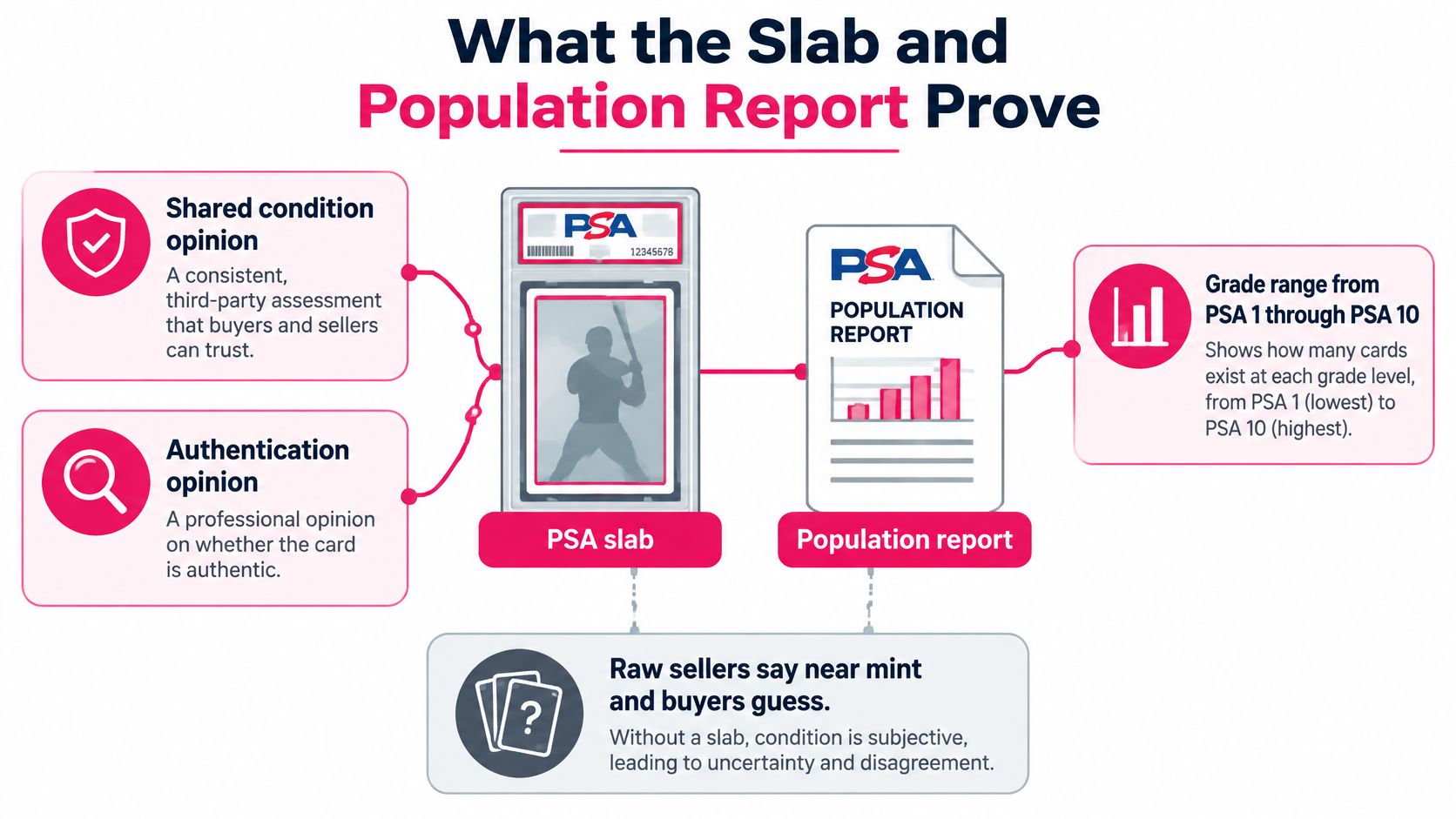
A PSA slab is a shared measuring stick, not a price tag. It gives buyers a standardized condition and authentication opinion, which is more useful than asking strangers to agree on what near mint means.
Consider a collector comparing an unslabbed vintage Pokémon card with a graded copy. The raw card's photographs might look convincing, but the buyer still has to judge wear, authenticity, and whether the seller's description is reasonable. The graded copy reduces some of that uncertainty, although the buyer still needs to inspect the listing and judge the price.
The distinction between the slab and the population count matters.
A population count isn't a census
Established in 1999, PSA's Population Report records cards graded from PSA 1 through PSA 10, but counts submitted cards rather than every surviving copy and excludes cards rejected for suspected alteration, restoration, or questionable authenticity.
That limitation should change how you interpret scarcity. An obscure issue can have a small population because owners rarely submit it. A popular chase card can have a large population because collectors actively search for clean copies and send them for grading.
Neither count tells you the complete supply sitting in binders, sealed products, dealer inventory, or other grading companies' holders.
For a thinly traded card, ask why the population is low. Is the issue truly difficult to find, or has grading been uneconomic? Does the apparent shortage exist across conditions, or only at the grade sellers advertise?
A low count without buyer demand isn't an investment case. Scarcity matters financially only when interested buyers compete for the available copies.
More grading can mean more competition
Licensing International's trading-card market report states that 26.8 million cards were professionally graded in 2025, up 32% from approximately 20 million in 2024. It also reports that trading-card-game grading increased 97%, compared with 2% for sports cards, while PSA accounted for about 71% of total volume.
Those figures don't prove that your particular card will fall in price. They do undermine the assumption that encapsulation automatically creates scarcity.
As more owners submit the same modern card, buyers can choose among more graded copies. Sellers then need something beyond a familiar label to defend their asking price: stronger demand, limited availability, or an attractive price relative to comparable sales.
For an iconic issue with established collectors, standardized grading can make transactions easier. For a common modern card, the same standardization makes competing copies easier to compare. That helps buyers negotiate as much as it helps sellers list.
Use the population report alongside these checks:
- Neighboring grades: Look at the supply in your target grade and the grade below it. A crowded lower grade matters if your copy misses.
- Completed transactions: Check whether buyers really purchase the available slabs at the premium you're using.
- Your likely proceeds: Translate the sold price into money left after the transaction, not a headline valuation.
Our guide to graded card prices can help you distinguish a meaningful comparable from an optimistic listing.
Grade scarcity, condition, or trust that buyers demonstrably value. Don't pay to turn an ordinary copy into another interchangeable slab unless the economics remain attractive.
How to Judge the Likely Grade
Inspect like a buyer looking for reasons to pay less. Ownership makes small defects easy to excuse, especially when the premium grade would solve your profit calculation.
Use a clean workspace, a bright adjustable lamp, and a magnifying loupe. Handle the card by its edges and change the light angle rather than repeatedly touching the surface.
Build a condition record
- Centering: Compare opposite borders on the front and back. Don't let attractive artwork distract you from an obviously uneven frame.
- Corners: Examine every corner under angled light. Look for softness, bends, compressed tips, and small dings.
- Edges: Follow the full perimeter for whitening, chipping, and roughness. Check against a contrasting background.
- Surface: Tilt the card slowly to reveal scratches, print lines, indentations, stains, and uneven gloss. A straight-on photograph can hide these.
- Authenticity concerns: Flag suspicious cuts, recoloring, or signs of restoration. Don't attempt to improve the card with trimming, polishing, or other alteration.
A card can look excellent in a sleeve and disappoint under direct light. Record what you find before looking at the most expensive graded sale, so that price doesn't influence your assessment.
Turn observations into grade odds
Assign a personal likelihood to the plausible outcomes, including a lower result when defects justify it. These are judgment calls, not official grading predictions.
Give the premium outcome less weight when you've found a visible flaw. If several areas show wear, don't push the card into a high-grade model because the higher sale price is attractive.
A clean-looking card is a candidate for inspection, not permission to assume the best grade.
Photograph the front, back, corners, and any questionable areas. Your notes should explain why you assigned each outcome a meaningful chance. If you can't defend the top-grade probability without saying it looks perfect to me, reduce it.
When the economics require certainty you don't have, sell raw.
How to Run the Break-Even Math
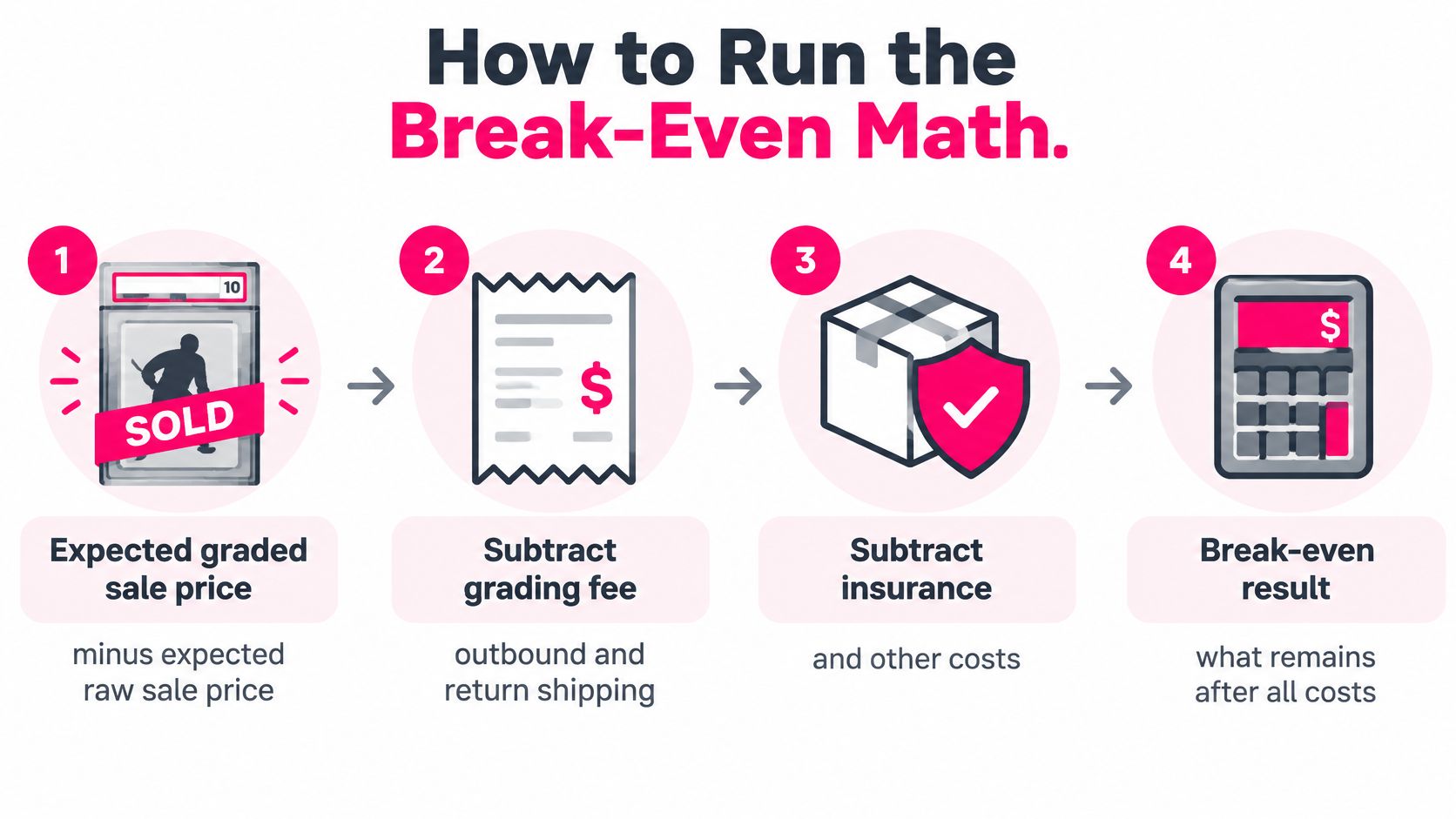
Expected grading advantage = probability-weighted graded proceeds − raw-sale proceeds − submission costs − holding cost.
Use net proceeds on both sides. If you subtract the entire graded selling commission but compare it with a raw price before commission, you're unfairly penalizing grading. Calculate each selling route consistently.
Start by establishing the exact card's market value. The guide to how much your trading card is worth helps organize that lookup before you attach a grading premium.
Build an outcome sheet
Create a row for each plausible grade. Enter your personal grade probability, a recent comparable sold price, and the transaction costs associated with that sale.
The arithmetic follows this sequence.
Your sheet should include:
- Weighted sale proceeds: Multiply each outcome's net sale proceeds by its estimated probability, then add the results.
- Submission expenses: Deduct grading, outbound and return shipping, insurance, packing, and any submission-related charges.
- Applicable taxes: Include costs that apply to your transaction, without treating marketplace-collected buyer taxes as your revenue.
- Capital commitment: Allow for what you give up by holding the card instead of selling it and using the cash elsewhere.
A card-grading analysis from Invest Alternative reports that approximately 43% of cards PSA graded in the first half of 2025 received a PSA 10; its separate $59.99 grading-fee illustration required roughly $75 more than raw to cover grading and marketplace-related costs.
That gem rate isn't your card's probability. Submitted cards have already been selected by their owners, and the mix includes different issues, eras, and conditions. Your copy's corner wear doesn't disappear because a substantial share of other submissions earned the top grade.
Test the miss, not just the hit
A large top-grade premium can justify submission when inspection supports it and the less favorable outcomes remain tolerable. But a spectacular sale at the highest grade shouldn't outweigh a likely loss at the grade your card resembles.
Also distinguish an illustration from a quote. The published cost example isn't a universal minimum, and it doesn't replace your shipping quote, insurance choice, selling platform, or selected service fee.
Run the sheet again with a less optimistic grade distribution. Then lower the expected selling prices and ask whether you would still accept the result.
Submit only when the weighted advantage is comfortably positive. A tiny theoretical surplus isn't enough compensation for uncertain grading, price movement, and the work of completing the sale.
What the Grading Wait Can Erase
The grading wait is a market position you can't readily exit. Once your card is in the submission process, you can't respond to an attractive buyer by immediately shipping it.
The service choice changes both the cash commitment and the exposure window.
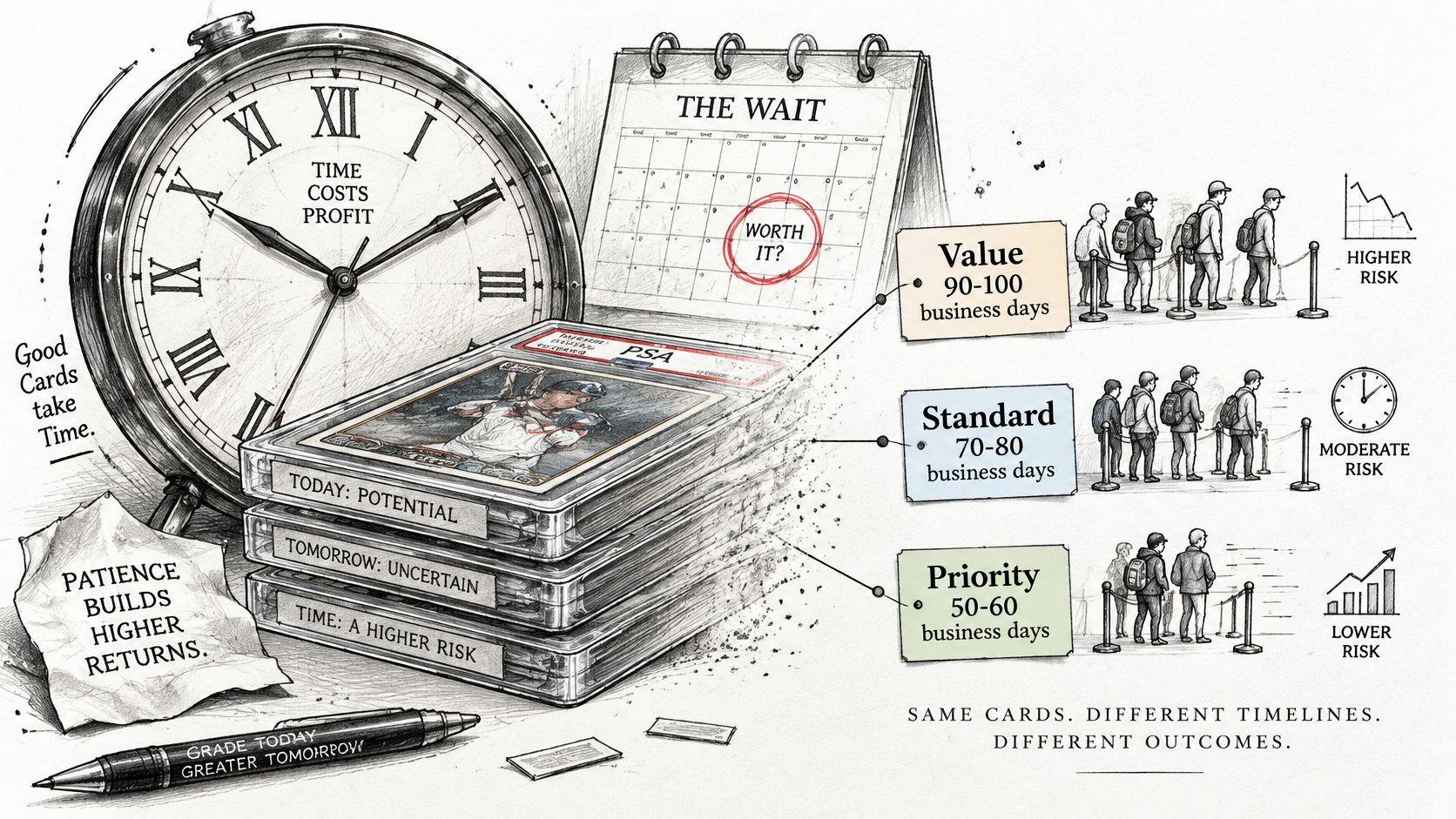
PSA's submission updates give recent estimates of 90–100 business days for Value, 70–80 for Standard, and 50–60 for Priority, creating an approximate two-to-five-month period without sale liquidity; PSA says volume, capacity, and unforeseen circumstances can affect those estimates.
Price the card for the return date
Don't assume today's premium will survive until you receive the slab. Buyers may shift attention to another release, more graded copies may become available, or sellers may cut prices while your card is unavailable.
A scarce, iconic Pokémon issue with established collector demand is better suited to waiting than a modern single whose premium depends on a sudden burst of attention. Neither is immune to declines, but the reasons buyers want them differ.
Record the raw and graded market at submission, then model a weaker selling environment. Apply that reduction to the expected sale proceeds rather than inventing a precise forecast.
Time-risk check: If a modest decline would erase the entire benefit, selling today is the stronger trade.
Use the video as supplementary context, not a replacement for your current service quote and card-specific calculation.
Faster service is worth considering only when the expected benefit of earlier access exceeds the additional fee. Paying more to receive an uneconomic card sooner doesn't improve the investment.
If you need the sale proceeds for a near-term expense or another purchase, treat that constraint seriously. A profitable-looking submission can still be the wrong use of your available cash.
ROI Scenarios Hobby Sellers Actually Face
The same grading service can be sensible for a valuable vintage card and wasteful for a handsome modern single. Judge the transaction, not the category's reputation.
Every row below is an illustration of the decision logic, not a listing quote or promised return. Replace the benchmarks with your own completed-sale evidence and actual submission costs.
Illustrated grading outcomes after full costs
| Situation | Raw benchmark | Graded outcome assumed | Cost pressure | Net call |
|---|---|---|---|---|
| Modest modern single, illustration | Recent raw sold comp | A modest premium at the likely grade | Grading consumes the gap before logistics and selling costs | Likely loss |
| Clean iconic with a wide top-grade gap, illustration | Established raw comp | Strong top-grade price, with meaningful lower-grade risk | Full friction must fit inside the weighted premium | Worth submitting only with a positive weighted net |
| Valuable vintage or fraud-sensitive card, illustration | High raw-sale benchmark | Buyers pay for authentication and comparable condition | Authentication benefit must exceed total expense | Worth it when trust improves net proceeds |
| Bulk cheap modern or short-lived hype card, illustration | Low or volatile raw price | Small uplift or a premium that may fade | Submission costs and time risk outweigh the improvement | Skip and sell raw |
Read the result in net dollars
For the modest modern single, the important result is a negative incremental net. The graded selling price can exceed the raw price while the seller still takes home less. Achieving the expected grade doesn't rescue a transaction that was underpriced from the start.
For the clean iconic card, the result is conditionally positive. Strong eye appeal supports further inspection, but submission earns its place only after the lower-grade outcomes receive honest weight.
The valuable vintage card has a different job. Authentication can make buyers more comfortable completing the purchase and comparing condition, so the highest grade isn't necessarily the source of value. Still, a large overall sale price doesn't excuse a negative incremental return.
For bulk cheap modern cards, the result is usually negative unless card-specific evidence proves otherwise. Combining weak candidates into a submission doesn't create demand or enlarge their individual premiums.
Handle the expensive-card exception
A card whose likely graded value exceeds the selected service's ceiling needs a fresh cost calculation. Don't keep the cheaper service assumption while using the more valuable graded outcome.
Also separate financial return from collecting enjoyment. Paying to preserve a personal favorite can be a reasonable hobby expense, even when selling it afterward wouldn't recover the cost. Just record that decision as collecting, not profitable inventory management.
Submit, Sell Raw, or Buy the Slab
So, is it worth getting cards PSA graded? Yes for selected cards, not as a default collection upgrade. The right decision ends with a choice among submitting, selling raw, and buying an existing slab.
Submit when you have an identifiable advantage
Choose submission when your inspection supports the grade distribution, completed sales support the premium, and the expected proceeds comfortably beat the raw alternative. Keep enough margin to tolerate a disappointing result or softer demand.
Save your condition photographs, comparable sales, service quote, and calculation. That record makes the decision auditable and helps you improve future grade estimates without rewriting your expectations after the result arrives.
Sell raw when the buyer can pay you now
Sell raw when the premium is thin, the card has visible problems, or competing slabs make your target price difficult to defend. A straightforward raw sale can be a better outcome than funding an uncertain submission.
Choose the selling route deliberately, too. Our guide to where you can sell your card collection can help you assess alternatives without assuming grading must come first.
Buy the slab when the slab is the goal
If you want a particular graded card for your collection, compare the cost of an existing example with the full expense and uncertainty of submitting a raw copy. Paying a known price avoids grade risk and lets you choose the actual card you'll own.
Check the certification number, label details, photographs, and comparable sold prices before buying. Don't pay a premium because the holder is familiar.
Your final submission decision should fit on a worksheet: raw proceeds, graded outcomes, personal grade odds, full expenses, and a downside case. If the expected advantage isn't convincing on paper, keep your money and choose another route.
We sell trading cards, sealed booster boxes, and PSA-graded cards, and all cards we sell are guaranteed authentic. If buying the finished slab makes more sense than funding a submission, visit Lucardio Collectibles and compare available graded cards with your all-in submission budget. Check the grade and certification details before choosing the copy you want to own.