
A Secret Rare copy from Reshef of Destruction carried a $30.14 marker in 2026 on TCG Index. That figure applies to one print, rarity, and product. It does not establish the value of a reissue, tournament print, or graded copy with the same card name.
The name “Knight Dark Magician” can point buyers toward releases across languages and formats. Match the specific printing, language, and rarity to the price: each copy needs its own verification, and the card name alone is not enough.
Table of Contents
- Dark Magician Knight Stats and Card Identity at a Glance
- How the Summon Trigger Changes Play and Value
- Print Runs and Release History Timeline
- Checking Edition, Rarity and Print Details
- Grading and Condition Checks That Set the Price
- Typical 2026 Market Prices by Variant
- Confirm the Copy Before You Buy or Sell
Dark Magician Knight Stats and Card Identity at a Glance
| Identifier | Value | Why It Matters for Collectors |
|---|---|---|
| Card type | Level 7 DARK Warrior/Effect Monster | Confirms the card's monster type and level during catalog checks |
| ATK / DEF | 2,500 / 2,100 | Stat line to compare against the physical card and reference scans |
| Summoning requirement | Special Summon only, using Knight's Title | Explains why it cannot be Normal Summoned or Set |
| Effect trigger | On Special Summon, target and destroy one card on the field | Core effect text to verify on any copy |
Start with what's printed, not what a seller calls it. The official Yu-Gi-Oh! card page for Dark Magician Knight identifies it as a Level 7 DARK Warrior/Effect Monster with 2,500 ATK and 2,100 DEF, the same headline combat values associated with the original Dark Magician, but with a different monster type and effect profile. That shared stat line explains the family resemblance. It doesn't make the two cards interchangeable in a catalog.
What Each Row Tells You in Hand
The Level 7 and Warrior typing are your fastest scan checks. Count the level stars, read the type line, then compare both against a reference image before you look at price. A mismatch on either field means you're holding a different card, a mislabeled listing, or a copy that needs closer inspection.
The summoning line matters just as much. This monster cannot be Normal Summoned or Set and must be Special Summoned using Knight's Title, with no other summoning method. For a cataloger, that restriction explains how the card is meant to enter play. For a buyer, it's another block of text to match word for word, because sellers sometimes photograph one Dark Magician variant and describe another.
Name confusion is the quiet risk here. Dark Magician the Dragon Knight and Dark Magician the Knight of Dragon Magic sound close enough to cause mix-ups in search results, binders, and marketplace titles. The exact name at the top of the card, paired with the effect wording, separates them.
Read the name, type line, and summoning restriction as one unit. If any one of the three doesn't match, stop and re-identify the card before discussing value.
Those four identifiers confirm what the card is. They don't yet confirm which printing you have, and that distinction drives everything that follows.
How the Summon Trigger Changes Play and Value
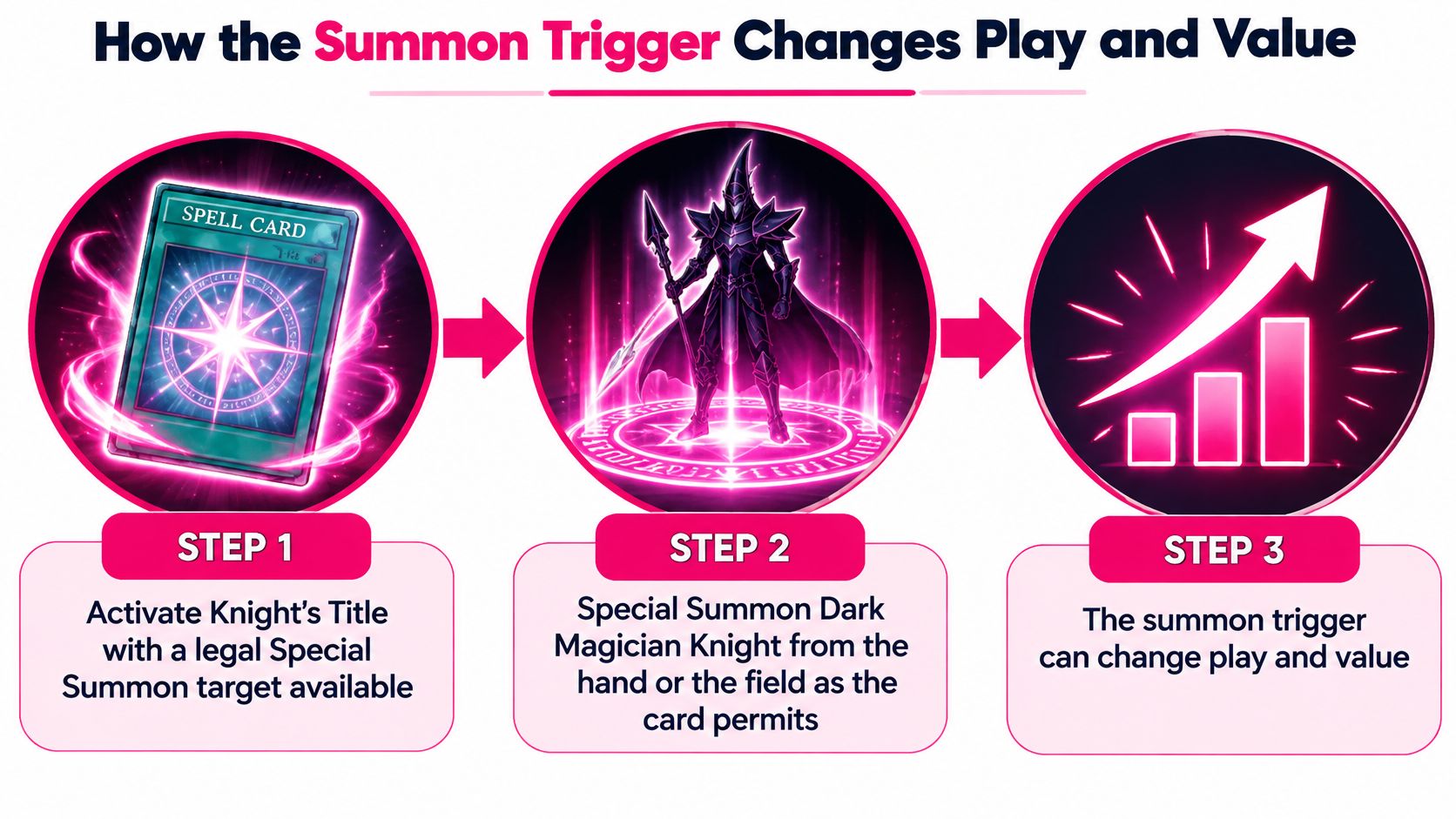
Dark Magician Knight's value in play depends on a single window: its effect activates when it is Special Summoned. The result is targeted removal attached to a 2,500 ATK monster, not an effect that generates value over multiple turns.
The Sequence Step by Step
- Activate Knight's Title with a legal Special Summon target available.
- Special Summon Dark Magician Knight from the hand or field as the card permits.
- Let the summon complete without disruption.
- Activate the trigger and target one card on the field.
- Destroy the target unless a replacement effect applies.
The official Yu-Gi-Oh! card database entry for Dark Magician Knight identifies the effect: when the card is Special Summoned, it targets one card on the field and destroys it. The effect provides one instance of removal, not repeated destruction. It can target an opposing monster, Spell, or Trap when that card is a legal target, though a replacement effect may prevent its destruction.
Timing determines whether the effect can resolve. Disruption that stops the summon prevents the trigger from providing removal. If Knight's Title resolves and the summon succeeds, the play turns its setup into a targeted removal effect and a large body.
Two Boards, Two Different Cards
If your opponent controls one monster and no backrow, the trigger can target that monster. The result is removal plus board presence, provided the target remains legal and destruction is not replaced.
If the opposing field is empty, the summon still produces a 2,500 ATK body, but the effect has no card to target. The difference in value comes from the board state, not a change to the card.
That dependency matters when evaluating a deck built around this Knight Dark Magician variant. The deck needs access to Knight's Title and situations where an opposing card can be targeted. Attack value alone does not show how often the summon will produce removal.
For collection records, capture the exact effect wording alongside the card's printing details. The summon trigger and targeted destruction describe how the card plays; the printing, language, and rarity identify which copy a listing is selling.
Print Runs and Release History Timeline
The listed releases span March 20, 2003, to January 10, 2015, across promotional, tournament, and collector products. Each entry is a separate identification problem: the card name alone does not establish its release, language, or rarity.
| Release | Format | Date | Notes |
|---|---|---|---|
| Reshef of Destruction pre-order promo | OCG promotional card | March 20, 2003 | Earliest documented appearance |
| Reshef of Destruction promo | English TCG promotional card | June 29, 2004 | About 15 months after the OCG debut |
| Yu-Gi-Oh! Double Pack | TCG promotional reissue | February 22, 2006 | About 20 months after the first TCG appearance |
| Tournament Pack 2009 Vol. 1 | OCG tournament product | April 1, 2009 | Tournament-format product |
| Tournament Pack 2011 Vol. 9 | OCG tournament product | June 22, 2011 | Tournament-format product |
| Legendary Collection 3 Yugi's World Mega Pack | TCG collector product | September 29 or October 2, 2012 | Date depends on catalog convention |
| Duelist Road, Piece of Memory, Side Yami Yugi | OCG collector product | January 10, 2015 | Later collector-oriented release |
The earliest listed OCG appearance is the Reshef of Destruction pre-order promo, dated March 20, 2003. The English TCG promotional card followed on June 29, 2004, roughly 15 months later. That gap creates the first distinction for a collector: an early Japanese copy and an early English copy belong to different release records, even when the card name matches.
The next listed TCG release is the Yu-Gi-Oh! Double Pack on February 22, 2006, about 20 months after the first English appearance. Record the product as well as the name. Otherwise, the original promo and later reissue can be conflated in a collection or price comparison.
The Long Middle of the Timeline
The listed OCG tournament products are Tournament Pack 2009 Vol. 1, dated April 1, 2009, and Tournament Pack 2011 Vol. 9, dated June 22, 2011. Their product identities distinguish them from retail and collector releases; the dates alone do not establish how many copies circulated.
The English collector release listed here is Legendary Collection 3 Yugi's World Mega Pack in 2012. The table preserves both catalog dates, September 29 and October 2, rather than treating them as interchangeable without identifying the convention used. The OCG timeline continues with Duelist Road, Piece of Memory, Side Yami Yugi, dated January 10, 2015.
Catalog rule. Record edition, product, language, rarity, and release date for every copy. A name-only record cannot distinguish the card's listed releases.
The timeline runs from 2003 through 2015 and includes promotional, tournament, and collector products. Rarity can also vary between printings, so a product match is only part of the identification. To connect a listing to a price, match the specific copy's product, language, and rarity rather than relying on “Dark Magician Knight” alone.
Checking Edition, Rarity and Print Details
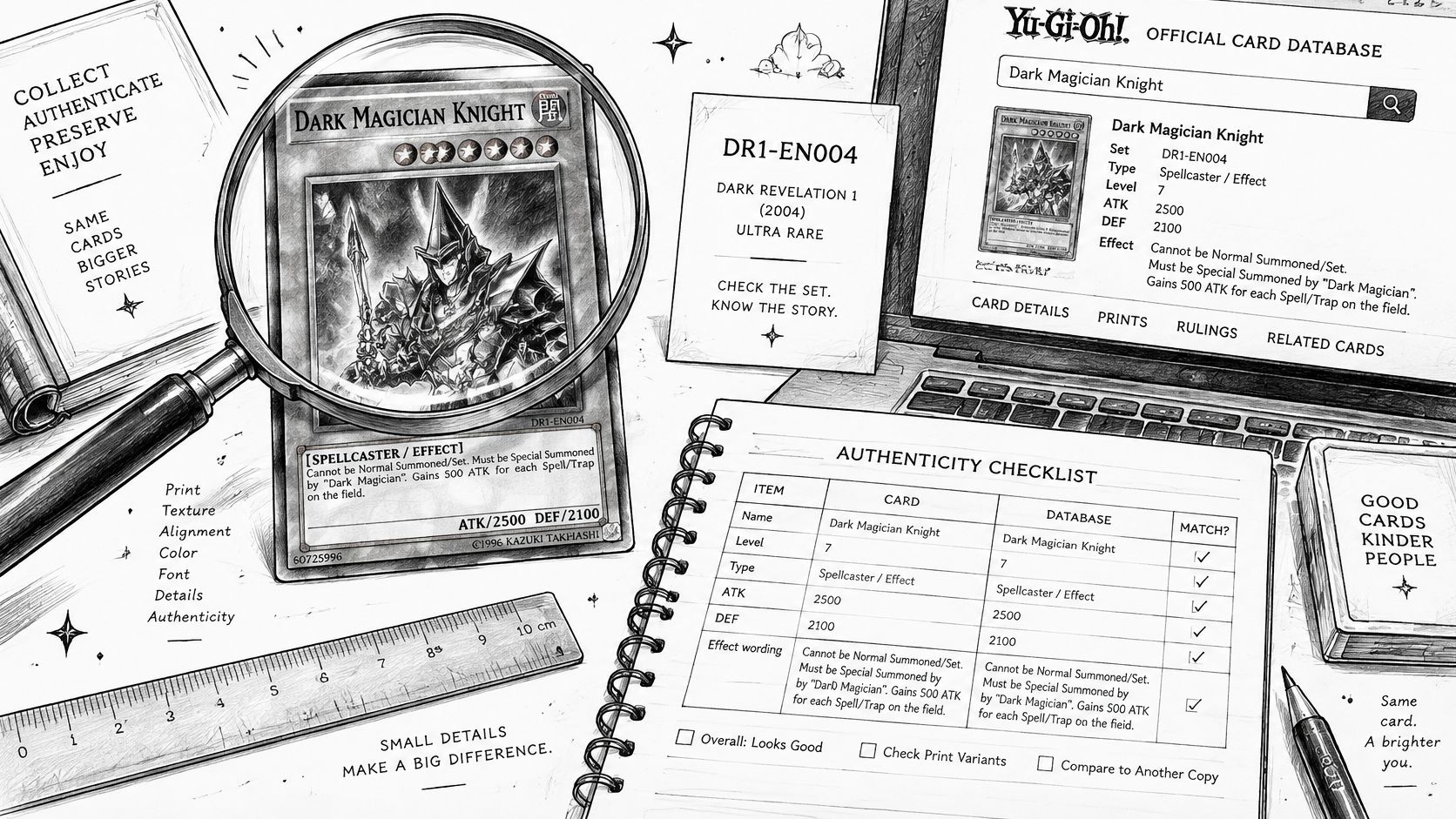
Begin with the text block, because it's the cheapest check you can run. Compare the name, level, type, stats, and effect wording against the official database entry for the card. If the wording on the physical copy doesn't match, don't negotiate yet. Identify what you're holding first.
Next, read the set code and print line and match them to a documented release. A set code that doesn't belong to the claimed product is a clear warning sign, no matter how convincing the artwork looks. Sellers make honest filing mistakes, and counterfeiters count on buyers skipping this step. Either way, the code settles the question faster than the photo does.
Rarity, Language and Surface Checks
Check the rarity against what the claimed product offered. A secret rare, a parallel print, and a standard print carry different values, and foil treatment is often the visible tell. If you're unsure how foil patterns should look and behave under light, the guide to identifying foil trading cards walks through what to look for before you pay.
Language is a pricing field, not a footnote. A Japanese-text card sold as English, or an English-text card attributed to an OCG product, changes both the buyer pool and the price. Read the card, don't rely on the listing title.
Then inspect the physical object. Look at the foil or holographic pattern, print quality, edges, and card back against reference scans from a trusted source. Hold the card at an angle under a lamp, since flat photos hide surface problems. Blurry text, off-register printing, or a back that feels wrong in weight or finish all justify walking away.
Keep two categories separate in your notes. A printing defect is not the same as a counterfeit, and a genuine defect can raise or lower value depending on severity and buyer interest. Mislabeling a defect as fake, or a fake as a defect, corrupts your price comparison either way.
A Checklist You Can Carry
- Edition and product. The claimed release matches a documented product.
- Rarity. The foil treatment fits what that product offered.
- Language. The card text matches the region of the claimed release.
- Set code. The code belongs to the named product.
- Text match. Name, stats, and effect wording match the official entry.
- Visible condition. Edges, surface, and back show no undisclosed damage.
Run those six checks at a shop counter, a show table, or from auction photos. If a seller can't provide images clear enough to complete the list, treat the missing information as risk you're being asked to absorb.
Grading and Condition Checks That Set the Price
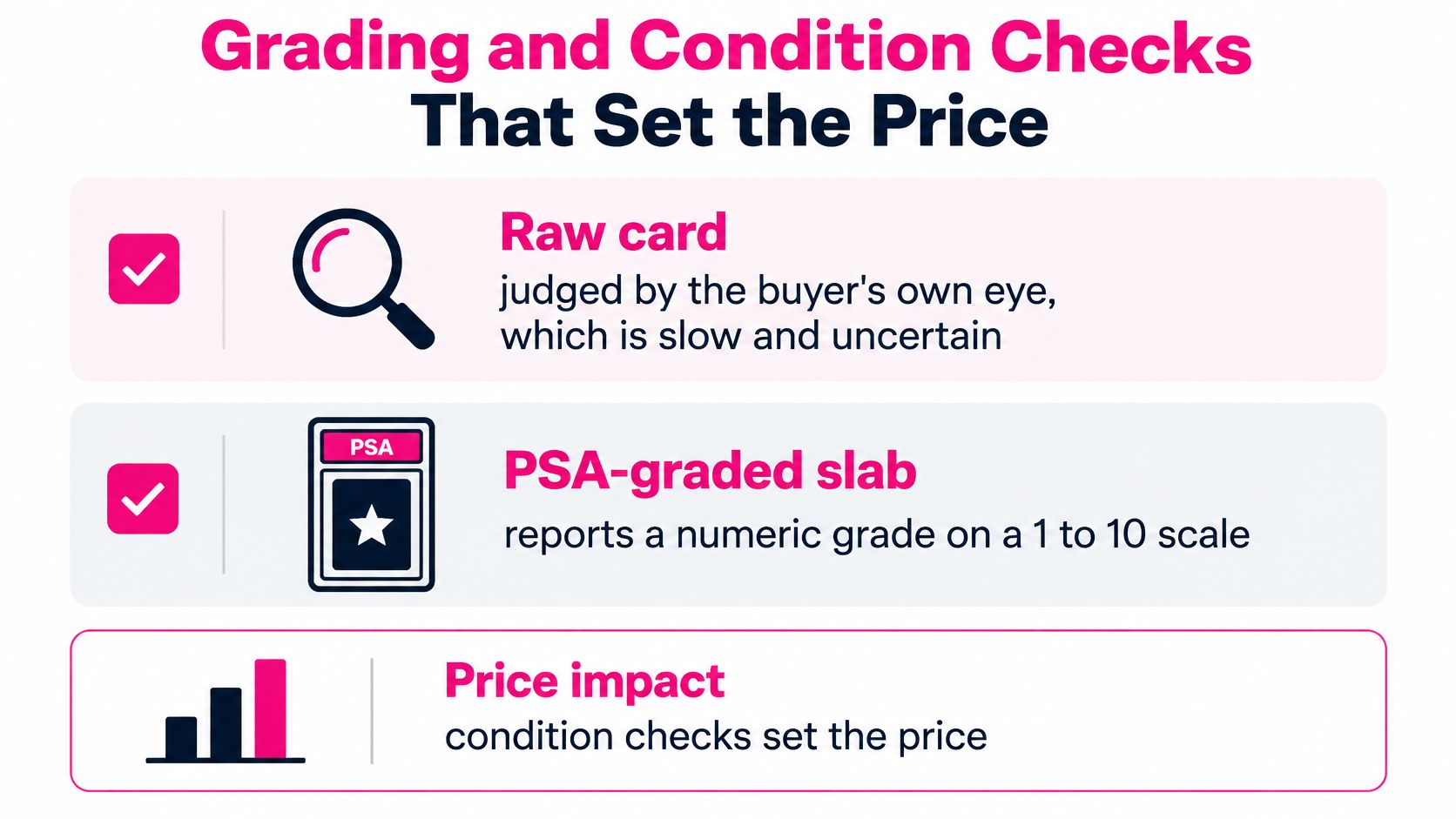
A raw card and a graded slab are priced by different logic. A raw copy is judged by the buyer's own eye, which is slow, subjective, and hard to do from listing photos. A PSA-graded slab reports a numeric grade on a 1 to 10 scale and seals the card in a holder, so two strangers can argue about price instead of arguing about condition.
Graders assess a consistent set of factors. Centering measures how evenly the artwork sits within the borders, while corners and edges capture handling wear. Surface covers scratches, print lines, and foil damage, and overall print quality catches defects that left the factory with the card. You can pre-check all five with a lamp, a magnifier, and a reference scan before you spend anything on submission.
How One Flaw Moves the Number
Say you have two copies of the same Knight Dark Magician printing. One is sharply centered with clean corners, and the other sits visibly off-center with a soft corner. They share a product, rarity, and language, yet they can land several grade points apart. That's why a price quoted for one copy tells you little about the other until condition is pinned down.
A PSA 10 generally commands a large premium over a PSA 9, but the size of that gap depends on the print and on recent sold data, not on the grade alone. For a clear breakdown of how those premiums form, see this overview of graded card prices and what drives them. Use it as a method, not as a shortcut. Your variant still needs its own comparable sales.
A grade you can't verify is just a number in a listing. Confirm the certification before you price the slab.
Fake holders are a known tactic, so verify the grade and certification number through the grader's lookup before paying. Check that the label details match the card inside, including product and variant. If the number doesn't resolve or the description conflicts with the physical card, stop the transaction.
If you own a raw copy you're considering grading, work backward. Estimate the likely grade from centering, corners, edges, and surface. Then compare grading cost and turnaround against the expected price difference between that grade and a raw sale. Grading a mid-condition copy of a common reissue often locks in a loss. Grading a clean early promo can be the opposite, but only your pre-check tells you which case you're in.
Typical 2026 Market Prices by Variant
| Variant | Product | Price Reference | Source and Date |
|---|---|---|---|
| Secret Rare | Reshef of Destruction promo | $30.14 | TCG Index, 2026 |
| Standard TCG print | Yu-Gi-Oh! Double Pack | No verified price available | No current source recorded |
| Collector print | Legendary Collection 3 Yugi's World Mega Pack | No verified price available | No current source recorded |
| PSA-graded copy | Any printing with PSA certification | No verified price available | No current source recorded |
The only supported 2026 figure here is $30.14 for the Reshef of Destruction Secret Rare, listed by TCG Index. That figure applies to this specific printing, not every card called Dark Magician Knight. No current checkable figure is recorded for the Double Pack print, the Legendary Collection 3 print, or PSA-graded copies.
A blank price is not evidence that a copy has little value. It means the matching sale data is missing. For a practical method to estimate what a trading card is worth, start with completed sales for the same printing, language, rarity, and condition.
The name alone is too broad for a useful comparison. Product and print identify the card first; rarity, language, and condition then narrow the comparable sales. A Reshef Secret Rare and a later reprint should not share a price estimate just because their names match.
Record the source and date beside each price. Then compare multiple completed sales for the exact variant. The $30.14 marker is a reference point for one row, not a substitute for evidence on the others.
Confirm the Copy Before You Buy or Sell
Verification works best as a fixed sequence, because excitement at a good price tends to reorder your priorities. Run the checks in order and let a failure at any step end the deal. The card will still exist tomorrow. A bad purchase is harder to unwind.
The Five-Step Decision Sequence
- Pass the print checks. Set code, language, and rarity must match a documented release, and the name, stats, and effect text must match the official entry.
- Confirm any grade. Verify the certification number and label details for a slabbed copy before discussing its premium.
- Compare recent sales. Pull two or three completed sales for the same variant and grade, and note the date of each.
- Decide on evidence. Buy when print, text, and condition all match and the asking price sits within the recent range.
- Mirror the process as a seller. Run the same checks to set a fair starting price and reduce disputes after the sale.
The walk-away triggers are just as specific. Leave the deal if the set code doesn't fit the claimed product, if the holder can't be verified, or if the asking price sits well above recent sales for the same variant. None of those problems gets better after payment. A seller who resists providing clear photos of the set code, card back, or label is asking you to fund their uncertainty.
Sellers benefit from the same discipline. Photograph the set code, foil pattern, corners, and card back clearly, state the product and language in the title, and disclose defects before a buyer finds them. Listings for this Knight Dark Magician card that lead with identification details attract buyers who know which printing they want. Those buyers dispute less and pay closer to asking, because the copy matches the description they searched for.
One final caution ties the whole process together. A blank price cell for your variant means there's no current verified data, not that you've found a bargain or an overlooked treasure. Gather the missing comparisons yourself, date them, and only then set your number. The collectors who do well with multi-print cards aren't faster. They're more specific.
Before your next purchase, put the checklist to work on authenticated singles, sealed products, and PSA-graded items at Lucardio Collectibles, where verified authenticity, insured fulfillment, and collection management tools help you confirm exactly which printing you're buying. Browse upcoming drops, live auctions, and graded inventory there, and bring the same print, rarity, and certification checks from this guide to every listing you consider.