
Magmortar LV.X doesn't refer to a video-game level. It's a Pokémon TCG card mechanic from the Mysterious Treasures expansion, while Magmortar itself evolves through an item-and-trade requirement rather than a fixed Magmortar level.
So why does a search for “Magmortar level X” produce two completely different kinds of answers? One collector may be trying to evolve Magmar in a Pokémon game. Another may be identifying a vintage card, checking its burn effect, or comparing raw and graded prices. The phrase joins two hobbies through one misleading label.
That distinction matters before you buy, grade, sell, or write a listing. This guide separates the video-game evolution method, the level-up move tables, the Magmortar LV.X card, and the unreliable price signals surrounding it. Think of “level” as a word that changes meaning depending on whether you're standing in a game menu or sorting cards in a binder.
Table of Contents
- Why Magmortar Level X Confuses So Many Collectors
- What Level X Actually Means in Pokemon Games and Cards
- How Magmortar Evolves and What It Learns by Level
- The Magmortar LV.X Card From Mysterious Treasures
- Why Magmortar Level X Prices Vary So Sharply
- Smart Ways to Buy Grade or Sell Magmortar Level X
- Your Next Steps as a Magmortar Collector
Why Magmortar Level X Confuses So Many Collectors
A collector types magmortar level x into a search box after seeing a card listing. The result sounds like it might identify a Pokémon reached at a particular level, perhaps the level where Magmar becomes Magmortar. Then the card appears, with “LV.X” printed as part of its name, and the confusion deepens.
The problem is a split search intent. Game players want to know how Magmortar is obtained or which moves it learns by level. TCG collectors want to know what the Magmortar LV.X card is, how its effect works, and whether a price is sensible. Those questions overlap in vocabulary but not in mechanics.
Practical rule: If “LV.X” appears in a card name, read it as a TCG classification first, not as the Pokémon's in-game level.
A Magmortar LV.X card belongs to the level-up era of the Pokémon Trading Card Game. It isn't evidence that the Pokémon evolves at a particular video-game level. Conversely, a game guide listing a move at a certain level isn't describing a card designation or a graded collectible.
That separation also helps when you read marketplace descriptions. A seller may use “Magmortar level X” as shorthand for the card, while a player may use the same words while searching for evolution instructions. Before comparing prices, confirm whether you're looking at a Mysterious Treasures single, an in-game Magmortar, or a move learnset.
The useful path is straightforward: identify the context, verify the exact card or game generation, inspect the condition, and only then interpret the price. Collectors researching related cards can also compare the terminology with this guide to Salamence LV.X cards, another example of the same TCG-era naming convention.
What Level X Actually Means in Pokemon Games and Cards
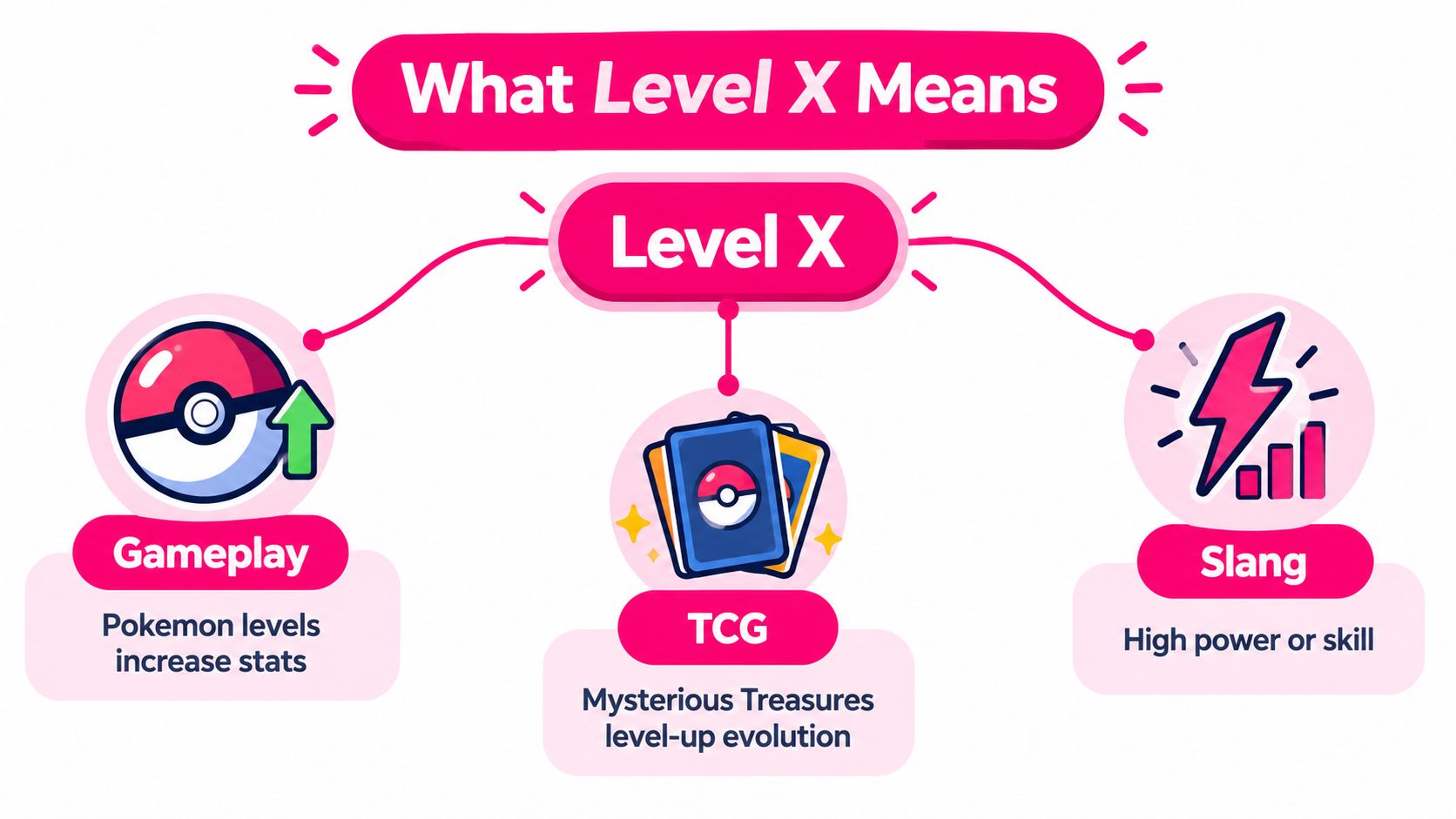
Why can “Magmortar level X” refer to a card, an evolution method, or a move level? The answer is that one phrase crosses two systems. Its meaning depends on the words around it.
First, LV.X is a Pokémon TCG level-up mechanic. In this setting, Magmortar LV.X is a special card form, not a character reaching a numbered level. The card belongs to the Mysterious Treasures expansion, a Diamond & Pearl-era set released in 2007.
Second, Magmortar's video-game evolution is not tied to a fixed Magmortar level. Magmortar is obtained by item trade, not by level. The dedicated evolution details matter because the exact requirement varies by game.
Third, a numbered level can describe when Magmortar learns a move. That is a learnset entry, not an evolution requirement and not a card classification. For example, “Magmortar level 49” may identify when it learns Flamethrower in one generation, rather than when the Pokémon is obtained.
A useful analogy is the word “draft.” In a sports league, it concerns player selection. In a legal document, it means a version of a text. “Level X” works the same way. Identify the setting before interpreting the term.
| Term | What it means | What it does not mean |
|---|---|---|
| Magmortar LV.X | A TCG level-up card classification | A video-game evolution level |
| Magmortar level | A game character level or learnset entry | A card grade or market category |
| Magmortar evolution | A family progression governed by game mechanics | A universal level threshold |
The surrounding vocabulary usually settles the question. “Mysterious Treasures,” “Poké-Power,” and “damage counters” indicate the TCG. “Magmarizer,” “trade,” and “Magby” indicate a game mechanic. “Flamethrower,” “Fire Blast,” and a numbered level point to a generation-specific learnset.
Collectors comparing related terminology can also review this guide to Salamence LV.X cards. It shows the same naming convention in another TCG-era card context.
How Magmortar Evolves and What It Learns by Level
The Magby line has three stages: Magby, Magmar, and Magmortar. The first transition uses a level threshold. Magby evolves into Magmar at level 30, but the final transition works differently in the mainline games.
To obtain Magmortar, Magmar must be traded while holding a Magmarizer. That means a player can have a Magmar at a high level and still not have a Magmortar until the item-and-trade requirement is completed. The method isn't a universal “reach level X” event.
Pokémon Legends: Arceus handles the same family relationship differently. There, the trade requirement is replaced by using a Magmarizer directly, showing why game version matters when you write an evolution guide or interpret a product description. The underlying evolutionary family stays the same, but the action required by the player changes.
Learnset levels depend on generation
Levels become relevant again when you examine moves. In sixth- to seventh-generation data, Magmortar learns Flamethrower at level 49, Fire Blast at level 55, and Hyper Beam at level 62, according to the Magmortar Generation IX move reference, which also contrasts generation-specific tables.
A Generation IX listing places those moves at different points: Flamethrower at level 46, Fire Blast at level 58, and Hyper Beam at level 64. It also lists Lava Plume at level 34 and Sunny Day at level 52.
Those differences aren't an error to smooth over. They're a warning against presenting one chart as universal.
- Flamethrower offers a consistent special Fire option.
- Fire Blast trades reliability for greater burst potential.
- Hyper Beam brings high nominal power but requires a recharge turn.
- Lava Plume and Sunny Day appear at generation-specific positions in the newer listing.
If you're preparing gameplay notes, always name the generation. If you're writing card metadata, don't attach one of these game levels to Magmortar LV.X. A move learnset describes a particular video-game ruleset, while LV.X describes a physical TCG card.
The Magmortar LV.X Card From Mysterious Treasures
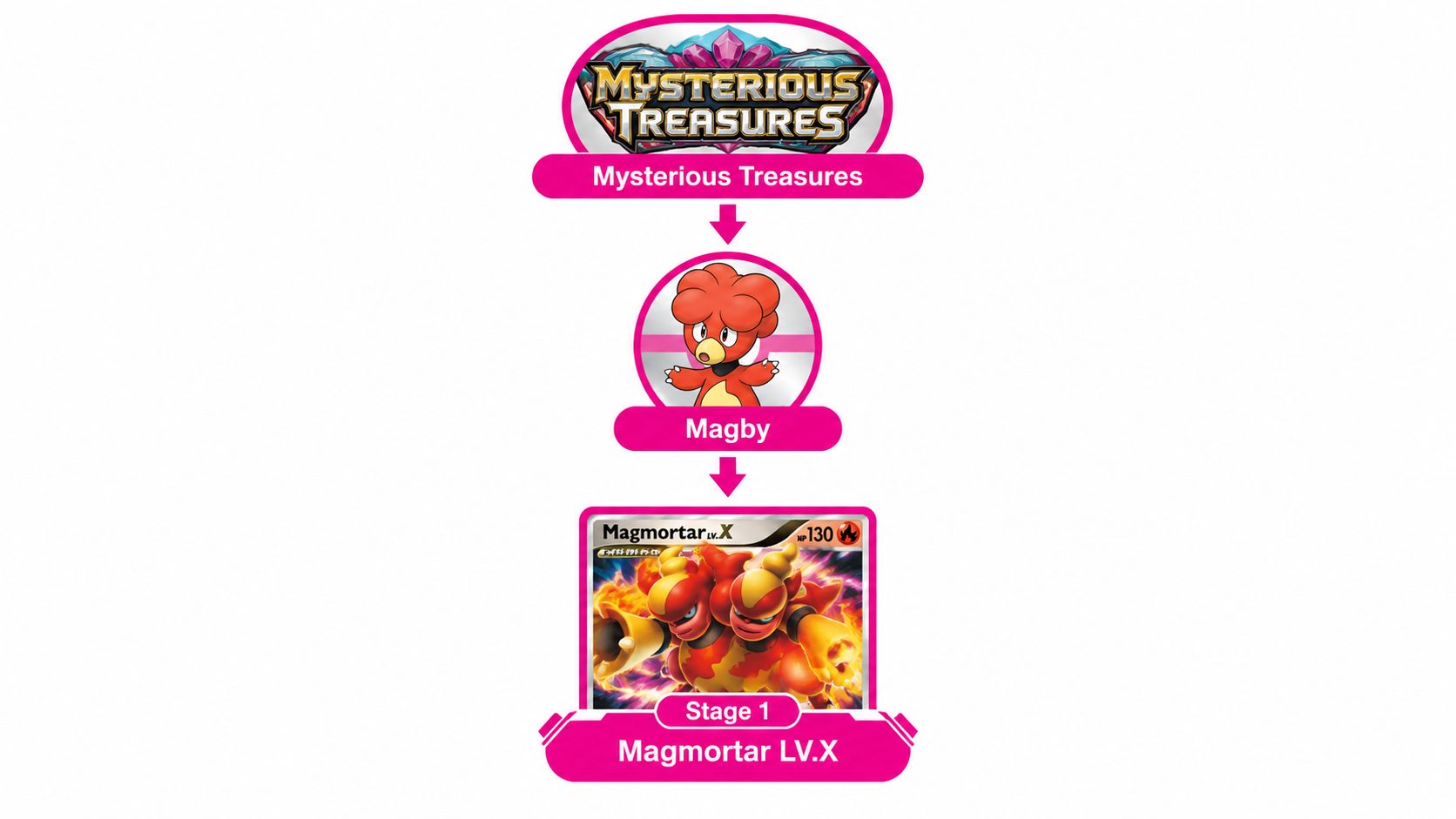
What makes Magmortar LV.X different from an ordinary Magmortar card? It is a level-up card from the Mysterious Treasures expansion, so its “level-up” label describes how it enters play in the TCG, not a video-game level. The distinction is easy to miss in a listing, yet it changes both the card's rules and the way collectors should identify it.
Its defining feature is a Burn enhancement. When the relevant Poké-Power applies, a Burned Pokémon receives 3 damage counters instead of the standard 2 between turns. With each counter representing 10 damage, recurring damage rises from 20 HP to 30 HP per cycle, a 50% increase, before coin-flip-based Burn removal or other effects are considered. The card text and details are shown in the Mysterious Treasures Magmortar LV.X reference.
Burn damage is the point
The effect strengthens damage over time, rather than Magmortar's immediate attack power. Its value depends on applying Burn consistently and keeping Magmortar LV.X in the active or otherwise relevant board position until the between-turns effect occurs.
A direct attacker deals its threat at once. Magmortar LV.X supports a status-based plan, where the opponent's condition creates repeated pressure. Burn removal uses a coin flip, and other effects may interrupt the sequence, so the printed bonus is not guaranteed damage in every position.
Identify the object before valuing it
A collector should verify the card itself before considering price:
- Condition, including surface wear, edge damage, and centering.
- Edition and language, which identify the version.
- Certification, if the card is encapsulated.
- Print identification, including the correct expansion and card details.
These checks prevent a basic category error. Magmortar LV.X is a vintage TCG object with specific card attributes, not Magmortar at a particular video-game level. That difference also explains why gameplay evolution and a collectible card can describe the same Pokémon while answering different questions.
Why Magmortar Level X Prices Vary So Sharply
A price page can make this card look easy to value. The available figures say otherwise. One tracker reports roughly $38.70 ungraded and approximately $18,000 for PSA 10, while another reports a market price near $70.27 and says Magmortar cards rose 86.5% year to date and 6.7% over the previous 30 days, as shown on Cardtrack's Magmortar price page.
Those figures aren't a clean price ladder. They may represent different data pools, conditions, time windows, or methodologies. An active asking price isn't the same as a completed transaction, and a high graded estimate can be especially fragile when comparable sales are scarce.
| Price Figure | Likely Meaning | Buyer Caution |
|---|---|---|
| Roughly $38.70 ungraded | A raw-card estimate from one tracker | Raw condition varies substantially, so the label may combine very different copies |
| Near $70.27 market price | A separate market estimate | Confirm whether the figure reflects completed sales, listings, or a blended calculation |
| Approximately $18,000 PSA 10 | An extreme graded estimate | Treat it as a possible low-liquidity signal, not a guaranteed clearing price |
Why thin liquidity changes the story
A low-population vintage card can show a dramatic percentage movement after only a small number of relevant sales. That doesn't automatically prove broad demand or lasting appreciation. It may just mean that one unusual copy, one motivated buyer, or one isolated auction has a large influence on the displayed estimate.
A headline price describes a data point. It doesn't promise that your copy will sell at that number.
Before paying a premium, ask four questions:
- Are the comparisons raw or graded?
- Do the copies match in language, condition, and certification?
- Are the figures based on completed transactions or active asking prices?
- How many comparable sales support the estimate, and when did they occur?
A buyer who wants a deeper framework for separating slab quality from headline pricing can use this guide to graded card prices. The central lesson is simple. A very large gap between raw, market, and top-grade estimates should make you investigate liquidity, not assume automatic investment value.
Smart Ways to Buy Grade or Sell Magmortar Level X
Start with the card, not the price. Confirm that the copy is the Mysterious Treasures Magmortar LV.X and check the language, visible numbering, holo pattern, and any certification details. A vague listing that uses “Magmortar level X” without clear photographs deserves more scrutiny because the phrase can hide confusion between a game reference and a TCG card.
Choose raw or graded with a reason
A raw card gives you direct control over inspection, but you accept uncertainty about the final grade and authenticity. An already-certified slab costs more when the market recognizes the grade, yet it gives you a defined encapsulated condition and a certification trail to verify.
Inspect a raw copy under strong, angled light:
- Centering: Compare the borders rather than judging from a quick glance.
- Surface: Look for scratches, dents, print lines, and pressure marks.
- Edges and corners: Check whitening, lifting, bends, and impact points.
- Holo area: Tilt the card to reveal scratches that disappear under flat light.
- Authenticity: Compare the print details and card construction with trusted references.
Don't submit a card for grading because an automated estimate shows a dramatic PSA 10 figure. Submit it because the copy's condition, provenance, and likely grade justify the cost and waiting time.
Match the selling method to the evidence
If you sell, document the exact card and condition before setting an asking price. Separate raw comparisons from graded comparisons, record the date of each comparable transaction, and flag outliers instead of building your whole valuation around the highest result.
Live breaks and real-time auctions can create energy around collectibles, but participation doesn't remove the need for authentication or a clear description. A card-management tool such as a Card Vault can also help you organize slabs and retain condition notes, which becomes valuable when you later insure, trade, or sell the collection.
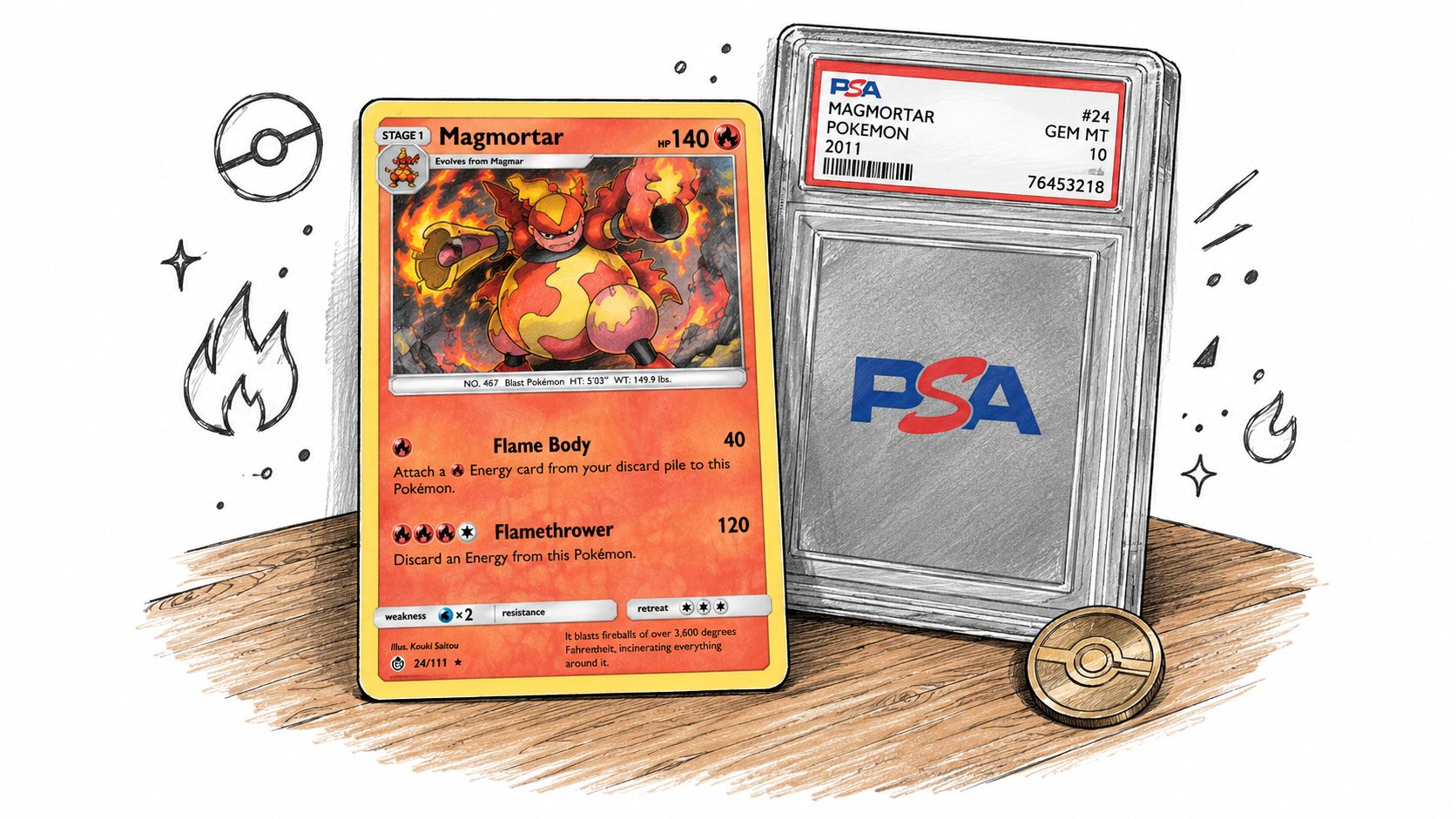
Before purchasing a slab, compare the certification information with the photographed card. Before selling one, photograph the slab and card clearly, disclose flaws, and avoid implying that a price estimate is a guaranteed outcome. You can also review PSA graded cards for sale to see how certified inventory is presented, while still checking each item individually.
Your Next Steps as a Magmortar Collector
Keep three ideas separate. LV.X is a TCG card mechanic, Magmortar's game evolution depends on the specific game's rules, and a displayed price is only useful when you know what transactions produced it.
If you're researching the card, identify the Mysterious Treasures printing first. If you're playing a game, check the evolution method and generation-specific learnset. If you're buying or selling, compare like with like, raw against raw and graded against graded, while recording condition, language, certification, and transaction timing.
A confident collector doesn't chase the largest number on a price page. They verify the object, understand the mechanic, inspect the condition, and treat thin-market estimates as uncertain until comparable sales support them.
Lucardio Collectibles brings together authenticated Pokémon singles, sealed products, and PSA-graded items with live breaks, real-time auctions, insured fulfillment, and collection tools such as Card Vault. Visit Lucardio Collectibles to explore verified inventory and manage your collection with more confidence.