
In 2026, PSA 10 Moonbreon completed sales run roughly $3,150-$3,900, with market-value trackers near $3,550 and reported medians at $3,888-$3,900. Those figures describe different sales samples and valuation methods, not a guaranteed price for every slab.
The important question isn't which number looks most authoritative. It's whether the underlying transactions match the card you're buying, whether the price includes fees, and whether the seller can document the slab's identity. A defensible Moonbreon PSA 10 price starts with completed sales and ends with a certification check.
Table of Contents
- Moonbreon PSA 10 Price at a Glance
- How to Read Moonbreon Price Numbers
- Historical Sales and Market Liquidity
- PSA 10 Value Against Raw and Other Grades
- Population Report and What Rarity Really Means
- Demand Drivers Behind the Price
- How to Track and Verify Moonbreon Prices Safely
- Where to Buy, Sell or Win One in 2026
Moonbreon PSA 10 Price at a Glance
The price comparison applies to the English Umbreon VMAX Alternate Art Secret Rare #215/203, not every Umbreon card sold under the Moonbreon nickname. Ultraball's English Evolving Skies record identifies the card as part of the 2021 expansion and reports an estimated PSA 10 value near $3,550, alongside a raw near-mint benchmark near $1,785.
Moonbreon PSA 10 price snapshot for 2026
The benchmarks below separate estimates, medians, individual transactions, and an ungraded comparison. They're useful together, but they aren't interchangeable measurements.
| Benchmark | Value | Source | Basis |
|---|---|---|---|
| PSA 10 market value | ~$3,550 | CardTrack | 2026 tracker estimate |
| PSA 10 median | $3,888 | PokeInvest | 183 sales in 2026 |
| PSA 10 median | $3,900 | Sales ledger | 439 completed PSA 10 sales |
| Recent PSA 10 sales | $3,150-$3,400 | November 2026 transactions | Individual completed sales |
| PSA 10 fair-value range | $2,705-$4,590 | CardTrack | 22-month sales window |
| Raw near-mint | ~$1,785 | Market tracking | Ungraded comparison |
The market-value estimate is a tracker's assessment, not a promise that a buyer will pay that amount today. Use it as a reference when the newest transactions are sparse or inconsistent.
A median describes the middle of a particular sales sample. It can remain above the newest completed transactions when the sample includes stronger earlier sales or a different mix of marketplaces.
The individual completed sales are more specific: they show where particular buyers and sellers agreed. They deserve attention when negotiating a comparable slab, although a small cluster doesn't establish the value of every copy.
What the snapshot does and doesn't establish
The fair-value band provides broader context rather than a recommended shopping interval. Its upper boundary isn't evidence that an ordinary listing deserves a premium, and its lower boundary isn't a guaranteed floor.
The raw benchmark answers a different question altogether. It helps you compare buying an already graded card with accepting the condition uncertainty of an ungraded copy.
Practical rule: Identify the exact card, grade, language, and certification number before deciding whether a listing is cheap or expensive.
For a purchase, auction reserve, or promotional valuation, record the transaction date and price basis beside the figure. A completed sale without that context can be just as misleading as an ambitious asking price.
The snapshot is therefore a starting framework: recent comparable sales for negotiation, medians for context, and modeled estimates as a reasonableness check. None substitutes for inspecting the particular slab.
How to Read Moonbreon Price Numbers
Two trackers can disagree without either making an error. They may collect different transactions, apply different exclusions, or summarize different periods. Before comparing their headline figures, identify what each figure measures.
PokeInvest reports a 2026 PSA 10 median of $3,888, based on 183 sales, for Umbreon VMAX #215. That tells you the center of its recorded sample. It doesn't tell you the cheapest available copy, the seller's net proceeds, or the amount you'll spend after checkout.
Separate the price types
| Price type | What it tells you | Main limitation |
|---|---|---|
| Asking price | What a seller currently wants | A buyer may never accept it |
| Completed sale | What a recorded transaction cleared at | Fees and payment status need checking |
| Median | The middle observation in a defined sample | Results change with the sample |
| Fair-value estimate | A tracker's modeled assessment | Methodology may differ between trackers |
| Seller proceeds | What the seller retains | Selling costs reduce the headline amount |
An asking price is useful for assessing available inventory and competition. It isn't proof of value. A seller can leave an overpriced slab listed while buyers transact elsewhere.
A completed sale is stronger evidence, but inspect its context. A listing marked sold can still require scrutiny for accepted-offer reporting, duplicate records, unusual shipping terms, or a subsequent relisting.
Normalize the amount before comparing
Hammer price is the winning auction bid before additional charges. All-in price includes applicable buyer's premiums, shipping, taxes, and currency conversion.
Those differences matter because the buyer and seller can describe the same transaction with different totals. For your buying decision, calculate your checkout cost; for your selling decision, calculate proceeds after marketplace charges and fulfillment expenses.
Use a consistent comparison sheet:
- Record the price basis. Mark each transaction as hammer, item-only, or all-in.
- Keep currencies separate until conversion. Record the exchange-rate basis rather than treating different currencies as equivalent.
- Flag missing information. An unclear accepted offer shouldn't carry the same weight as a transparent auction result.
- Separate estimates from observations. Don't average a modeled valuation together with actual transactions.
A larger sales sample helps reduce dependence on an unusual auction, but size alone doesn't make a sample clean. A carefully filtered set of matching slabs is more useful than a large collection of mixed languages and grades.
The working approach is straightforward: use completed-sale medians and ranges to value the card, then use asking prices to understand your current alternatives. Don't turn unlike measurements into a single average merely because each appears beside the same card name.
Historical Sales and Market Liquidity
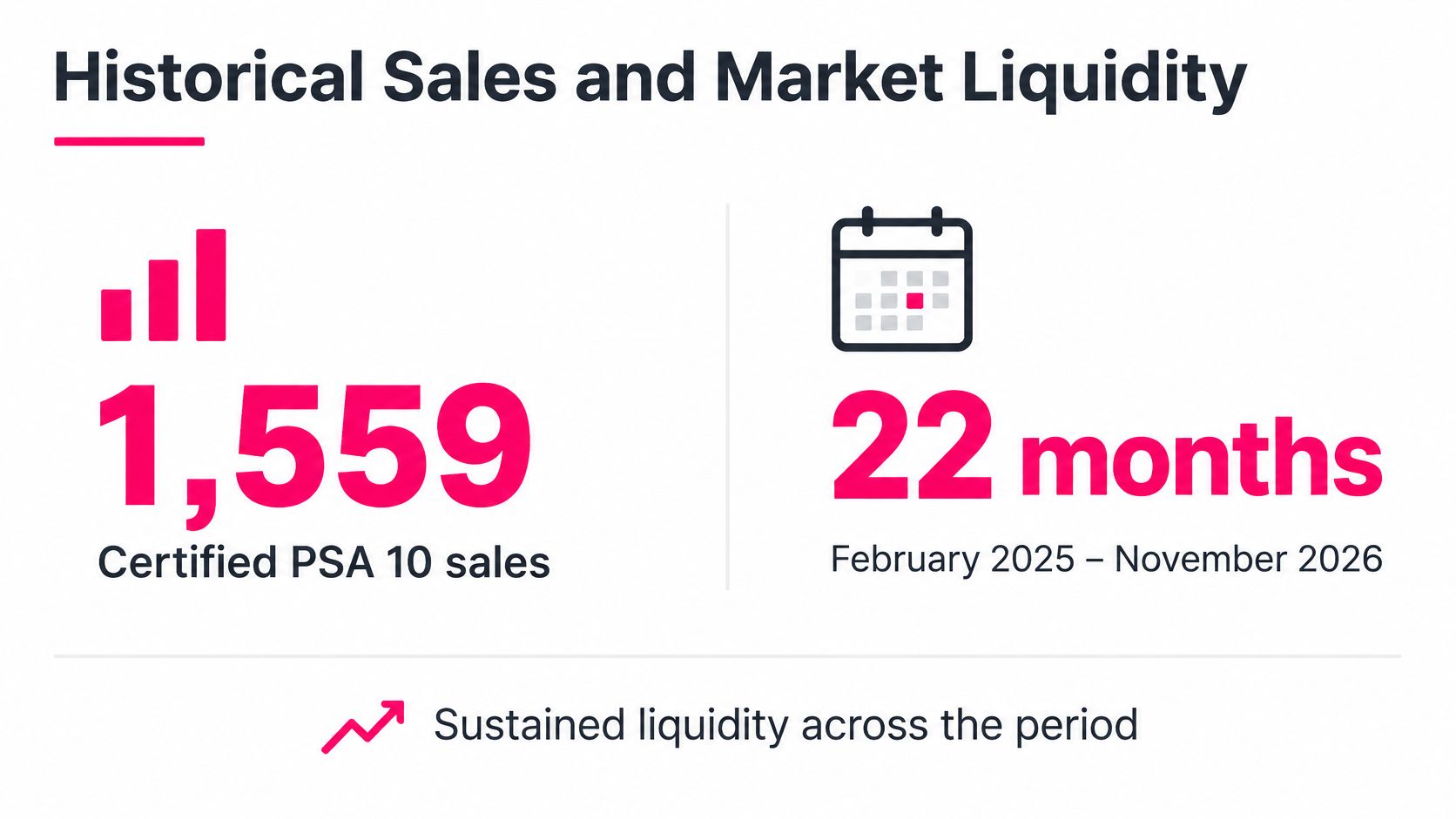
Moonbreon's pricing record is substantial enough to analyze beyond headline auctions. CardTrack's PSA 10 record reports 1,559 certified PSA 10 sales across 22 months, from February 2025 through November 2026, providing evidence of recurring transaction activity rather than an isolated sale.
The historical volume is summarized below.
Read transaction counts within their scope
Sales volume makes comparison possible, but it doesn't eliminate judgment. A tracker counting the card across multiple conditions answers a different question from a ledger filtered strictly to PSA's top numerical grade.
Don't add overlapping tracker totals together. The same marketplace transaction may appear in more than one database, and the same physical slab may change hands repeatedly. Recorded sales aren't a count of unique cards or unique collectors.
Volume also doesn't guarantee an immediate exit at your preferred price. A seller who needs a quick transaction may accept less than someone prepared to wait, even when both own comparable slabs.
What the individual transactions establish
The same CardTrack record includes PSA 10 transactions at $3,312.43 and $3,150 on November 11, 2026, and a CGC 10 transaction at $2,737 on November 12, 2026. These are observations about particular transactions, not universal conversion rates between grading companies.
The important analytical distinction is between evidence of activity and evidence of direction. Numerous sales support the conclusion that buyers participate regularly. Establishing a rising or falling trend requires comparable observations through time, with consistent treatment of fees, marketplaces, and grading labels.
For example, newer sales below an older median warrant investigation. They don't, by themselves, prove that every owner must now accept the lower price. Check whether the sample changed, whether the slab had presentation issues, and whether earlier higher sales still reflect current buyer behavior.
A liquid collectible is easier to benchmark. It isn't automatically easy to sell at yesterday's valuation.
For a broader framework, our guide to graded-card prices helps distinguish a card's identity from the grade-specific evidence needed to price it.
The useful conclusion is narrower than a bullish sales pitch: Moonbreon has enough recorded activity to support disciplined comparison. That makes selective quoting harder to justify. Buyers and sellers should be able to explain why their chosen transactions belong in the comparison set.
PSA 10 Value Against Raw and Other Grades
Buying raw and buying PSA 10 are different decisions, even when the artwork is identical. CardTrack's card-level valuation places the PSA 10 English Umbreon VMAX #215/203 at approximately $3,550 in 2026. That is a valuation of an already graded format, not an expected payout from submitting an ungraded card.
Moonbreon value by grade and format
| Format | Recent value | Notes |
|---|---|---|
| Raw near-mint | ~$1,785 | Ungraded; carries grading risk |
| CGC 10 | $2,737 (Nov 12, 2026) | Different label; not a PSA 10 comp |
| PSA 10 recent low | $3,150 (Nov 11, 2026) | Completed sale below the 2026 medians |
| PSA 10 median | $3,888-$3,900 | 2026 medians from 183-439 sales |
| PSA 10 fair-value high | $4,590 | Top of the 22-month band |
The raw-to-graded gap isn't automatically available as profit. To realize the PSA 10 benchmark, a raw buyer must first obtain the required grade, while also paying submission-related costs and accepting the possibility of a different result.
Near-mint is a seller's condition description, not a grading guarantee. Review centering, corners, edges, and surface under suitable lighting, and remember that photographs can hide dents, scratches, and print defects.
Don't infer a grading-company exchange rate
The CGC transaction belongs in a comparison of available formats, but not in a PSA-only median. A shared numerical grade doesn't establish identical buyer preferences, grading standards, or resale behavior.
Nor does an individual lower-priced sale prove that every card bearing that label deserves the same discount. To price another grading company's slab, collect that company's own completed sales for the exact card and label designation.
| Buyer priority | More relevant decision |
|---|---|
| Owning the artwork at lower entry cost | Evaluate raw condition and seller documentation |
| Owning the specified PSA grade | Compare verified PSA 10 slabs directly |
| Buying another grading label | Build a separate label-specific sales sample |
| Submitting a raw card | Evaluate possible outcomes, not only the desired grade |
A PSA-graded purchase reduces uncertainty about the assigned grade, but it doesn't remove every purchase risk. You still need to authenticate the holder, match the certification, inspect presentation, and assess the seller.
The practical verdict is that PSA 10 is the correct benchmark for a PSA 10 listing. Raw cards and other holders are alternatives, not substitutes within the same average. Choose the format that fits your objective, then value that format on its own evidence.
Population Report and What Rarity Really Means
Approximately 69% of the reported PSA-graded population is PSA 10, according to MoonstoneHQ's English Moonbreon tracker, which reports roughly 31,889-31,930 total graded copies and 21,974-22,029 PSA 10 copies. That changes the rarity argument: the grade isn't exceptionally scarce within the submitted population.
PSA population report for English Moonbreon #215/203
| Measure | Figure | Share or note |
|---|---|---|
| Total PSA-graded copies | 31,889-31,930 | English #215/203 only |
| Graded PSA 10 | 21,974-22,029 | ~69% of graded population |
| Population trend | Dynamic | Submissions, resubmissions, and cracked slabs change counts |
A population report measures grading records. It doesn't measure how many owners want to sell, how many buyers are actively searching, or how much inventory is available at a particular price.
That's why a large graded population doesn't impose a fixed price ceiling. Owners can retain their cards while buyers compete for the smaller selection currently offered. Equally, additional listings can weaken a seller's negotiating position without any immediate change in the grading population.
The denominator matters
The reported gem rate describes submitted cards, not all copies printed and not every raw copy available online. Submitters choose what to send, so the graded population is a selected group.
You can't turn that share into your personal probability of receiving the same grade. A raw listing with visible defects doesn't inherit the population's outcomes.
Population counts also require a date. New submissions, resubmissions, cracked holders, and corrections can change the record, and a tracker may refresh on a different schedule from the grading company's report.
For inventory records, preserve:
- Population observation date. Note when you checked the report.
- Exact card identity. Keep language, set, number, and description together.
- Certification and images. Connect the population category to the physical item you're valuing.
- Market observation date. Keep the sales analysis contemporaneous with the population check.
Rarity check: Graded population is neither current marketplace inventory nor a forecast of future selling pressure.
The defensible interpretation is that buyers pay for more than scarcity of grade. Artwork, character preference, familiarity, and the ability to compare transactions can support demand even when many copies share the same grade.
That also creates a risk worth recognizing. If buyer interest softens, a seller can't rely on an extremely small graded population as the main defense of their asking price.
Demand Drivers Behind the Price
Moonbreon's appeal begins with a recognizable visual subject: Umbreon reaching toward the moon. The nickname gives collectors a convenient way to discuss the artwork, but an analyst still needs the precise card identity beneath that shorthand.
The distinction matters because recognition and scarcity aren't the same thing. Buyers can strongly prefer a card that many other collectors own. A familiar collectible may attract interest because it fits a collecting goal, not because its owner can claim near-exclusive possession.
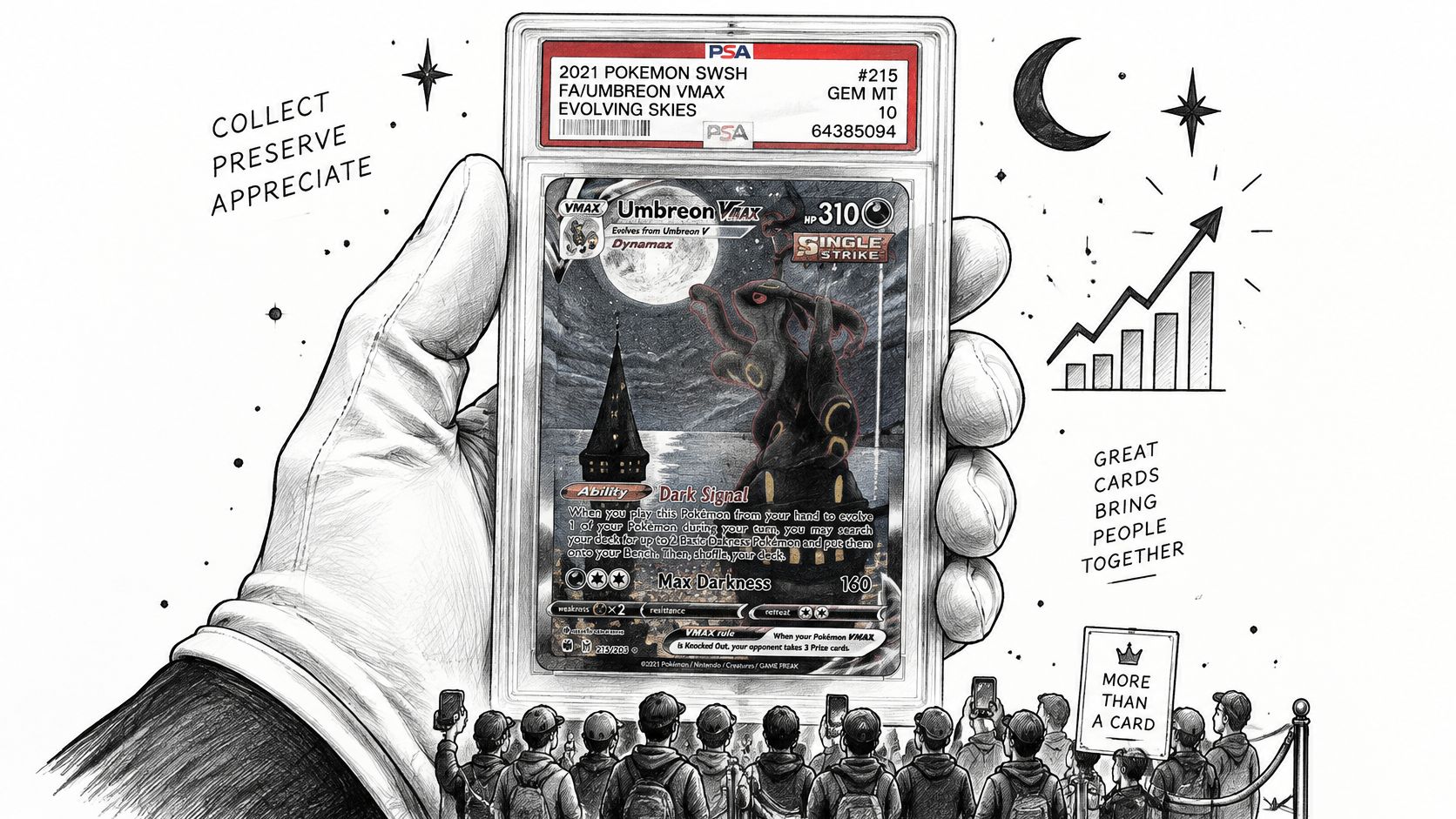
The image below illustrates the card's visual identity and its presentation as a graded collectible.
Separate plausible drivers from measured causes
Artwork, the Umbreon character, Pokémon collecting, and the Evolving Skies set identity are reasonable factors to consider. The available transaction records don't isolate how much of the purchase price each factor explains.
That limits the claims a careful analyst should make. Calling the card recognizable is different from claiming that social visibility caused a measurable price increase. Likewise, repeated sales demonstrate participation, not a guaranteed stream of new buyers.
Liquidity can influence a buyer's decision without promising appreciation. Someone may prefer a well-documented collectible because they can inspect comparable sales and understand possible exit prices more clearly than they could for an obscure item.
Provenance supports the transaction
For an ordinary graded copy, documentation should first establish that the seller possesses the pictured item and that its description is accurate. Purchase receipts, reputable-dealer records, and clear holder photographs can reduce uncertainty.
They don't automatically justify a collectible premium. A seller asking more because a slab has a documented history should explain why that history matters beyond ordinary proof of ownership.
The same discipline applies to presentation. A clean holder and detailed photography can make a transaction easier to evaluate, but they shouldn't be treated as evidence of a higher card grade.
Demand explains why collectors may want Moonbreon; competition among actual buyers determines what a particular listing clears for. Those are related but distinct ideas. Enthusiasm for the artwork can coexist with a cautious bid, especially when the buyer has comparable verified alternatives.
The strongest investment argument therefore isn't that the nickname guarantees enduring value. It's that the card is sufficiently identifiable and actively traded to let a buyer make an evidence-based decision, while remaining exposed to changes in collector preferences.
How to Track and Verify Moonbreon Prices Safely
Treat valuation and authentication as connected tasks. A convincing price comparison is worthless if the listing shows the wrong printing, a borrowed certification image, or a holder that doesn't match the seller's description.
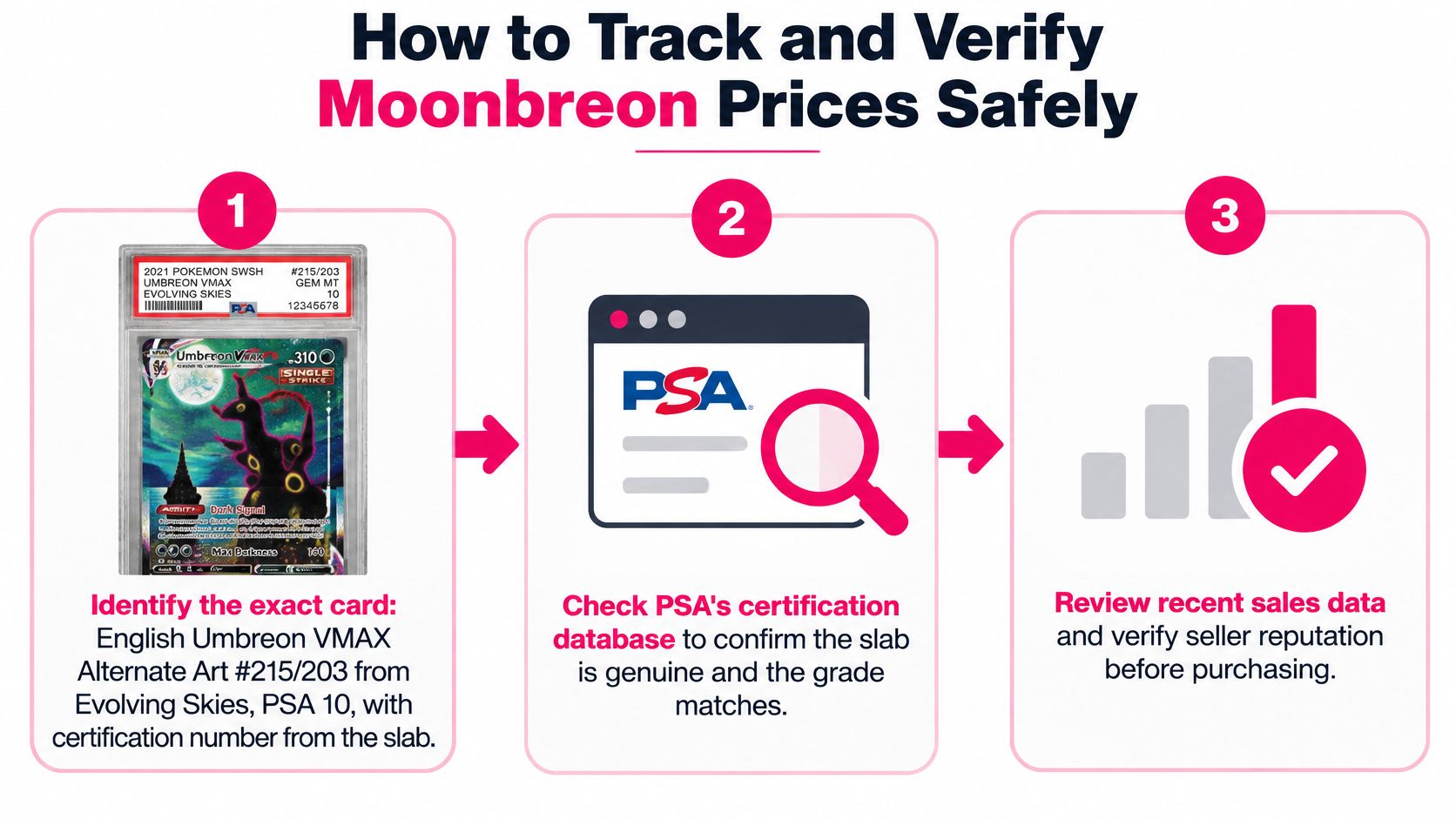
This visual summarizes the main checkpoints.
Build an auditable comparison
Identify the exact item. Copy the card name, language, set, card number, grade, and certification number from the label into your worksheet. Compare that information with the card itself rather than trusting the listing title.
Pull completed sales from independent tracking tools over the same recent period. Record the underlying marketplace where available, because different trackers may reproduce the same transaction.
Filter by grading company and grade. Keep raw copies and other grading labels in separate tabs. A cleaner sample is more useful than a larger mixed average.
Investigate outliers before removing them. Wrong-language cards, lots, damaged holders, or unclear price reporting may explain an unusual result, but an inconvenient low sale isn't automatically invalid.
Check the certification through PSA's certification lookup. Match the returned description and available images against the seller's item, including label details and visible features. A valid number alone doesn't prove that the pictured holder is genuine or that the seller possesses it.
Save the population-report date with your valuation date. Keep screenshots or notes showing what you checked so you can refresh the analysis without reconstructing it from memory.
Calculate a median and observed range, then set your own buying limit or selling threshold. Keep acquisition costs, selling costs, and required proceeds separate from the card's gross transaction value.
Test the listing, not just the number
Ask for fresh front-and-back photographs if possession or condition is unclear. A seller should be able to show the actual slab rather than relying entirely on stock images or a certification screenshot.
Our guide to how to spot a fake PSA slab provides additional holder-focused checks. Use those alongside seller feedback, payment protections, and the marketplace's dispute process.
The video is an additional viewing resource, not a substitute for verifying the item you're considering.
Watch for wrong-language substitutions, certification photographs reused across listings, and stale sold listings presented as current inventory. If a card reappears after an apparent sale, investigate whether the original transaction completed before treating it as a reliable comp.
Authentication answers whether the item matches its description. Valuation answers what comparable buyers paid. You need both.
Your final worksheet should let another collector understand the conclusion without taking your word for it: exact item, dated observations, selected transactions, exclusions, price basis, and a documented verification result.
Where to Buy, Sell or Win One in 2026
Choose the transaction route according to your objective. Buying secures a specific item, selling converts an item into proceeds, and entering a prize draw offers a chance rather than ownership. Treating those as equivalent ways to acquire value leads to poor spending decisions.
The checklist below summarizes the different decisions involved.
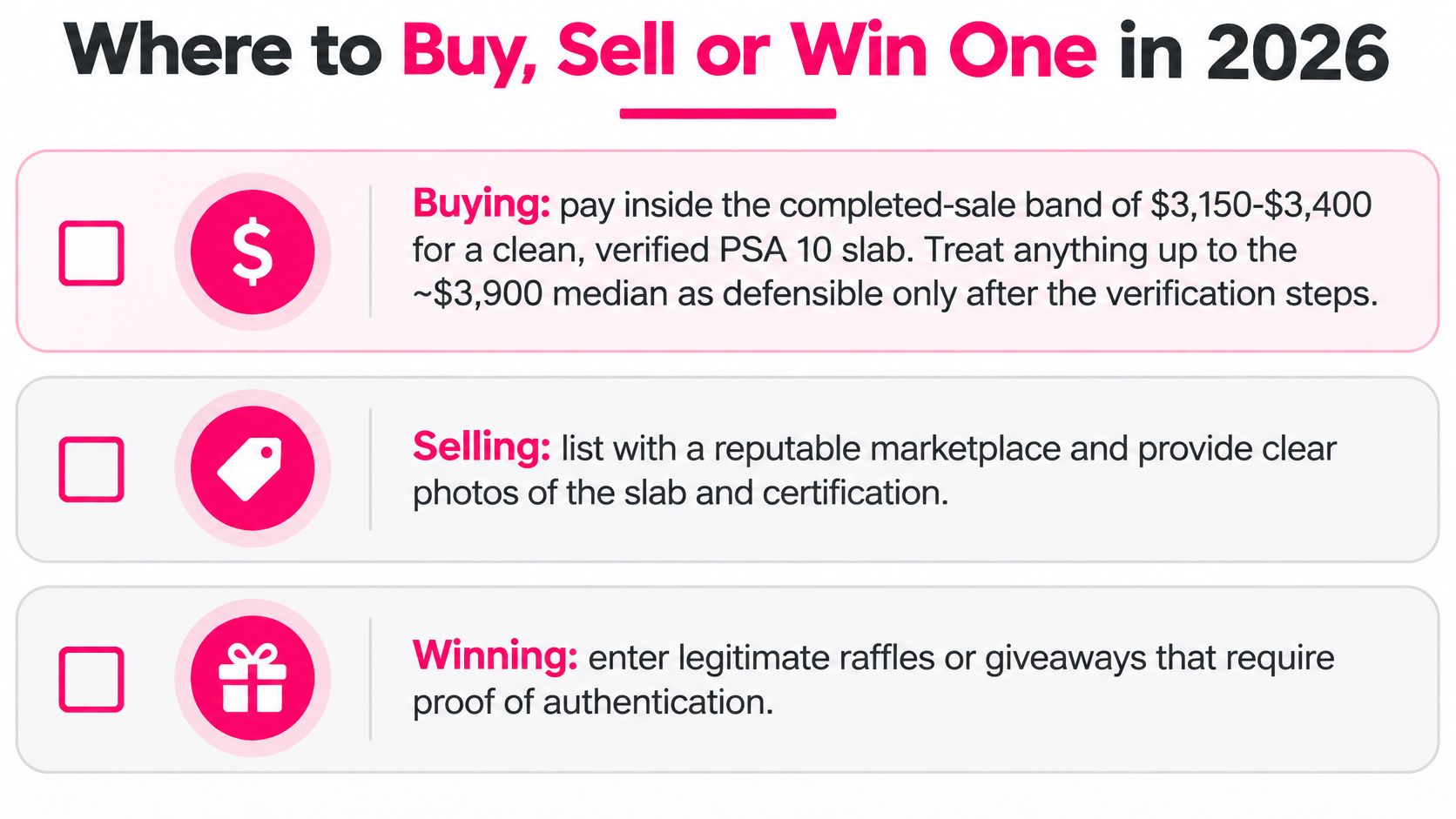
Buying and selling require different limits
For a purchase, use established card marketplaces, reputable specialist dealers, or auction venues where you can inspect the actual item and understand buyer protections. Compare the total checkout amount with your selected completed transactions, not just the headline listing price.
A higher price can be defensible if the transaction offers something you value, such as clearer documentation or more suitable purchase terms. It isn't defensible merely because another seller asks more.
For a sale, determine the proceeds you need before choosing an asking price. Provide readable label photographs, full front-and-back slab images, and an accurate description of any holder damage.
| Your intent | Decision to make before committing |
|---|---|
| Buy | Maximum all-in cost for the verified slab |
| Sell | Minimum acceptable net proceeds |
| Enter a draw | Maximum discretionary entry spending |
| Compare alternatives | Whether you want this exact grade or simply the artwork |
Avoid pricing against the highest visible ask unless actual transactions support it. If you need a prompt sale, judge your offer against competing verified inventory as well as historical results.
Our guide to PSA-graded cards for sale can help you evaluate listings by their documentation rather than their promotional language.
Prize draws aren't a valuation shortcut
A valuable prize doesn't make every entry worthwhile. Review the rules, entry cost, eligibility, available odds, closing terms, and how the winner receives the item before spending.
At Lucardio Collectibles, a PSA 10 Moonbreon is one of the prizes offered in our weekly prize draws. We also sell trading cards, sealed booster boxes, and PSA-graded cards. Those are distinct options, so choose according to whether you want a specific collectible or participation in a draw.
Subscribing is free and gives access to free giveaways, early access to new drops, and collector updates. Don't confuse that subscription with a guarantee of winning or with the terms of any separate promotion.
Before committing, save the listing, confirm the certification, and write down your spending limit. A well-supported valuation is useful only if you apply it when a countdown, auction, or appealing photograph encourages you to stretch beyond your plan.
We offer trading cards, sealed booster boxes, and PSA-graded cards, with a PSA 10 Moonbreon among our weekly prize-draw prizes. Visit Lucardio Collectibles to explore the offerings and subscribe free for giveaways, early access to new drops, and collector updates. Before purchasing or entering a draw, check the item's documentation and the applicable terms against your own budget.