

A Mosaic hobby box is Panini's premium sealed format, typically built around roughly 10 packs of 15 cards with about 2 guaranteed autographs and 20 inserts. Depending on the year and sport, you're looking at roughly $250 to $550, which means the core question isn't what's inside, but whether the rip makes financial sense.
The popular advice is to study the checklist, memorize every parallel, and chase the biggest autograph. That's useful only after you've answered the harder question: what can this box realistically return, and how quickly can you sell the cards that matter?
Mosaic looks expensive because it offers chrome shine, colorful parallels, and a dense hit profile. It can also be a frustrating purchase because the product spreads value across a large number of cards, while only a small portion of those cards carry meaningful resale demand. A box can feel full without being profitable.
That distinction matters whether you're buying a sealed box, joining a break, grading a pull, or deciding between one rip and several targeted singles.
Table of Contents
- Why the Mosaic Hobby Box Question Is Really About Value
- What a Mosaic Hobby Box Actually Is
- Typical Box Contents and Hit Odds
- Hobby vs Retail vs First Off the Line
- Chase Inserts and Hobby-Only Parallels
- Grading, Resale, and Singles Versus Sealed
- Live Breaks and the Case for Ripping on Camera
- Should You Rip, Hold, or Buy Singles Instead
Why the Mosaic Hobby Box Question Is Really About Value
Most buyers ask, “What can I pull?” Experienced buyers ask, “What has to happen for this purchase to break even?”
That's the difference between checklist browsing and actual hobby math. A Mosaic hobby box may include two autographs, a stack of inserts, and a range of Prizms, but those cards don't have equal value. A base autograph of an unproven player can be almost irrelevant to resale, while a low-numbered rookie parallel may carry the entire box's economics.
The box price is therefore only the starting point. Your rough calculation should include:
- Expected singles value, based on recent sales rather than optimistic asking prices.
- Hit concentration, because a few rare parallels often account for most of the upside.
- Player demand, especially for rookies whose markets can change quickly.
- Selling friction, including listing time, platform fees, shipping, and negotiation.
- Personal utility, meaning the entertainment value of opening the product live or on camera.
Mosaic's standardized format makes the product easy to compare, but it doesn't remove variance. A box gives you access to potential upside, not a balanced basket of desirable cards. The sealed purchase is closer to a controlled gamble than to buying inventory at wholesale cost.
Practical rule: If you'd be disappointed owning most of the cards on the checklist, don't buy the box. Buy the specific cards you actually want.
The sealed-pack psychology discussed in Lucardio's guide to sealed packs explains why unopened products remain attractive even when singles offer cleaner value. Opening creates an experience, a story, and the possibility of a major hit. Those benefits are real, but they belong in your entertainment budget, not in your expected resale return.
Mosaic is a rational rip for a collector who values the opening experience, enjoys parallels, and accepts that the outcome may underperform the purchase price. It's usually an irrational purchase for someone who wants a specific rookie, a particular color, or a reliable store of value.
What a Mosaic Hobby Box Actually Is
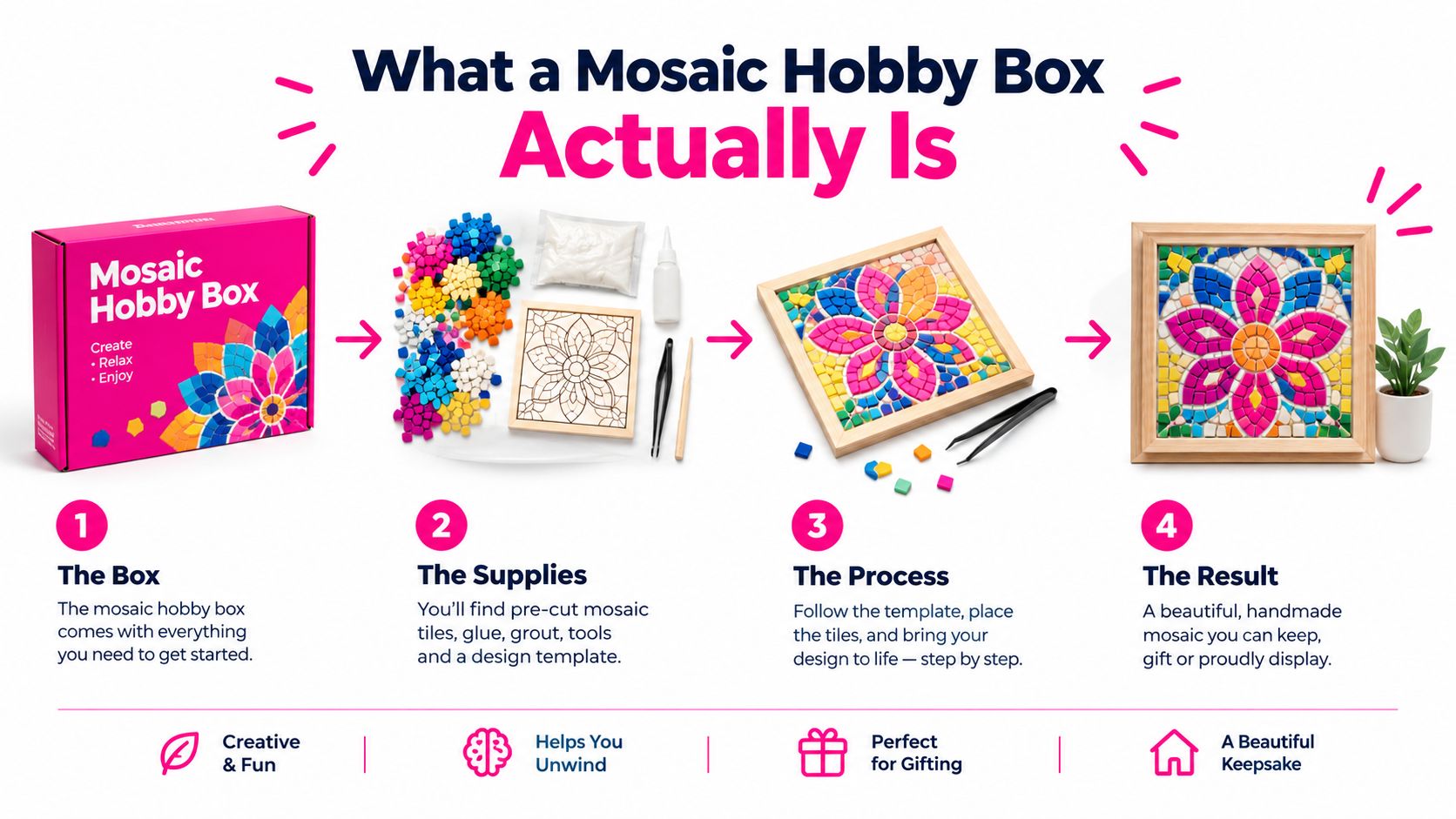
A Mosaic hobby box is the premium hobby-channel configuration of Panini's chromium-style Mosaic product line. It's designed around a small number of packs, a concentrated hit structure, and access to parallels or autograph content that may not appear in the same form across retail releases.
The exact build changes by year and sport. A 2024/25 Mosaic Basketball hobby box is listed with 3 packs of 15 cards, while a 2023/24 basketball configuration used 10 packs of 15 cards, with an expected autograph, 20 parallels, and 20 inserts per box, as documented by Cardboard Connection's Mosaic checklist review. The lesson is simple: never assume that one year's pack configuration applies to every Mosaic release.
The format changes by release
The 2024/25 basketball listing guarantees 2 autographs, 18 Base Prizms, and 6 inserts or insert parallels on average, which makes that configuration attractive to collectors who want both autograph access and a substantial parallel run. The product details are available from the listed 2024/25 Mosaic Basketball hobby box.
A 2025 Mosaic NFL hobby configuration is described with 10 packs of 15 cards, plus 2 autographs, 20 inserts, 15 Mosaic Prizms, and 5 silvers on average in the supplied product information. Those guarantees create a denser experience than a casual retail rip, but they still don't guarantee that the cards will be desirable on the secondary market.
Mosaic has appeared across major sports, including basketball, football, soccer, and other licensed releases. The visual identity stays recognizable, while the rookie class, autograph checklist, licensing, and player demand change with each sport and season.
What the box does not guarantee
A guaranteed autograph isn't the same as a guaranteed valuable autograph. A guaranteed Prizm isn't automatically a short print. Even a colorful card may have limited resale demand if the player lacks a collector base.
That's why the box should be treated as a hit-access product, not a guaranteed-value product. You're paying for exposure to the product's rarest cards, alongside a large quantity of cards whose value depends on player performance and collector taste.
Typical Box Contents and Hit Odds
The contents vary enough that a single universal Mosaic box formula would be misleading. Some releases emphasize autograph content, while others provide more inserts or Mosaic Prizms. The reliable approach is to read the exact product configuration for the year you're considering, then separate guaranteed averages from genuine scarcity.
For example, the 2024/25 basketball configuration lists 2 autographs, 18 Base Prizms, and 6 inserts or insert parallels on average, while the 2025 football configuration lists 2 autographs, 20 inserts, 15 Mosaic Prizms, and 5 silvers. Those figures describe average box contents, not a promise that every buyer receives an equally strong assortment.
Mosaic Hobby Box Hit Odds by Tier
| Hit Tier | Per Hobby Pack Odds | Per Hobby Box Odds | Print Run |
|---|---|---|---|
| Base cards and rookies | Varies by release | Varies by release | Generally not serial-numbered |
| Base or Silver Prizms | Varies by release | Listed as an average in some configurations | Varies by release |
| Mosaic Prizms and color parallels | Varies by release | Varies by release | Some versions are serial-numbered |
| Autographs | Varies by release | Some boxes guarantee 1 or 2 on average | Varies by checklist and card |
| Gold parallels | Not consistently published across releases | Not consistently published across releases | Commonly /10 in hobby products |
| Black parallels | Not consistently published across releases | Not consistently published across releases | 1/1 |
The important point is that Mosaic doesn't give you one universal odds sheet. Pack odds, guaranteed averages, and print runs change by product year, sport, and configuration. A checklist can show what exists without telling you that your box is likely to contain a meaningful version of it.
The parallel ladder is where the risk becomes concentrated. Hobby releases can include lower-tier colors such as Red, Blue, Purple, and White, alongside scarcer tiers such as Gold /10 and Black 1/1, as described in Beckett's overview of Mosaic parallel structures. The color alone doesn't create value. The serial number, player, condition, and buyer demand do the work.
Use Lucardio's Mosaic Mega Box guide as a reminder that box formats can look similar while offering materially different contents. Retail-style products may provide more affordable access to the design, but they don't necessarily provide the same autograph or hobby-exclusive chase.
Hobby vs Retail vs First Off the Line
The three formats serve different buyers, and treating them as interchangeable leads to bad purchases.
| Format | Pack Count | Guaranteed Autos | Top Parallel | Avg Price |
|---|---|---|---|---|
| Hobby | Varies by release, often a concentrated pack format | Varies by release, with some boxes listing 1 or 2 on average | Hobby-level serial-numbered colors, depending on year | Mid-premium to premium |
| Retail | Varies by product type | Usually not comparable to hobby guarantees | More limited configuration-specific selection | Lower than hobby |
| First Off the Line | Release-specific | Release-specific | FOTL-exclusive parallels where offered | Usually carries a scarcity premium |
Hobby is the format for collectors who want the strongest access to the full parallel ecosystem and meaningful autograph exposure. The 2024/25 basketball listing makes that positioning clear by combining autograph guarantees with Base Prizms and insert parallels in a compact sealed product.
Retail is a different proposition. It offers an easier entry point and can be enjoyable when you want the design, a few rookies, or a low-cost rip. It's a poor substitute for hobby if your actual goal is a premium autograph or a hobby-level numbered parallel. Don't pay a retail price and expect hobby economics.
First Off the Line can be appealing when the exclusive parallel has genuine collector demand. It can also be overpriced when buyers pay a scarcity premium before the market has established whether the exclusive card is desirable. FOTL is not automatically better value. It is a narrower product with a different scarcity profile.
The clean verdict is this:
- Choose hobby when you want the widest serious chase and accept the price.
- Choose retail when entertainment and affordability matter more than hit access.
- Choose FOTL only when you understand the exclusive parallel and have checked actual sales.
The mistake is buying retail while expecting hobby hits, or buying FOTL because the label sounds rare without checking liquidation demand.
Chase Inserts and Hobby-Only Parallels
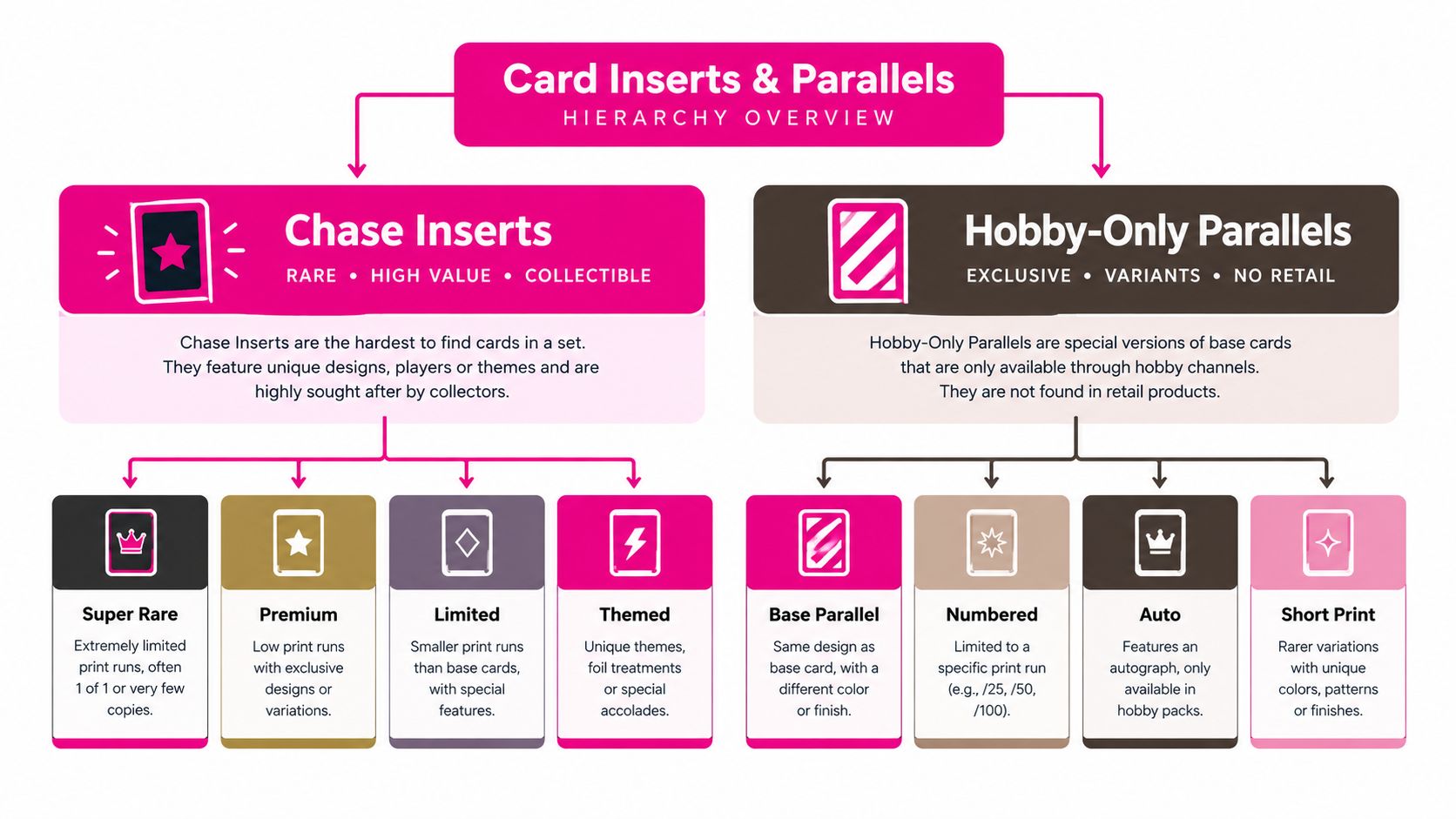
Mosaic's strongest appeal is visual, but its financial appeal comes from scarcity and player selection. The product uses reflective card stock, bold geometric patterns, and a broad parallel structure that encourages collectors to build rainbows. That visual variety creates excitement, but it also creates supply.
Autographs remain the headline chase. The exact subsets change by sport and year, with rookie autographs, veteran signatures, and themed insert signatures appearing across different checklists. A buyer should evaluate the autograph checklist before purchasing, not after opening. Two guaranteed autographs are only as useful as the players and designs represented in those slots.
The color ladder is not the value ladder
Mosaic collectors often talk about color as if every parallel deserves equal attention. It doesn't.
A serial-numbered Gold card can be far more important than a common red or blue parallel, but even Gold /10 isn't a guarantee of a strong sale. The player, rookie status, autograph presence, centering, surface, and current demand all matter. At the top end, Black 1/1 cards represent the clearest scarcity, but a 1/1 of an unwanted player can still be difficult to liquidate.
A useful hierarchy is:
- Player and card type
- Rookie or established-star demand
- Autograph or insert significance
- Serial-numbered scarcity
- Condition and grading potential
- Color and visual appeal
That order keeps you from overvaluing a flashy card with weak fundamentals.
What a memorable rip looks like
The dream Mosaic box combines player demand, scarcity, and condition. A Gold rookie autograph can matter because it gives the buyer a recognizable player, a serial-numbered card, and a premium card type in one pull. A Black 1/1 can be a centerpiece, but its market depends heavily on who appears on the card.
Collectors sometimes use a famous rookie example, such as a highly sought-after women's basketball player paired with a Gold Vinyl Prizm 1/1 and a Silver Prizm rookie autograph, to describe the ceiling of a memorable rip. That's a useful illustration of the product's upside, not a normal expectation and not a reason to assume every box has a path to that result.
Watch a Mosaic opening and chase breakdown with the same discipline you'd bring to a purchase. Enjoy the designs, but separate the cards that look impressive on camera from the cards buyers consistently pursue afterward.
Grading, Resale, and Singles Versus Sealed
The best card to grade is not necessarily the best card you pulled. Grading makes sense when the card has enough market value and upside to absorb the submission cost, shipping, insurance, and the risk of receiving a grade that doesn't support the premium.
Start with the card's raw sales history. Then ask whether a strong grade changes the buyer pool. A serial-numbered rookie autograph, a major short print, or a 1/1 may justify a closer inspection. A common base Silver usually doesn't, especially if the card has visible surface issues, soft corners, print lines, or off-centering.
The graded card pricing guide is useful for framing the decision, but the actual rule is straightforward: grade for market expansion, not for emotional attachment.
The grading decision
Before submitting, check:
- Surface: Mosaic's reflective finish can expose scratches, dimples, print lines, and roller marks.
- Centering: A strong card can lose much of its grading upside if the borders are visibly uneven.
- Corners and edges: Chromium cards can show whitening or chipping that hurts the final grade.
- Demand: A high grade matters more when buyers actively search for that player and card.
- Exit price: The expected graded sale must justify the full cost of the process.
Do not grade a card just because it is colorful. Do not grade every autograph. Grade the cards with a credible path to a meaningful premium.
Ripping versus buying the card directly
| Path | Upfront Cost | Expected Return | Liquidation Speed |
|---|---|---|---|
| Rip a hobby box | High and release-dependent | Highly variable, with value concentrated in scarce hits | Slow if the box produces many ordinary cards |
| Buy equivalent singles | Based on selected cards | More predictable because you choose the players and parallels | Faster for recognizable cards |
| Hold sealed product | Capital remains tied up | Depends on future demand and supply | Slow until a buyer accepts the asking price |
The sealed-versus-single comparison is where many collectors get uncomfortable. A box gives you access to cards you couldn't buy efficiently before release, but once the checklist is available, singles often become the cleaner purchase. You can target the rookie, parallel, or autograph you want without taking ownership of every low-demand card around it.
Market snapshots show wide dispersion across Mosaic years. Secondary-market estimates place some 2023 Mosaic hobby boxes around $145 to $356, while a 2025 product snapshot sits around $545, and earlier football Mosaic boxes appear around $319 to $550 depending on the source and product condition, as shown in the Mosaic price chart. That spread tells you release hype and perceived scarcity can matter more than a stable underlying value model.
The blunt verdict is that singles usually win for targeted collecting and faster liquidation. Sealed product can outperform if a release develops enduring demand, but you're tying up money while waiting for that thesis to play out. A rip only makes sense when you're comfortable treating the entertainment and variance as part of the purchase.
Live Breaks and the Case for Ripping on Camera
Live breaks change the size of the decision, not the underlying odds. Instead of buying the entire box, participants buy a team, player, or random slot and receive the cards assigned to that position under the breaker's rules.
That can be a sensible way to access a product you don't want to buy outright. It can also produce a worse deal if the break structure, shipping terms, or spot allocation favors the seller more than the participant.
Before joining, check four things:
- Break rules: Confirm whether cards are assigned by team, player, draft position, or another method.
- Shipping policy: Find out whether cards ship automatically, whether base cards are bundled, and how insurance works.
- Recorded history: Look for previous streams, fulfilled orders, and visible customer feedback.
- Seal visibility: The breaker should show the sealed product before opening it on stream.
Random-team formats can be entertaining because every participant has a path to a strong card. They can also create uneven outcomes when one team has most of the valuable rookies and autograph subjects. A player break can be even more concentrated, especially when the chosen player has only a small number of cards in the checklist.
A break is not a discount on a box. It's a smaller purchase that gives you a narrower claim on the box's output.
For sellers and breakers, the attraction is inventory conversion. A sealed box becomes multiple paid spots, and the seller can recover capital without waiting for individual cards to sell. That model works when the breaker communicates clearly, ships reliably, and prices the spots around the actual product cost and operating expenses.
For buyers, use a simple rule. Join when you want a specific team, enjoy the live experience, and can accept receiving nothing that covers your spot. Skip when the format hides the box, buries the rules, or makes the purchase feel like a guaranteed investment.
Should You Rip, Hold, or Buy Singles Instead
Make the decision in this order.
Rip when the opening itself is worth the purchase price to you. You want the packs, the suspense, the chance at a rare parallel, and the social experience of sharing the result. Don't call it an investment after the fact if you bought it for entertainment.
Hold only when you have a clear sealed-product thesis. The product must have durable collector demand, manageable supply, and a reason buyers will want that specific release later. You'll also need suitable storage and patience. A sealed box is not liquid just because it has a factory seal.
Buy singles when you care about a particular player, card design, or parallel. This is the strongest route for collectors who want control. You pay for the card you want and avoid the long tail of ordinary base cards, redundant parallels, and low-demand autographs.
A practical checklist:
- Can you afford the box if the best card is only moderately desirable?
- Have you checked sold listings rather than optimistic asking prices?
- Do you understand the exact year's guaranteed contents?
- Are you buying for the rip, the cards, or the resale thesis?
- Would the same money buy several cards you already want?
- Is the potential hit worth grading after condition and fees?
My recommendation is direct. Rip Mosaic for the experience, buy singles for precision, and hold sealed only when you've researched the specific release rather than the brand name. Grade only a genuinely scarce, desirable card with condition strong enough to support the submission.
Lucardio Collectibles brings authenticated singles, sealed trading-card products, PSA-graded items, live breaks, auctions, insured fulfillment, and collection management tools into one platform. If you're comparing a Mosaic rip with singles or looking for a safer way to buy and sell collectible cards, visit Lucardio Collectibles.