
The global trading-cards market reached USD 30.0 billion in 2025, according to Grand View Research's market estimate summarized by Axiobench. That scale makes sealed product look like a shortcut to profit. It isn't. A pack is a small bundle with a known card count, unknown specific cards, and packaging you pay for whether the pull feels exciting or ordinary.
Table of Contents
- What a Pack of Cards Actually Contains
- Pack Formats Compared Side by Side
- How Odds and Hits Work Inside a Pack
- When Opening a Pack Makes Financial Sense
- How to Check a Sealed Pack Before You Buy
- Storage and Packaging Waste When Buying Sealed
- Choose the Pack Type That Matches Your Goal
What a Pack of Cards Actually Contains
Say you want one chase card from a new Pokémon set. You could buy that single card, or you could buy a sealed pack and hope. The second choice is what collectors mean by packs of cards in the trading-card hobby. The wrapper is closed. The set is named on the front. The exact cards inside are not listed anywhere you can read before you tear it.
A booster pack is the smallest sealed unit. A blister adds a few packs and often a promo. A box is many packs sold together. The word “pack” gets used for all three, which is where buyers get confused. Two products can share a set name and still contain different card counts, different promo cards, and a different number of chances at a rare slot.
Think of a sealed pack as a gift bag. The tag tells you the occasion, which is the set and the year. It does not tell you which present is inside. You know the bag holds a fixed number of items and that one of those items is supposed to be the “nice” one. You do not know which nice item you will get.
Every trading pack carries three facts you can check before you pay.
- Card count: A modern Pokémon-style booster is usually 10 or 11 cards from one set. That count is fixed even when the names inside are not.
- Slot structure: Most of those cards fill common and uncommon slots. One slot is reserved for a rarer tier. The tier is promised. The specific card in that tier is not.
- Set identity: The release name and year tell you which card pool the pack draws from. A pack from an older set and a pack from this year's set are different products even if both say “booster” on the front.
Before you pay, ask three questions: What is guaranteed, what is random, and which set does this pack belong to? If the listing cannot answer all three, you are buying a label, not a known product.
A standard pack of playing cards is a different object. It contains 52 cards in four suits, clubs, diamonds, hearts, and spades, with 13 ranks in each suit, as described in the Wikipedia entry on the standard 52-card deck. Nothing in that deck is a random slot. This guide is about sealed trading-card packs, where the wrapper hides which cards you receive.
Pack Formats Compared Side by Side
Size is the first difference that changes what you pay and how many rare chances you get. The counts below follow Pokémon-style products. Other games print different pack sizes, so the product listing is the final authority for the box in your cart.
| Format | Typical contents | Rare-or-better slots | Best for |
|---|---|---|---|
| Booster pack | 10-11 cards from one set | 1 | Opening for fun on a small budget |
| Blister pack | 3 booster packs plus a promo card | 3 | Sampling a set or gifting |
| Booster bundle | 6 booster packs in one box | 6 | Buying several packs at a lower per-pack cost |
| Elite trainer box | 9 booster packs plus sleeves, dice and a promo | 9 | Collectors who want accessories with their packs |
| Booster box | 36 booster packs | 36 | Bulk opening or holding sealed product |
From one pack to a full box
A booster pack is the entry point. You get one rare-or-better slot and a short session of opening. It suits a small budget and a single evening. It is a poor way to chase one named card, because one slot is one draw from a large list.
A blister pack usually holds three boosters plus a promo card you can see or that the listing names. That promo is the part that is not random. Blisters work for sampling a set or for a gift, because the receiver gets several openings and one known extra card. You are still paying for three separate wrappers.
A booster bundle puts six boosters in one box. The point is a lower price per pack than buying six loose boosters at a shop counter. You get six rare-or-better chances and no sleeves or dice. If you do not want accessories, this is the cleaner middle step.
An elite trainer box adds sleeves, dice, and a promo around nine boosters. Those extras change the price. Divide the shelf price by nine before you compare it with a loose booster. If you already own sleeves, you are paying for items you may not use.
A booster box holds 36 booster packs, so 36 rare-or-better slots if each pack carries one. Collectors buy boxes to open in bulk or to keep sealed. The box is one product with one wrapper history, which is why holders prefer it to a pile of loose packs.
A larger product does not automatically mean a better price per card. Accessories raise the price of the box without adding rare slots. Compare cost per pack, not cost per box.
Read the columns in that order. Contents tell you what is physically inside. Rare-or-better slots tell you how many chances at a higher tier you are buying. Best for only helps after you know whether you want to open, gift, hold, or supply a play kit.
How Odds and Hits Work Inside a Pack
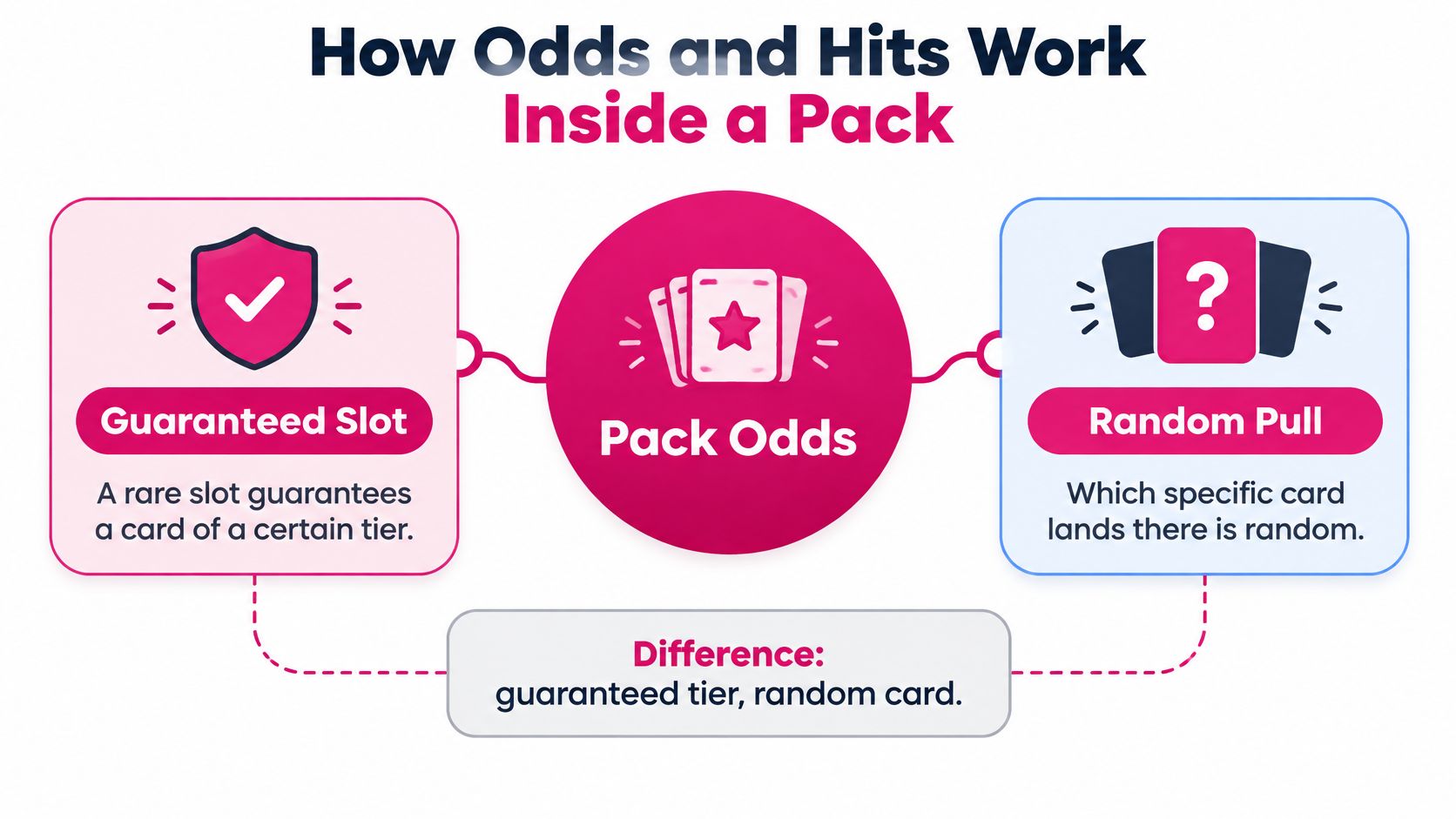
A rare slot and a specific chase card are not the same promise. The slot guarantees a tier. The card that lands in that slot is a probability.
The chain from pack to variance
Start with the pack. Inside it, cards sit in slots. Each slot has a tier, such as common, uncommon, or rare. Odds attach to the slot, not to your hopes. Variance is what you see when you open several packs from the same set and the hits do not match.
Publishers rarely print exact pull rates on the wrapper. Most numbers collectors quote come from community opening logs and set checklists. Treat those figures as approximate. A new print run, a different language, or a special subset can move the rate without a new sticker on the pack.
A “one in 100” line does not mean the card shows up by pack 100. Each pack is its own draw. You can open 100 packs and miss. Someone else can hit on pack two. The chance is spread across many packs and many buyers, not saved up until it is your turn.
What “one in X” does not promise
Picture two booster boxes from the same set, bought the same week. Box A might show several higher-tier cards. Box B might show the ordinary rare in almost every pack and one modest hit near the end. Both boxes followed the same slot rules. The difference is variance, not a broken product.
Mizuho's look at the trading card market describes pack-breaking content on YouTube, Twitch, and live-commerce platforms as a major discovery and purchasing channel. Live openings make the hit feel close because you watch it happen to someone in real time. That feeling is not a change in your odds.
Separate the three things a pack can offer.
- Guaranteed cards: The count, the tiers, and any named promo on a blister or trainer box.
- Random hits: Which named card fills the rare slot, including the cards people call hits.
- Entertainment value: The opening itself. That can be a fair purchase even when the cards are worth less than you paid.
Rarity does not equal profit. A scarce card can still sell for less than the packs you opened to find it, once you count the misses. A pack's fun can be a rational reason to buy when you already accept that the expected monetary value may be negative. If you want the ladder of rarity symbols explained before you open, the Pokémon card rarity guide walks through those tiers without treating them as a payout table.
This short walkthrough shows how a guaranteed rare slot still leaves the named card to chance.
When Opening a Pack Makes Financial Sense
Use round units so the math stays clear. These are not market prices. They only show the gap between what you pay and what the opened cards are worth on average.
Say a booster box costs 180 units and holds 36 packs. That is 5 units per pack. Suppose the cards inside, sold one by one at typical secondary prices for that set, average 3.20 units per pack. The opened pile is about 115 units for the whole box. The gap is about 65 units before selling fees and shipping.
Sealed value and opened value
Sealed value is what an unopened box sells for. Opened value is the sum of the individual cards after you remove them. Those two numbers are not rivals for the same object. Once the box is open, the sealed price is gone. You cannot tape it shut and ask for the sealed price again.
The gap is usually fees, postage, and the packs that miss. A seller who lists 36 cards pays fees on many small sales. Shipping a stack of singles costs more in time than shipping one box. The rare misses are the packs whose best card sells for less than the pack price. A single strong hit can shrink the gap. It does not erase the other 35 packs.
What should change your answer
Print run and demand. A small print and rising demand can lift the sealed box while it stays closed. If your goal is resale of the box itself, holding is yes and opening is no. You are betting on the sealed product, not on the cards inside.
Reprint news. A set that gets a heavy reprint usually makes holding less attractive, because more sealed supply arrives later. Opening for fun is still yes if you set the spend first. Holding for a quick rise is no.
Your reason for buying. Opening is reasonable when enjoyment is the point and the limit is chosen before you click buy. Opening is not reasonable when you need the money back. For a closer look at which sealed boxes people compare when profit is the goal, see which Pokémon booster box to consider.
Decide the budget before the purchase. Decide whether you are buying for enjoyment or for resale. Only then decide whether to open or hold.
If the opened average sits under the pack price, as in the 3.20 against 5 example, you are paying for the opening. Name that cost out loud. A hobby budget can include it. A bill-paying budget should not.
How to Check a Sealed Pack Before You Buy
Photos hide a lot. A clean product shot can be a different set, a different product type, or a wrapper that has already been opened. Work through the checks in order.
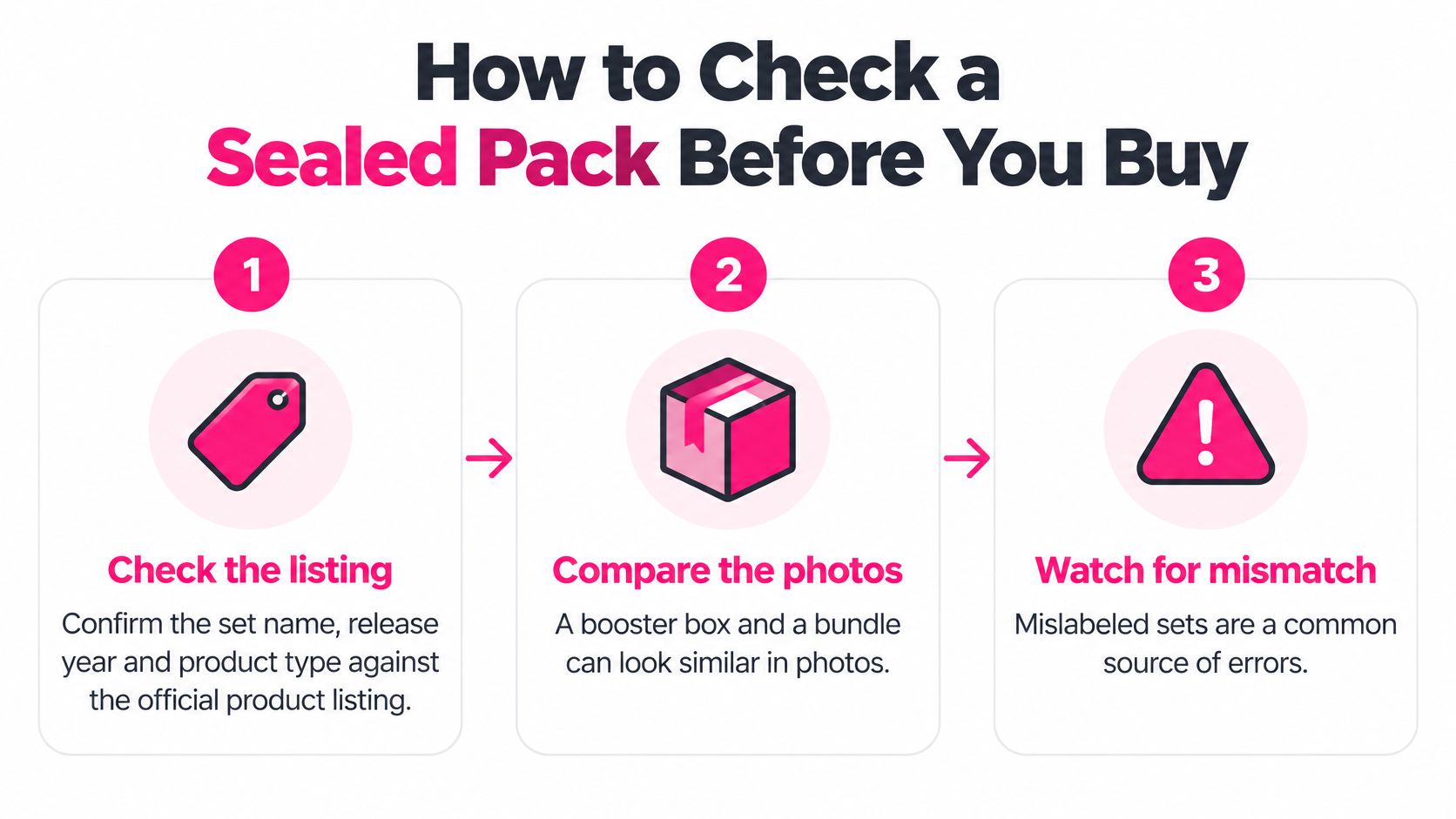
- Match the listing to the official product. Confirm the set name, release year, and product type against the publisher's product page. A booster box and a bundle can look alike in a thumbnail, and a mislabeled set is a common reason a buyer feels cheated after delivery.
- Read the wrapper with your eyes, then your hands if you already have it. Look for uneven crimps, glue residue, or a wrapper that feels loose or re-folded. Those signs can mean the product was opened and packed again.
- Compare shape and print with reference photos from sellers you already trust. Soft type, shifted colors, and a box that is the wrong height show up on fakes more often than a dramatic logo error.
- Read the authenticity policy before you pay. It should cover every item that seller offers, not a highlighted subset. A written guarantee is the strongest protection you have while the product is still in someone else's warehouse. The guide to buying hobby boxes online is a useful companion when you are comparing those policies across shops.
- Confirm tracking and insured delivery. Most damage to sealed product happens in transit, not on a shelf. Insurance is what pays for a crushed corner. A photo of the label is not a substitute.
- Keep the invoice, the listing, and the delivery photos together. Save them the day the parcel arrives. Disputes move faster when you are not hunting through email a month later.
- Store the product flat, out of direct sun, and away from humidity. Heat warps cardboard. Moisture softens glue and clouds a wrapper. A closet shelf beats a windowsill.
What an intact product looks like on arrival
The box should match the set name on your invoice. Corners should be square, not pushed in. The factory wrap should be tight, with even seals and no extra tape. Shrink that looks cloudy in one patch and tight everywhere else deserves a second look. If the outer box is fine and the inner wrap is loose, photograph both before you open anything.
Storage and Packaging Waste When Buying Sealed
Collectors are already voting with their wallets on packaging. A 2026 survey of 1,000 active collectors reported that 58% of consumers were willing to pay a premium for products using sustainable, plastic-free packaging, as covered by ICv2. Wanting less waste does not mean you have to stop buying sealed product. It means you should see what each buying pattern throws away.
A sealed purchase creates a foil or mixed-material wrapper, a paperboard box, and sometimes an inner plastic tray. That stack is the cost of keeping the cards unseen until you open them. Insurance-style protection during shipping reduces crushed boxes and the replacement parcels those crushes cause. Extra void fill and a new parcel for every single pack do the opposite.
| Buying pattern | Packaging per card | Shipment pattern | Best when |
|---|---|---|---|
| Single packs | Highest | Often several small parcels | Opening for fun |
| Booster boxes | Lower per pack | One parcel per box | Bulk opening or holding |
| Single cards | Lowest when the goal is one card | One combined parcel when the seller groups the order | A specific card is the goal |
What to keep and what to skip
Single packs create the most wrapper per card. Each pack has its own foil, and several small orders mean several mailers.
Booster boxes spread one outer carton across 36 packs. One parcel replaces a month of small shipments. You still have 36 inner wrappers if you open the box.
Single cards win when you want one named card. You skip the misses and most of the foil. Grouping those singles into one parcel matters. Ten separate envelopes undo the savings.
Paperboard is the part many local programs accept. Foil and mixed-plastic wrappers often are not, and the rule is local, not universal. Check your own recycling sheet instead of assuming the wrapper belongs in the bin.
For the cards you keep, reusable binders and rigid sleeves beat a new soft bag every time you sort. A simple digital list of what you already bought stops the repeat order of the same box. Buy in fewer, larger shipments, keep the paperboard when your area recycles it, and store sealed product in reusable containers that block light and humidity.
Choose the Pack Type That Matches Your Goal
The format only helps after the goal is clear. Use this as the last filter, not the first.
| Goal | Pack type to consider | What to check first |
|---|---|---|
| Open for fun on a budget | Booster pack or blister | Price per pack and set release date |
| Hold sealed product | Booster box | Print run, reprint news and authenticity guarantee |
| Get a specific card | Single cards, not packs | Graded condition and recent sold prices |
| Join a live break | Break slot | Seller authenticity policy and insured shipping terms |
| Build a collection over time | Booster bundles or boxes bought in batches | Storage plan and a record of each purchase |
If enjoyment is the goal, a booster or a blister is enough. You get the opening without a 36-pack commitment.
If holding is the goal, start with a booster box, then stop if you cannot find print-run context and reprint news. A box you cannot identify is not a hold. It is a guess.
If one card is the goal, singles beat packs on cost and on waste. You pay for the card, not for 10 commons you will not use. Check graded condition when the card is slabbed, and check recent sold prices rather than the asking price alone.
A live break splits a box among people who each take some of the slots. You pay less than a full box and you do not receive every card. The host's authenticity policy and the shipping terms for your hits matter as much as the pack odds. Use the same checks you would use on any sealed purchase.
Three steps after you pick a row
Set the budget with the same honesty as the 180-unit example. Write the number down before you open a listing.
Check the set name and the authenticity policy with the seven-step list. Do this even when the price looks fair.
Compare cost per pack with the format table. An elite trainer box can look cheaper as a “deal” and still cost more per booster once you ignore the dice.
Lucardio Collectibles sells trading cards, sealed booster boxes, and PSA graded cards, and all cards it sells are guaranteed to be authentic, so apply the same checks to any seller, including this one. The best pack is the one that matches the reason you are buying it.
If you want sealed booster boxes, authenticated singles, or PSA graded cards in one place, Lucardio Collectibles lists them with an authenticity guarantee and insured delivery. A free subscription adds giveaways, early access to new drops, and collector updates, which is an easy way to watch releases without opening a pack you did not plan to buy. Visit Lucardio Collectibles when you are ready to match a product to the goal you already chose.