
The most repeated advice about buying a Pokémon 151 booster box is to compare price per box and take the cheapest sealed unit you can find. That advice fails before you finish reading the first listing. In 2026, a Japanese 151 box and an international 151 product aren't the same item at two prices. They're different objects with different pack counts, different card numbering, different release dates and different card pools, and a listing that says only "151 booster box" can describe any of them.
Talk to three sellers and you'll get three answers about what's inside: 20 Japanese packs, a six-pack bundle, or a collection box with 16 packs and a metal promo. Ranking those by price tells you which is cheapest and nothing about which is comparable. The check that protects your money is sequential. Identify the edition, confirm the pack count and the seal, then price it against a dated market reference.
Price per box is the last question, not the first. Here's how to work backwards to it.
Table of Contents
- Identify Which 151 Booster Box You Have
- What Cards Are Inside the 151 Booster Box
- Price Drivers and Pre-Purchase Checks
- Sealed Packs Versus Buying Singles
- Grading and Storing Sealed 151 Boxes
- Compare Two Listings Before You Buy
Identify Which 151 Booster Box You Have
A listing that says "151 booster box" can mean one of three products, and they differ on every detail that decides value.
| Edition | Release | Pack configuration | Card pool |
|---|---|---|---|
| Japanese SV2a booster box | June 16, 2023 | 20 packs of 7 cards (140 nominal cards) | 165 main card numbers plus secret rares |
| International Scarlet & Violet 151 | September 22, 2023 | Six-pack Booster Bundles, no standard 36-pack display | International numbering and English-language cards |
| International Ultra-Premium Collection | October 6, 2023 | 16 Scarlet & Violet 151 packs plus accessories | Includes a Mew ex promo and an etched metal Mew ex |
Start with the language on the box. The sealed Japanese 151 booster box listing identifies the Japanese edition as set code SV2a, released in Japan on June 16, 2023. The documented configuration is 20 booster packs of 7 cards, a nominal 140 cards, set against 165 main card numbers plus secret rares. If a listing claims the Japanese edition and the box can't show SV2a, the claim dies there.
English 151 has no standard display box. Scarlet & Violet 151 reached international markets on September 22, 2023, and the sealed product line runs through six-pack Booster Bundles and collection products rather than a 36-pack display. That single fact resolves most mislabeled listings: a seller offering an "English 151 booster box" is holding a bundle or a collection item, and a listing describing an English display box is describing something that was never made.
The Ultra-Premium Collection is the third object. It landed on October 6, 2023 with 16 Scarlet & Violet 151 packs, a Mew ex promo, an etched metal Mew ex, a playmat, a deck box and accessories. If the listing on your screen matches that description, the Pokémon 151 Ultra-Premium Collection box is the product to price, and a loose pack count is the wrong yardstick for it.
Practical rule: If a listing doesn't name a language and a pack count, it hasn't told you what it's selling. Close the tab and find one that has.
Run the checks in order. Read the language and the printed set code first, since SV2a and an English 151 product are different items in any comparison. Count the packs, because 20, 6 and 16 describe three different purchases at any price. Confirm the factory seal and shrink wrap last, since a re-wrapped box is a used box whatever the label says.
What Cards Are Inside the 151 Booster Box
Every card in the set follows the original Pokédex. Bulbasaur sits at 001, Mew closes at 151, and the modern Scarlet and Violet styling is applied to artwork that a lot of buyers recognize from childhood.
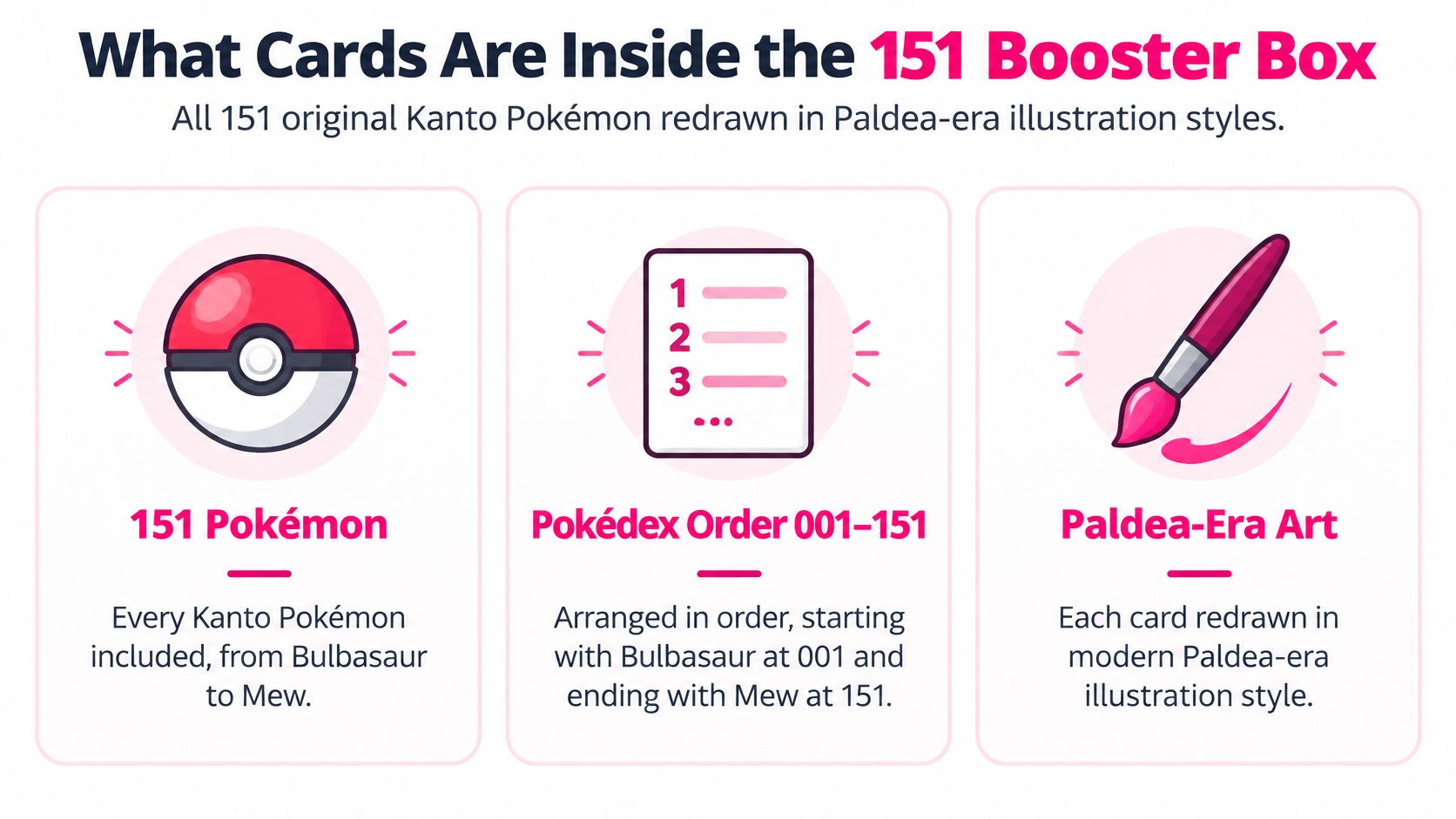
The official Scarlet & Violet 151 expansion page lays out the shape of the pool. The Pokémon Company states the expansion contains more than 160 cards, includes all 151 original Kanto Pokémon, adds 12 new Pokémon ex cards and carries more than 10 Trainer cards. It describes the set as the first expansion designed around featuring all 151 original Pokémon in Pokédex order while reimagining them in Paldea-era gameplay and illustration styles.
A box is a random sample of that pool. Pack count tells you how many draws you get, not what's in them, and the value of a sealed box sits in the small number of cards collectors chase rather than in the size of the checklist.
The categories you'll meet when you sort a box: Pokémon ex cards, including the 12 the set introduces; illustration rares and special alternate-art treatments, where the chase money concentrates; and the Mew ex promo and etched metal Mew ex card that ship only inside the Ultra-Premium Collection rather than in packs. Those last two are why sealed collection boxes price differently from loose packs.
Read the card list before you pay
- Check the number range. A full set list shows the highest main number. Anything above it is a secret rare, and secret rares are where the premium lives.
- Identify the illustration rares. Pull the art-card names out of the list and price those individually. If you don't want any of them, a sealed box is an expensive way to buy bulk.
- Compare the Japanese numbering. SV2a runs 165 main numbers plus secret rares, so a card's position in a Japanese checklist doesn't match its position in the English one. Use the right list for the box in your hand.
If your Pokémon card rarity tiers aren't second nature yet, learn the difference between an ex, an illustration rare and a secret rare before you read a set list. It changes what you're willing to pay.
Set the pool against your reason for buying. If you want the starters and Mew specifically, this pool is the entire argument for the set. If you want a wide spread of varied hits across a big checklist, this isn't the product that does it.
Price Drivers and Pre-Purchase Checks
The assumption worth killing is that one price tells you what a 151 box is worth. Look at the spread instead. A sealed Japanese box and a single international pack sit at very different price points, yet both surface under the same search term. The gap isn't one side being overpriced. It's two different items with different pack counts answering to one name.
Supply is where buyers overreach. The Pokémon Company doesn't publish print-run figures for 151, so anyone quoting a specific production total is guessing. Judge supply from what you can observe: how many sealed listings exist for the exact edition, whether that edition still shows up in regular retail, and whether boxes change hands at a steady rate or sit unsold for weeks. Sparse listings with fast turnover signal a different market from plentiful listings that never move.
What actually drives the number
- Language edition. A Japanese SV2a box and an international Scarlet and Violet 151 product draw different buyers, different pack structures and different inventories. Price them separately or the average means nothing.
- Seal and shrink wrap. Factory wrap with tight corners and clean seams supports a full asking price. A split seam, loose film or a re-wrapped box is a used item, and it should be priced like one.
- True box versus bundle. A six-pack bundle listed as a booster box is the most common mislabel in this category. It's usually sloppy listing rather than fraud, but it breaks the comparison either way.
- Nostalgia demand. The Kanto roster pulls in buyers who don't follow the modern game, which props prices up during hype cycles and lets them sag when attention moves on. I treat it as the least stable input of the four.
Six checks before you pay
- Confirm the edition and printed language. Japanese SV2a or international Scarlet and Violet 151. If the listing won't say, assume nothing.
- Confirm the pack count. The Japanese box is generally described as 20 packs. If a seller calls a six-pack bundle a booster box, ask directly how many packs ship.
- Request photos of the shrink wrap, corners and flaps in good light, taken before shipping rather than pulled from a catalogue.
- Compare the asking price against a dated reference. In 2026, the Pokémon Card 151 Booster Box was listed at an estimated $241 according to CardTrack's sealed booster box pricing. Write down the date you checked, because a reference without a date is a rumour.
- Ask how the item is authenticated and how it ships, including whether transit is insured and tracked.
- Pull the card list if you're buying for specific chase cards, and confirm they're in the pool for that edition.
Caveat worth printing on the listing: every price above is an asking or market indicator, not a realized sale. A listing that skips any of the six checks is a reason to slow down, not a bargain to grab.
Sealed Packs Versus Buying Singles
One international 151 booster pack was valued around $26.93 in November 2026, while acquiring all 208 cards as singles was estimated at approximately $1,578, according to CardTrack's sealed product market data.
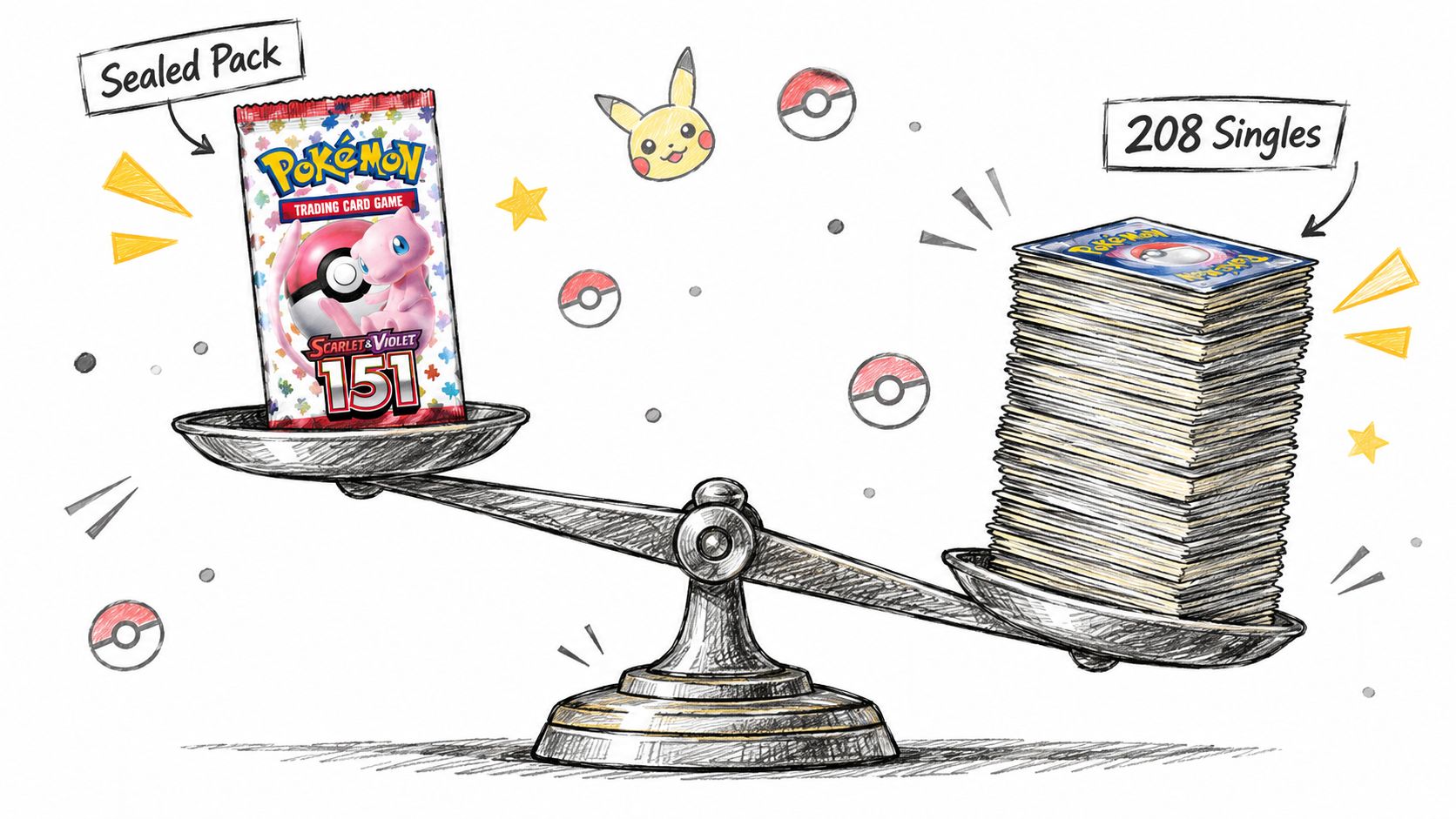
Two numbers, two very different purchases. The comparison doesn't tell you how many packs to open before switching to singles, how duplicates change the math, or how loose packs differ in value from factory-sealed boxes. What it does is put the two price tags side by side: the cost of one sealed pack against the cost of the whole set bought card by card.
Three goals, three break-even tests
| Goal | What you're actually buying | Break-even test |
|---|---|---|
| Enjoyment | A small number of packs opened for the experience | Set a pack budget, buy it once, and stop when it's spent |
| Set completion | Specific cards, sourced as singles | When the next pack costs more than the card you still need, buy the card |
| Preservation | Factory-sealed product held intact | Buy sealed only if the seal stays intact, and count every opened pack as spent |
The costs that decide the outcome are the ones buyers leave out of the headline comparison: duplicate rates, chase-card odds, grading fees, shipping, taxes and condition. Duplication is where ripping gets expensive, since every repeat pull is money spent on a card you already own. A pull that grades a nine instead of a ten changes the return on the whole box.
My rule: decide the goal before you break a seal. Open a handful for the experience, buy targeted singles to finish the set, and keep one sealed unit sealed if preservation is part of why you're collecting.
Grading and Storing Sealed 151 Boxes
A sealed box and a graded card are graded on completely different scales, which trips up newer collectors. Individual cards go to PSA and come back in a slab with a numeric grade. A sealed box gets no slab and no number. Buyers judge it on seal integrity, corner sharpness, shrink-wrap condition and visible wear, which means your photos are the grade.
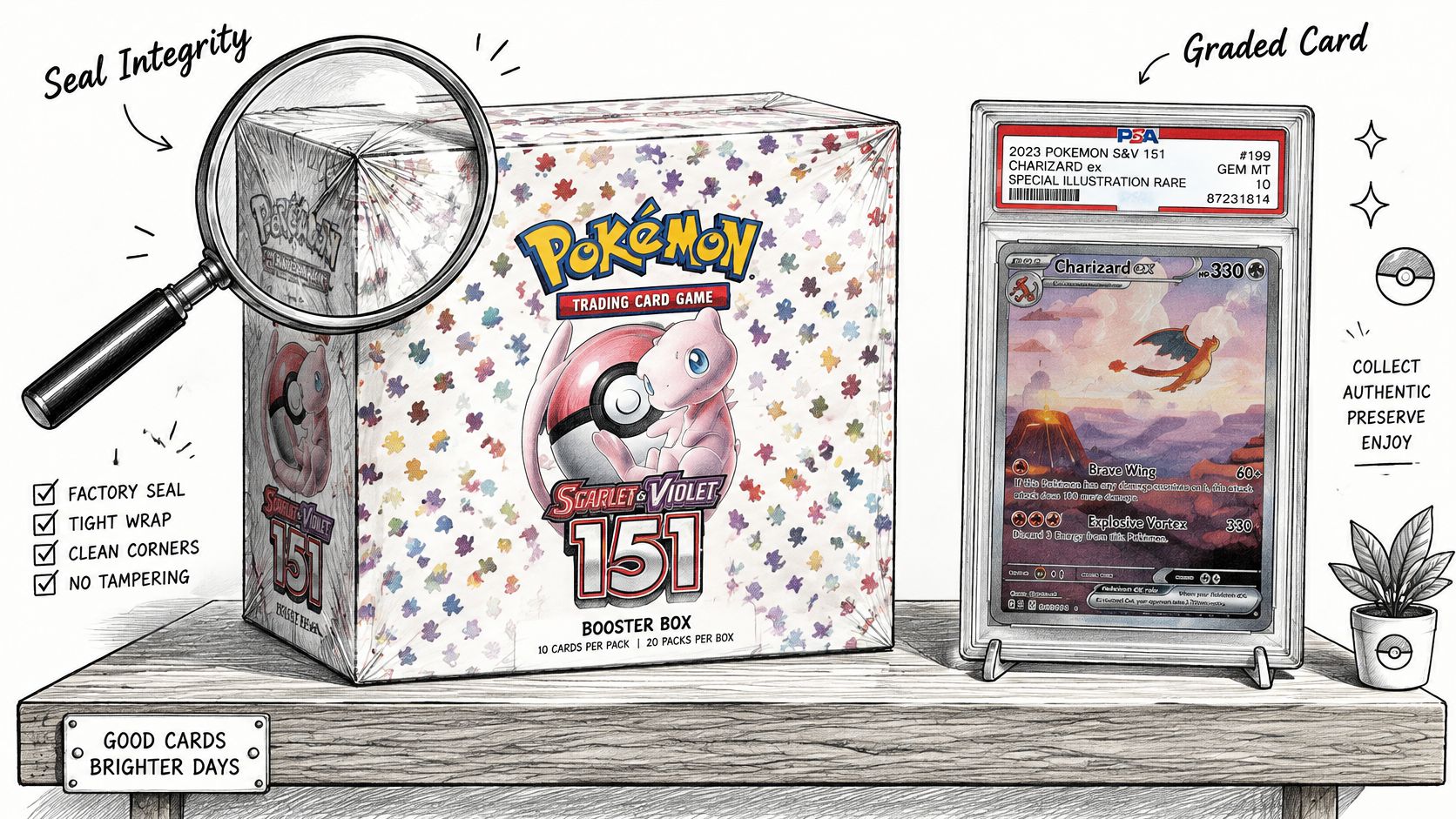
That distinction has a price consequence. Opening a box to chase a graded card destroys the sealed premium on the box itself, so you're trading one asset for a lottery ticket. Send a card for grading if the card is the thing you want. Leave the box wrapped if the box is.
| Risk | Why it matters | Practical fix |
|---|---|---|
| High humidity | Warps the box card and dulls the shrink wrap | Keep relative humidity around 40 to 50% and check with a hygrometer |
| Direct sunlight | Fades box artwork and yellows the wrap | Store in a closed cabinet away from windows |
| Temperature swings | Expands and contracts packaging over time | Keep the room steady around 18 to 22 C and avoid garages and attics |
| Handling and stacking pressure | Creases corners and stresses the seal | Store upright and keep heavy items off the box |
The routine that works
- Store upright in a closed cabinet, not flat under a stack of other boxes, and not against an exterior wall where condensation forms.
- Buy a cheap hygrometer and put it in the same room. You can't manage humidity you aren't measuring.
- Keep boxes out of garages, attics and lofts. Those spaces swing harder than any living space and the damage shows up months later.
- Photograph the seal in good light before storage. That set of photos becomes your condition record if you ever sell.
- Check every few months for shrink-wrap splits, moisture marks and colour fade, and move anything that shows early signs.
A sealed box is a document of its own condition. Once the wrap is compromised, no amount of careful storage gets that back.
Compare Two Listings Before You Buy
A lower price wins only after both listings survive the same checks. Run them in one order: language, set identifier, pack count, seal photos, authentication, shipping terms, and the date on any price reference. “151 booster box” can describe more than one edition and more than one pack structure, so a title alone is not enough; the listing that leaves a check blank loses, even if it is cheaper.
Lucardio Collectibles sells trading cards, sealed booster boxes, and PSA graded cards, so you can run these checks against real listings instead of a hypothetical. Every card is guaranteed authentic, and orders ship with insured delivery. Where a listing doesn't state pack count or seal condition, ask before paying rather than assuming the best case. The guide to buying Pokémon booster boxes walks through the same checks in more detail.
Then decide what the purchase is for: enjoyment, set completion or preservation, using the test in the goal table above. A collector buying for display and a collector buying to finish a binder should not be bidding on the same box, even when the boxes look identical in a photo.
If you're ready to buy with the checks already done, Lucardio Collectibles brings authenticated singles, sealed booster boxes and PSA graded cards into one place, with insured delivery and a stated authenticity guarantee on every card. Before checkout, confirm pack count, seal condition and authentication details with the seller instead of guessing from a listing title, and ask about anything the photos do not show. Knowing exactly which 151 box you're buying is the difference between a collection piece and an expensive lesson.