
The current U.S. MSRP for a 36-pack Pokémon booster box is $161.64, but real-world prices can range from roughly $110 to $310 depending on the set, seller, and timing. That difference is why “Pokémon booster box retail price” rarely means one universal number.
You may have seen the same sealed product listed at a big-box retailer, a local card shop, and a resale marketplace, each with a different price. A discounted listing might be completely legitimate, while a higher price could reflect limited supply, an older release, or collector demand rather than an arbitrary markup.
The useful question isn't just, “What does a Pokémon booster box cost?” It's, “Which price am I looking at, and what does that price represent?”
Table of Contents
- What a Pokémon Booster Box Costs at Retail
- The Five Prices Hiding Inside the Word Retail
- Hobby Channel vs Big-Box Retail and What Changes
- Why Booster Box Prices Drift Away from MSRP
- Real Set Examples of Booster Box Price Trajectories
- Where to Verify Official Pricing and Spot Fair Markups
- Making a Confident Purchase Decision
What a Pokémon Booster Box Costs at Retail
A new buyer may see the same sealed box at a card shop, a large retailer, and an online marketplace, then wonder which price is real. The answer depends on whether the listing shows the manufacturer's benchmark, a seller's price, or what buyers currently pay.
For a standard 36-pack Pokémon booster box, the cited U.S. MSRP is $161.64, or $4.49 per pack. That figure is a reference point for ordinary retail sales, not a guarantee that every store will have the product at that amount. The current market pricing discussion for Pokémon booster boxes shows why sealed products can trade both below and above MSRP.
| Format | Pack Count | Cards per Pack | U.S. MSRP |
|---|---|---|---|
| Pokémon booster box | 36 packs | 10 cards | $161.64 |
The table gives you the product's basic retail frame. The final price can change after release because stores may discount extra inventory, receive limited allocations, or run out of stock. A reprint can add supply and pull prices closer to the benchmark. Scarcity can push them higher when buyers compete for boxes that are no longer easy to find.
MSRP is a reference benchmark, not the current value of every sealed box.
That distinction makes “retail price” a label for five different figures: official MSRP, an authorized retailer's price, the launch price, the current market price, and the vintage collector price. They are like different readings on the same price gauge. MSRP marks the manufacturer's starting point, while the other figures reflect timing, availability, seller costs, and collector demand.
A discounted box may reflect a legitimate promotion or excess stock. A higher price may reflect limited supply or an older set. Comparing the number alone can therefore mislead you. First identify which of the five prices you are seeing, then judge whether the seller, product condition, and timing support it.
The Five Prices Hiding Inside the Word Retail
A buyer can see five very different prices for what appears to be the same Pokémon booster box. One listing may show the manufacturer's benchmark, another a retailer's promotion, and a third the amount collectors currently pay. An older sealed set belongs to a different market altogether.
Pokémon booster boxes make sense once you separate those price tiers.
Official MSRP
MSRP means manufacturer's suggested retail price. It is the formal benchmark for ordinary retail sales, not a promise that every store will have the product at that amount. The cited U.S. reference for a 36-pack box is $161.64.
MSRP is the starting line. It does not control stock, seller costs, or the price a buyer encounters after release.
Authorized-retailer price
An authorized retailer may list a box near MSRP, below it during a promotion, or above it when supply is limited. Shipping, taxes, loyalty discounts, allocation limits, and inventory costs can all affect the final amount.
A lower listing does not automatically provide better value. A verified seller with clear product photos, reliable fulfillment, and a return policy may be a safer purchase than an anonymous seller offering a slightly lower price.
Launch price
The launch price is what buyers encounter around release. Preorders, early allocations, retailer limits, and sudden collector interest can make this figure unstable. One buyer may secure a preorder below MSRP, while another sees a higher offer after stores sell through their first shipment.
Journey Together illustrates the difference. Its reported U.S. MSRP was $161.64, while pre-release offers appeared around $119.99 at Best Buy and $130 to $140 through Amazon and Walmart. Reported post-launch secondary prices reached $180 to $190, according to this Journey Together booster-box market report.
Current market price
The current market price reflects what buyers and sellers accept after the initial release period. Restocks can increase supply and pull prices down. Opened product, scarce cards, renewed collector interest, or a set leaving regular retail can push prices higher.
This price is a moving snapshot, not a permanent value.
Vintage price
A vintage price applies to sealed product valued mainly for age, scarcity, and set identity. At that point, the box behaves more like a collectible asset than ordinary retail inventory. Historical Pokémon booster-box tracking lists 1st Edition Fossil at approximately $15,116 and Team Up at approximately $11,725, illustrating the distance between an original retail benchmark and later collector demand. These figures appear in historical Pokémon booster-box market tracking.
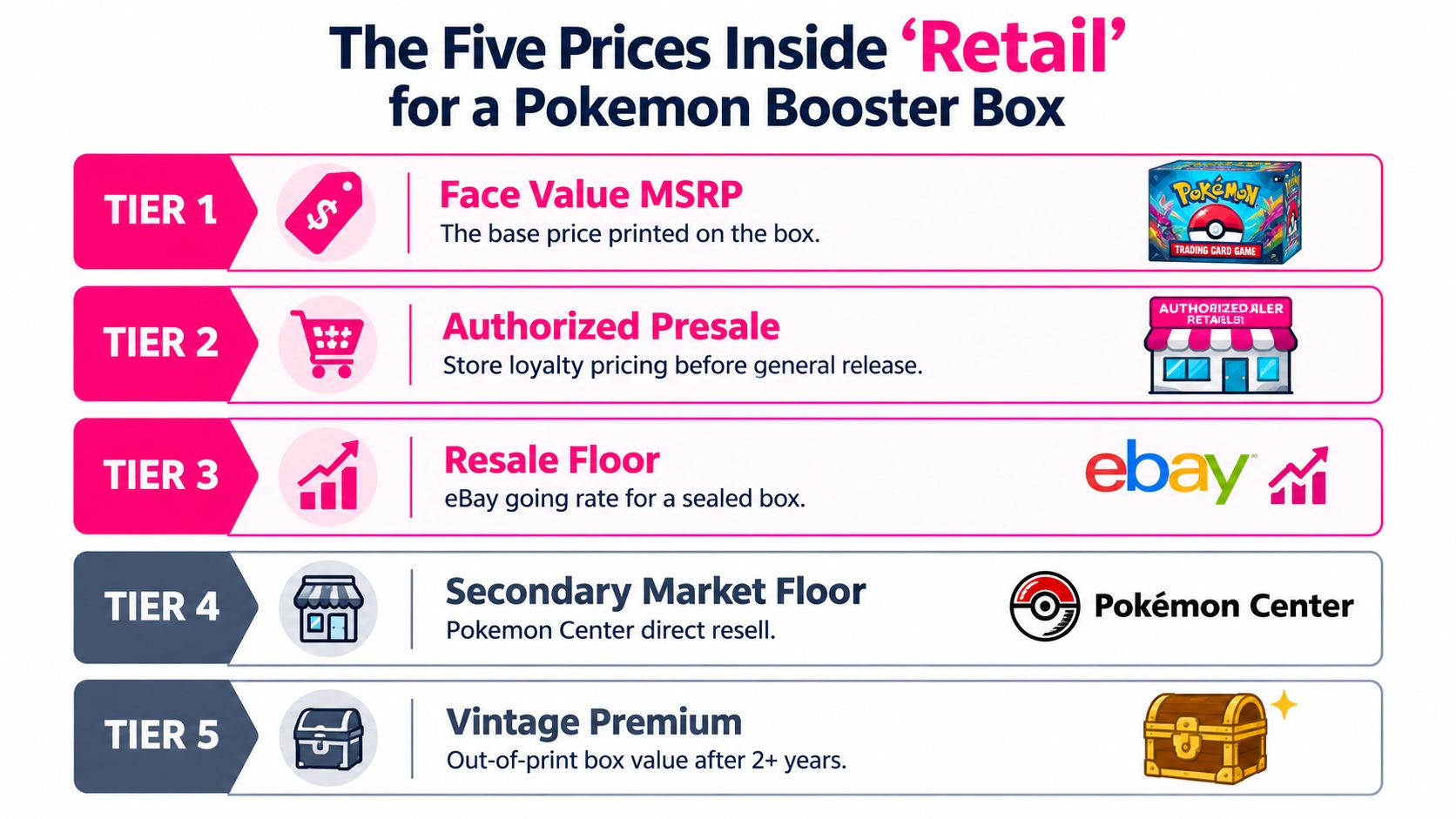
Before comparing two prices, identify the tier first. A vintage collector price, a current market listing, and an authorized retailer's offer answer different questions, even when they refer to the same type of sealed product. Further context on the language of retail pricing appears in The Five Prices Hiding Inside The Word Retail.
Hobby Channel vs Big-Box Retail and What Changes
A local game store and a national retailer may sell the same sealed Pokémon product, but the buying experience can be very different.
Hobby-channel sellers include local game stores, specialist card shops, and dedicated trading-card retailers. They tend to understand set demand, sealed condition, preorder expectations, and collector concerns. You can often ask about the product's source, inspect the box before buying, and discuss store credit or collection trades.
Big-box retailers include chains such as Target, Walmart, and Best Buy. They can offer convenient shopping and occasional access to official retail pricing, but availability may be inconsistent. A restock can disappear quickly, leaving buyers to search the secondary market immediately afterward.
| Factor | Hobby Channel, LGS or Hobby Shop | Big-Box Retail, Target, Walmart, Best Buy |
|---|---|---|
| Product knowledge | Staff often understand sets, sealed condition, and collector concerns | Knowledge varies by location and department |
| Availability | Smaller inventory, but possible preorder or direct communication | Larger retail footprint, but restocks can be unpredictable |
| Price setting | May reflect local demand, service, and stock costs | Often follows chain pricing during normal retail windows |
| Buying support | More opportunity to inspect packaging and ask questions | Usually self-service with limited product context |
| Collector relationship | May offer store credit, events, or community connections | Primarily focused on general retail transactions |
| Main tradeoff | A slightly higher price may include advice and confidence | A lower sticker price may come with limited availability |
A preorder can reduce uncertainty, but buyers should read the terms carefully. The Pokémon booster-box preorder guide can help you think through allocation, timing, and the difference between reserving a product and receiving it immediately.
Neither channel is automatically right for every purchase. Big-box retail can make sense when the product is available at a fair price and the seller is clearly responsible for fulfillment. A hobby shop may be the better fit when you care about packaging condition, seller knowledge, and the ability to resolve questions before paying.
The channel affects more than the price. It also affects how much information you receive, how easily you can inspect the product, and what recourse you have if something arrives damaged or appears questionable.
Why Booster Box Prices Drift Away from MSRP
MSRP is only one of five prices hiding inside “retail.” The others are the authorized-retailer price, the launch price, the current market price, and the vintage price. They are connected, but they answer different questions. MSRP gives a reference point. A current listing shows what a buyer may pay now. A vintage price reflects what happens after sealed supply becomes difficult to replace.
Supply changes the baseline
A box can stay near MSRP while stores receive regular shipments. Once that inventory contracts, buyers compete for the sealed boxes that remain, and the current market price can rise above both MSRP and the authorized-retailer price. A new shipment or reprint can reverse part of that movement by giving buyers another source of supply.
Scarcity works like a shrinking queue. Fewer boxes do not automatically create lasting value, but they give sellers more room to charge above the original reference.
Demand concentrates on specific sets
Collectors do not value every expansion equally. Memorable artwork, desirable chase cards, and nostalgia can draw more sealed buyers than a set with a similar pack count. Historical tracking records this difference: Fusion Strike, released in November 2021, was listed at approximately $909.31, while Sword & Shield Base Set, released in February 2020, was listed at approximately $688.99. These observations appear in the historical booster-box pricing dataset.
Those figures describe different market outcomes, not a rule that every older or popular set will reach a particular price. Set identity can matter as much as age.
Distribution creates local shortages
A product may be available somewhere while remaining difficult to find in one area. Retailer allocations, shipping timing, and regional demand can create short-lived gaps. Buyers who cannot find a box through ordinary channels may turn to resale listings, where the seller's price reflects local scarcity rather than the original retail benchmark.
That gap also explains why an authorized-retailer price and a current market price can differ on the same day.
Reprints reset expectations
A reprint can change buyer behavior quickly. Buyers who were paying a premium may wait for new supply, while sellers may lower prices to compete. A high launch price therefore does not prove that a product will become a valuable vintage box, and a quiet launch does not rule out later collector interest.
One reported example, Chaos Rising, moved from about $240 to $250 to roughly $200 by late August 2026, a decline of approximately 17%. Pitch Black reportedly moved from about $230 to $240 to $180 to $185, a decline of roughly 22% to 24%. The sealed-market analysis reports both price paths and their percentages, illustrating why launch enthusiasm and lasting demand can separate.
Ask whether supply is expanding, shrinking, or becoming harder to verify.
The walkthrough below shows how these four pressures appear in live listings:
Real Set Examples of Booster Box Price Trajectories
A sealed Pokémon box can follow several different price tracks during its life. The same product may have an official MSRP, an authorized-retailer price, a launch price, a current market price, and eventually a vintage price. These examples show how those figures separate as supply, timing, and collector interest change. They describe past price behavior, not guaranteed returns.
Journey Together shows why timing matters
Journey Together is a useful current-print example because its prices changed across the release cycle. The spread covered earlier shows why a preorder offer, an official retail reference, and a secondary-market listing should not be placed on the same timeline.
A preorder is a reservation for expected supply. A resale listing reflects a buyer who missed that window, limited availability, or a seller testing demand. Those prices work like snapshots taken at different points in a moving queue. Labeling the timing prevents an ordinary launch fluctuation from being mistaken for a permanent markup.
Evolving Skies represents an older sealed-product premium
Evolving Skies, released in 2021, shows what can happen after a set leaves regular retail circulation. Reported sealed-box prices reached $2,400 to $2,600, roughly 1,900% above its $161.64-era retail reference. The size of that gap reflects contracted sealed supply and concentrated collector demand, rather than a normal relationship between MSRP and resale value.
That result belongs to a specific product history. A popular modern set can still receive more supply, lose attention, or remain widely available, so Evolving Skies should not serve as a forecast for every sought-after release.
Set identity can separate products from the same era
Cosmic Eclipse, Unified Minds, and Team Up came from a similar broad period, yet their recorded sealed values diverged sharply. Their different outcomes show that release age alone does not determine a vintage price. Set identity, memorable cards, collector demand, and the amount of sealed product still available all influence the final market.
| Set | Release Year | MSRP | Peak Sealed Price | Current Market Range |
|---|---|---|---|---|
| Journey Together | 2025 | $161.64 reported U.S. MSRP | $180 to $190 reported secondary-market price | Varies by seller |
| Evolving Skies | 2021 | $161.64-era retail reference | $2,400 to $2,600 reported | $2,400 to $2,600 reported |
| Cosmic Eclipse | 2019 | Varies by seller | Varies by seller | Varies by seller |
Use the best Pokémon booster-box guide to compare set appeal, then check the specific box, seller, and timing. A desirable set can carry an inflated current market price, while a less fashionable set may offer better value when its supply and condition are clear.
Where to Verify Official Pricing and Spot Fair Markups
Start with the official product information whenever you can. Look for the manufacturer's listed product details, the set name, the release context, and the stated retail benchmark. Then compare that figure with several recent sealed-product sales rather than relying on one active listing.
A practical verification routine looks like this:
- Confirm the product identity: Match the set name, language, artwork, and pack format across the listing and official product images.
- Separate price types: Record the official MSRP, the seller's listed price, shipping, taxes, and any marketplace fees that affect the final total.
- Compare completed sales: Use established trading-card marketplaces to review what buyers recently paid for sealed boxes, not only what sellers hope to receive.
- Inspect the evidence: Prefer photographs of the actual box. Stock images make it harder to assess shrink wrap, corners, printing, and damage.
- Check seller accountability: Look for a clear business identity, customer-service route, return terms, and a history of selling sealed products.
Packaging deserves close attention. Modern sealed boxes commonly use branded shrink wrap, and loose plastic, uneven seams, blurry printing, or visible resealing can justify walking away. A suspiciously low price isn't proof of a counterfeit, but it should make you demand stronger evidence before checkout.
Before paying a premium: Verify the benchmark, compare recent sales, inspect the actual product, and calculate the complete delivered cost.
The cheapest listing may not be the fairest deal. Shipping, taxes, damaged packaging, weak return policies, and authenticity uncertainty can erase the apparent saving. A slightly higher price from a seller who documents condition and stands behind fulfillment may carry less practical risk.
Making a Confident Purchase Decision
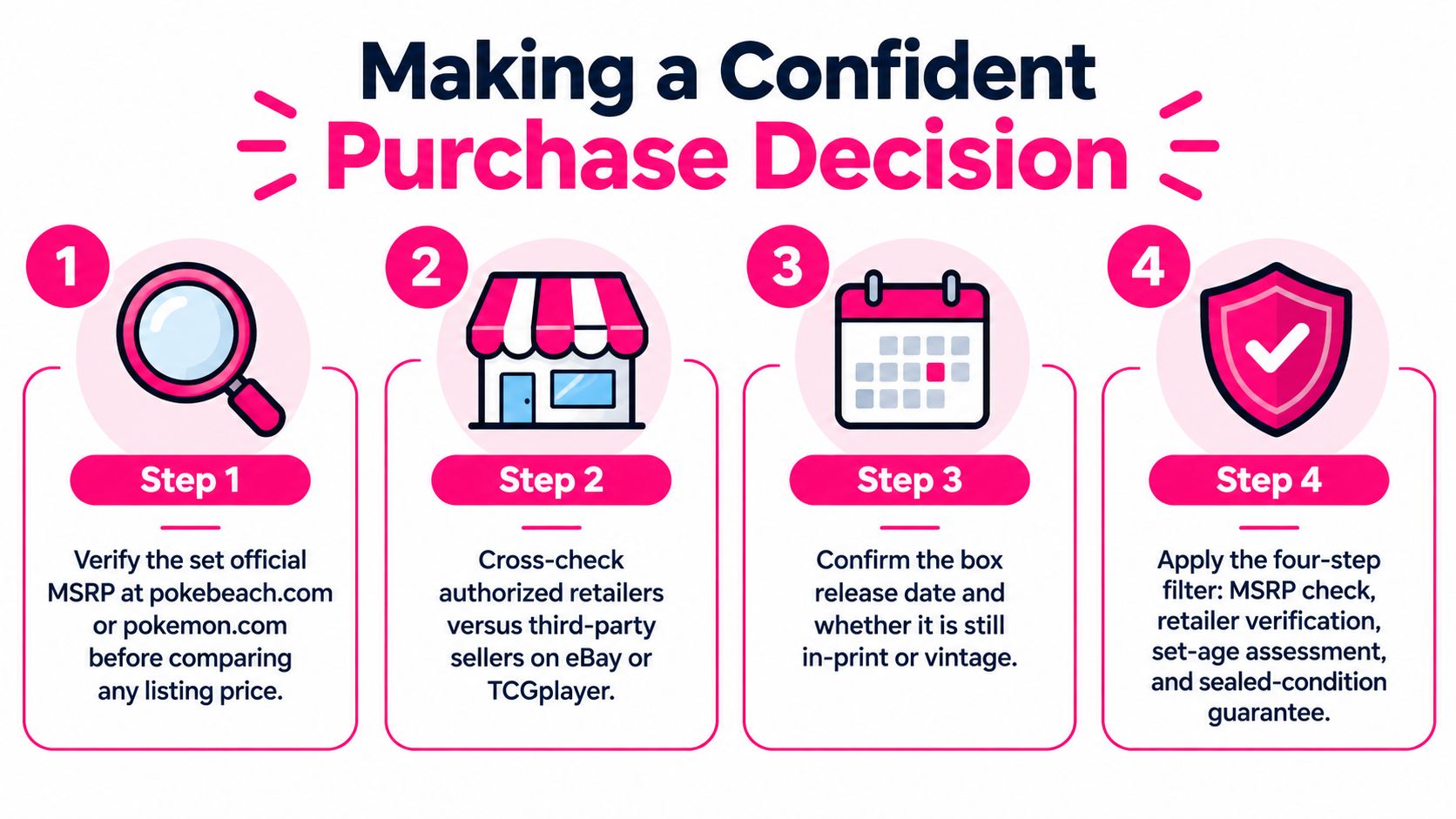
Use a simple filter before you buy.
First, verify the benchmark. Find the official MSRP or the most reliable retail reference for that specific set and format. Don't compare a discounted preorder with a vintage sealed box as if they belong to the same category.
Second, identify the seller. A Pokémon Center listing, an established hobby shop, and a third-party marketplace seller each provide a different level of access, documentation, and recourse. Confirm who holds the inventory and who will handle the order if the box arrives damaged.
Third, compare the market. Review recent sealed sales and distinguish active asking prices from completed transactions. If the listing sits far above comparable sales, ask what supports the premium. If it sits far below them, inspect authenticity and condition before celebrating the discount.
Fourth, assess the box itself. Check actual photos, shrink wrap, corners, printing, and any signs of tampering. Include shipping and taxes in your calculation, because the advertised price isn't always the amount you'll pay.
A casual buyer may decide that a current set is worth purchasing near a verified retail reference, even if the market fluctuates afterward. A collector considering an older sealed product should focus more on authenticity, condition, supply status, and liquidity than on the original sticker price.
The Pokémon booster-box buying guide offers another way to organize those checks before placing an order. Authenticated sealed inventory can suit buyers who want product verification and documented condition handled as part of the purchase rather than negotiated afterward.
Lucardio Collectibles offers authenticated sealed products, trading cards, PSA-graded collectibles, insured fulfillment, and collection-management tools for Pokémon collectors and sellers. Visit Lucardio Collectibles to review its sealed inventory and follow upcoming buying, selling, and live-commerce opportunities.