
Around 75 billion Pokémon TCG cards had been produced worldwide by March 2025, so modern cards are accessible while older or specific chase cards are comparatively scarce. That's the central reality of Pokémon card collecting for beginners: there's plenty to buy, but building a worthwhile collection requires focus, protection, and caution.
The hobby began in Japan and expanded into as many as 90 countries and regions, creating a global collecting ecosystem rather than a small specialist market. This market overview shows why a new collector can find recent products almost anywhere, yet still face serious scarcity around vintage cards, condition-sensitive singles, and narrowly pursued cards.
Treat your collection like both a personal archive and a fluctuating asset. You can collect for artwork, nostalgia, gameplay, or resale potential, but each objective changes what you should buy, how you should store it, and how carefully you should verify it.
Table of Contents
- Starting Your Pokemon Card Collection
- Understanding the Pokemon TCG Market
- Buying Sealed Products vs Singles
- Storage and Preservation Essentials
- Grading and Authentication Awareness
- Live Breaks and Digital Collection Management
Starting Your Pokemon Card Collection
The scale of Pokémon's production can feel intimidating. You're not entering a hobby with a short checklist. You're entering a catalog spanning decades, regional releases, modern expansions, promotional cards, sealed products, and professionally graded items.
That's why the first purchase shouldn't be “whatever is popular.” Start by choosing a collecting objective:
- Character collection: Focus on one Pokémon, such as Pikachu, Gengar, or Charizard, across different sets and eras.
- Set collection: Choose one expansion and work toward a defined binder goal.
- Artwork collection: Select cards because of their illustration style, artist, or visual theme.
- Gameplay collection: Buy cards that support a deck or format rather than cards with the highest resale appeal.
- Value-focused collection: Concentrate on authenticated singles, graded cards, or sealed products, while accepting that prices can move sharply.
A practical beginner roadmap
Set a spending limit before browsing. A budget protects you from buying repeatedly during a release rush, and it gives you a clear way to compare packs, sealed products, singles, and supplies.
Buy a small amount first, then inspect how you enjoy the hobby. Some collectors love opening packs. Others discover that they prefer building a complete binder, researching card condition, or buying one carefully selected single instead of many random products.
Prepare protection before the cards arrive. Keep penny sleeves, a binder, and rigid holders available so a desirable pull doesn't sit loose on a desk while you search for supplies.
Practical rule: Decide what a card must do for your collection before you decide whether it's worth buying.
For beginners who want a more controlled entry point, an established marketplace can reduce the risk associated with unknown sellers. Lucardio Collectibles presents authenticated singles, verified sealed products, and PSA-graded inventory alongside collection tools, so buyers can compare targeted purchases without treating every online listing as equally reliable. You should still review condition details, seller policies, and delivery terms before paying.
Keep a simple inventory from the first day. Record the set, card number, condition, purchase price, and storage location. That record becomes useful when you trade duplicates, prepare cards for grading, insure valuable inventory, or decide what to sell.
Understanding the Pokemon TCG Market
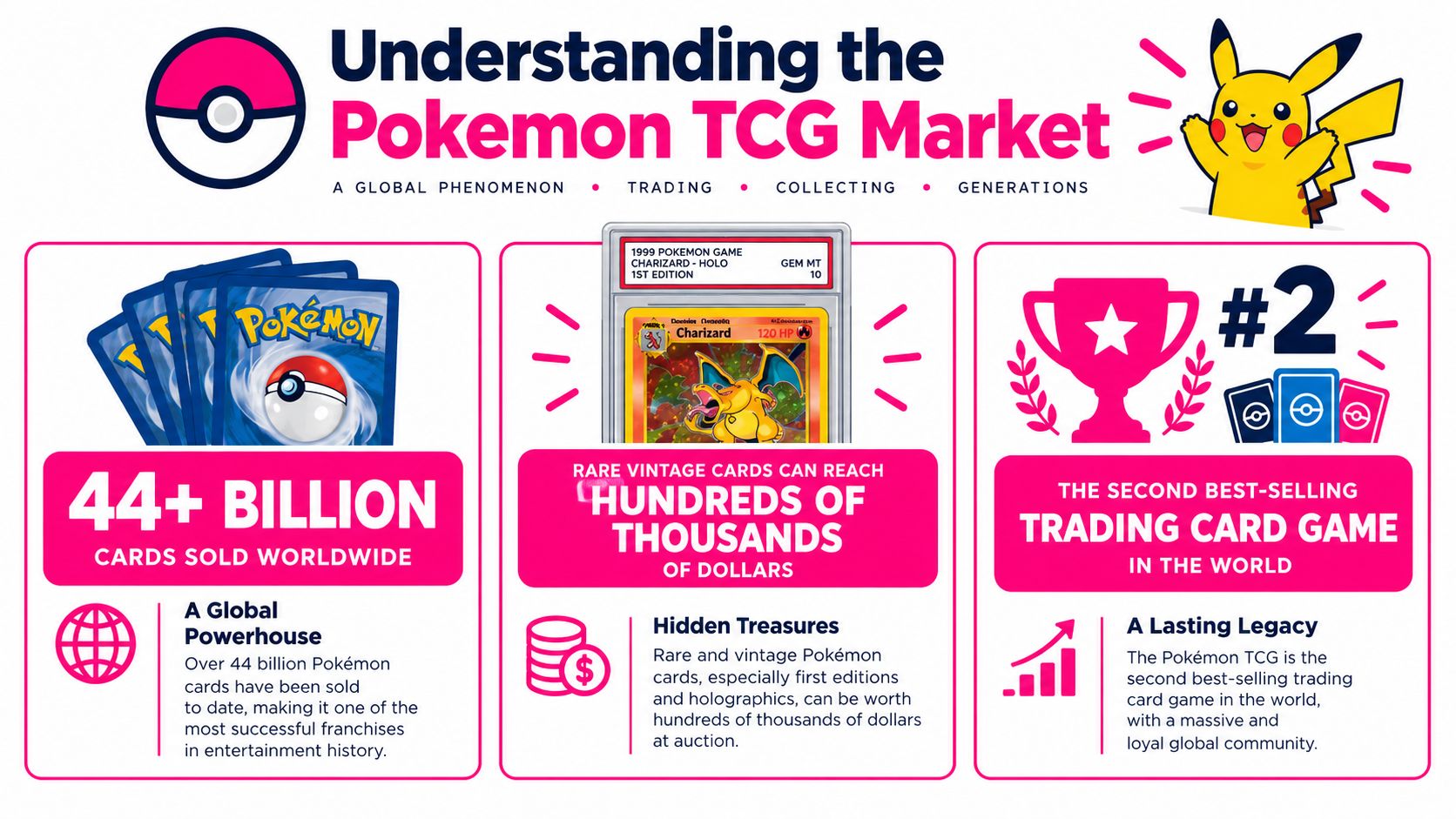
Pokémon cards don't behave like a stable retail product. Demand can accelerate around nostalgia cycles, anniversaries, new releases, competitive play, and social-media attention, while supply differs dramatically between current mass-market products and older cards.
One source reports that global Pokémon TCG sales reached $1.8 billion in 2021, up from $600 million in 2019, a 3x increase over two years. The same market evolution analysis reports category gains of more than 500% on some auction platforms during that period. Those figures describe a historical surge, not a guaranteed repeat, but they show how quickly attention and pricing can change.
What market movement means for a beginner
The key lesson isn't to predict the next spike. It's to avoid making your entire collection dependent on one.
During a hype wave, buyers often pay for urgency rather than quality. A card may attract attention because a new set has launched, a character appears in a major promotion, or an anniversary renews interest in vintage Pokémon. If you buy only because everyone else is buying, you may end up with an expensive item that doesn't fit your long-term objective.
The franchise's 30th anniversary in 2026 has been described by market commentary as a critical period for collecting, with renewed attention on vintage products. The referenced beginner market guidance also emphasizes that modern sealed products and vintage singles can differ in liquidity and volatility. For a new collector, that means “Pokémon card value” isn't one market. A recent sealed product, a raw modern chase card, and a vintage graded single each carry different risks.
Use market information to set expectations, not to justify impulsive spending. Compare multiple listings, study condition, and leave room in your budget for the possibility that demand cools.
Buying Sealed Products vs Singles
Sealed products sell you uncertainty and experience. Singles sell you precision.
Opening packs can be the most enjoyable way to discover a set, especially when you're learning what kinds of artwork, rarities, and characters appeal to you. The trade-off is that the contents are unpredictable, and repeated openings can leave you with duplicates while the card you want remains absent.
Singles work better when you have a defined target. You can choose a particular illustration, character, set number, or condition instead of paying for multiple chances at one card. The downside is that you need to evaluate centering, corners, surface quality, authenticity, seller reputation, and the gap between raw and graded condition.
| Aspect | Sealed Products | Singles |
|---|---|---|
| Primary appeal | Opening experience and unopened inventory | Targeted ownership of specific cards |
| Control | Low control over the cards received | High control over the card purchased |
| Main risk | Unpredictable contents and hype-driven pricing | Condition, authenticity, and price selection |
| Best fit | Collectors who enjoy opening or preserving sealed items | Set builders, character collectors, and focused buyers |
| Liquidity considerations | Depends on product demand, availability, and buyer interest | Depends on card demand, condition, grading, and authenticity |
Match the purchase to the objective
If your goal is to learn a set, buy a small amount of sealed product and inspect what you pull. If your goal is to complete a binder, shift toward singles once you know which cards are missing. If your goal is to preserve value, sealed products and graded singles require different storage and buying decisions, so don't treat them as interchangeable.
A disciplined collector also separates the entertainment budget from the acquisition budget. Opening a product can be worth the cost because you enjoyed the experience, even if the cards don't match the purchase price. That's different from claiming the opening was an efficient way to obtain one specific chase card.
For targeted buying, this guide to Pokémon singles can help you compare approaches before purchasing. The important distinction is simple: buy sealed when the experience or unopened format matters to you, and buy singles when the exact card matters more than the thrill of discovery.
Storage and Preservation Essentials
A card's condition can deteriorate without any dramatic accident. Moisture swings, heat, friction, sunlight, dust, and careless handling can create warping, surface scratches, mold, or brittle cardstock. Preservation starts immediately after opening or receiving the card.
Use a three-tier system rather than putting every item in the same type of storage.
Tier one for everyday raw cards
Place ordinary raw cards in penny sleeves before putting them into a binder. A sleeve limits contact with skin oils and surface debris, while a good binder keeps cards organized and reduces loose handling.
Use binders for cards you want to view or access regularly. Don't overfill pages, force thick cards into narrow pockets, or push cards into sleeves that create excessive pressure. Store the binder upright or flat in a clean area, away from direct UV exposure.
Tier two for valuable singles
Put more valuable raw cards in a sleeve and then a rigid holder, such as a top loader. The sleeve should sit between the card and the rigid plastic, because inserting a raw card directly can create scratches or catch an edge.
Choose holders sized for trading cards and keep the cards supported without bending. A rigid card holder guide covers the role of rigid protection for cards that need more security than a binder page provides.
Tier three for long-term inventory
Keep long-term inventory in a stable indoor environment with humidity around 40–50% and temperature roughly 18–22°C, as recommended in this card storage guidance. A hygrometer lets you monitor conditions instead of guessing. If relative humidity rises above 60% or falls below 30%, silica gel or dehumidification can help restore a safer range.
Avoid basements, attics, garages, windowsills, and areas exposed to direct sunlight. These spaces often experience temperature and moisture changes that damage cardboard over time.
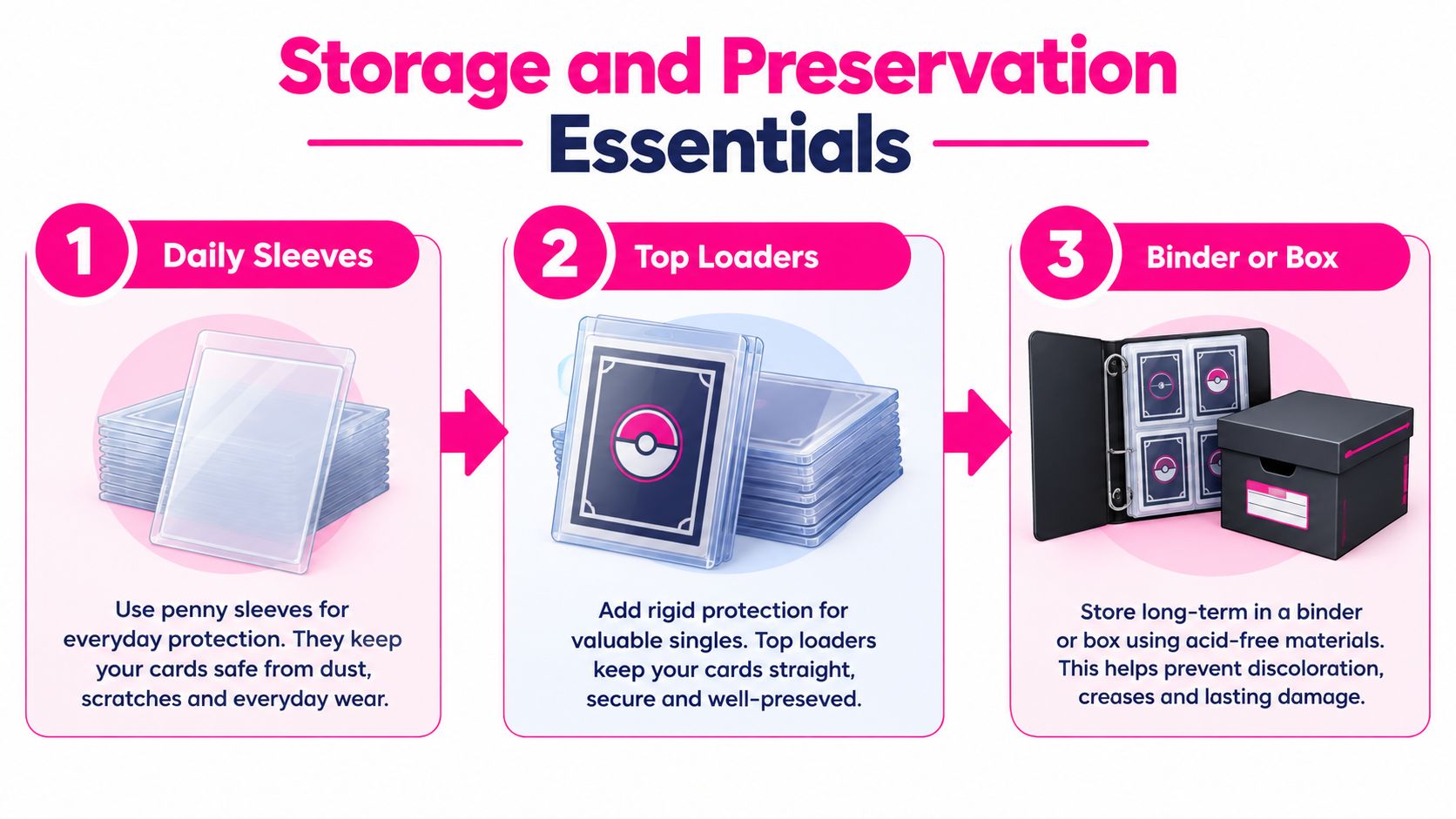
The system works because each layer solves a different problem. Sleeves reduce contact and friction, binders provide organization and display, rigid holders limit bending and impact, and stable environmental conditions reduce long-term physical degradation.
For a visual demonstration of basic handling and preservation, watch the following:
Grading and Authentication Awareness
Grading can increase confidence around condition, but it doesn't turn every attractive card into a top-grade asset. A card can look excellent at normal viewing distance and still lose points because of off-centering, edge wear, a print line, whitening, or a surface defect visible under strong light.
A 2026 analysis of 55,000 cards reported that 6.7% earned a perfect 10, while 24.4% reached 9.5 or higher and 56.3% scored 9 or higher. The referenced grading analysis makes the practical point clear: a strong grade is more probable than a perfect grade, but a perfect grade remains a meaningful condition threshold.
Pre-screen before you submit
Inspect the card under a bright, angled light before spending money on grading.
- Corners: Look for whitening, dents, soft tips, and uneven cuts.
- Centering: Compare the visible borders on the front and back rather than judging from memory.
- Surface: Tilt the card slowly to reveal scratches, print lines, dents, and marks.
- Edges: Check for chipping and factory damage, particularly on dark borders.
- Handling: Keep the card sleeved while moving it, and don't touch the surface unnecessarily.
The market had more than 26 million graded cards in 2025, according to the same source. High grading volume makes careful selection more important, not less. Submitting every exciting pull can turn grading into an expense attached to cards that were never strong candidates.
Authentication demands the same discipline. Counterfeits now include cards with darker inner layers, so the old light test alone isn't sufficient. Compare the back print with a known genuine card, inspect fonts and spacing, feel the texture, review the holo pattern, and check the certification number on a slab.
Authentication rule: Treat several consistent checks as evidence. Never let one quick test decide whether an expensive card is genuine.
For slab purchases, this guide to spotting fake PSA slabs provides a useful checklist. If a seller resists detailed photographs, avoids questions about provenance, or offers a valuable card far below comparable listings, walk away. A missed purchase is cheaper than an unverified counterfeit.
Live Breaks and Digital Collection Management
Live breaks change the buying experience from a silent checkout into a visible event. You can watch sealed products opened in real time, follow the allocation or bidding process, and see the cards handled as they enter the market. That transparency doesn't remove risk, so buyers should still understand the format, fees, shipping arrangements, and what happens if a card is pulled.
Live auctions add a different kind of pressure. A closing timer can encourage emotional bidding, especially when several viewers want the same slab or chase card. Set your maximum before the auction becomes competitive, then stop when the price passes it.
The advantage of an integrated platform is organization. Instead of tracking purchases across separate marketplaces, livestreams, messages, and spreadsheets, collectors can use authenticated inventory, event participation, transaction records, and an online vault in one account. A digital vault is especially useful when you want to keep a record of owned cards, display your collection, or prepare items for a future sale.
For a beginner, the safest workflow is straightforward:
- Choose a clear objective: Know whether you're buying for play, artwork, completion, or long-term ownership.
- Set a maximum price: Decide your limit before a live auction starts.
- Verify the item: Review authentication, condition details, and slab certification information.
- Record the purchase: Save the card, price, date, and storage location in your collection records.
- Protect it immediately: Move the physical card into the appropriate sleeve, holder, or controlled storage environment.
Lucardio Collectibles combines authenticated singles, sealed inventory, graded items, live breaks, real-time auctions, and a Card Vault for organizing owned cards. That model can make participation easier to manage, but the underlying discipline remains yours: buy deliberately, verify before paying, and preserve every card according to its condition and intended use.
Lucardio Collectibles brings authenticated Pokémon singles, sealed products, PSA-graded items, live breaks, auctions, and Card Vault collection management into one platform. Visit Lucardio Collectibles to explore verified inventory and build your collection with authentication and preservation in mind.