

A Pokémon card's rarity is determined by more than its printed symbol. A card can be a 1-in-8 Illustration Rare, compete against dozens of cards in its tier, and still become much scarcer in top condition when only a small share of graded copies reaches PSA 10.
That's the counterintuitive part of Pokémon cards rarity. The black star, the secret-rare designation, or the language on the card gives you a starting point, but it doesn't tell you how many copies exist, how difficult one specific card is to pull, or how many high-grade examples remain available.
Collectors often use “rare” as if it were a complete market description. It isn't. Rarity has several layers, and each layer answers a different question:
- Printed rarity: What symbol or tier does the card carry?
- Pack rarity: How often does that tier appear in sealed product?
- Card-level rarity: How many cards compete for that tier?
- Distribution scarcity: Was the card widely packed, promoted, or given to a limited audience?
- Condition scarcity: How many copies survived in a grade buyers want?
- Market rarity: How strong is demand for the scarce copies that actually exist?
A useful rarity analysis combines all six. That approach prevents a common mistake, treating every card with the same star or rarity label as equally scarce. It also explains why an attractive illustration can command attention while a technically rare card remains easy to find, and why a card from a less dramatic tier can become valuable when its supply is limited and its demand is concentrated.
Table of Contents
- Understanding Pokémon Cards Rarity as a Layered System
- How Pokémon Card Rarity Symbols Work
- Pull Rates and the Two-Layer Rarity Model
- Graded Scarcity Versus Pack Rarity
- Why Printed Rarity Does Not Always Match Market Rarity
- How to Identify Truly Rare and Chase Cards
- Building a Practical Rarity Strategy for Collectors and Sellers
Understanding Pokémon Cards Rarity as a Layered System
The original Pokémon TCG made rarity easy to read. The first Base Set era used a black circle for common cards, a black diamond for uncommons, and a black star for rares. In that early pack structure, the rare slot was effectively guaranteed at one per pack, so the black star identified the rare position without making every rare card equally scarce in the wider market. This foundation dates to the first internationally released Pokémon TCG products in 1999, and it still shapes how collectors discuss older and newer sets in the historical overview of Pokémon pull-rate realities.

Modern products require a different mental model. A rarity tier can appear at a known slot rate, but an individual card must compete with every other card assigned to that tier. That distinction is the first major separation between symbolic rarity and effective scarcity.
The six questions behind a rarity assessment
Start with the symbol, but don't stop there. A careful buyer should ask:
- What does the printed mark identify? It may describe a broad production tier rather than one card's exact supply.
- How often does the tier appear? A difficult pull slot creates scarcity at the tier level.
- How many cards share the tier? More competition spreads the available hits across more designs.
- How was the card distributed? A booster card, a retail promo, and a contest card can have entirely different supply histories.
- How many copies graded well? Surface flaws, centering, and edge wear can reduce the supply of desirable slabs.
- Who wants the card? Scarcity creates a premium only when buyers care about that character, artwork, set, language, or grade.
This framework also clarifies why price isn't a direct translation of rarity. A card with a dramatic symbol may have broad supply, while a card with less impressive labeling may have restricted distribution or a very small high-grade population. Demand then determines whether that scarcity becomes visible in market prices.
Practical rule: Treat the symbol as an index label, not as a complete valuation.
The most reliable buying decisions come from comparing pack mechanics with card-level competition and then checking authenticated population data. That process takes longer than reading a star, but it gives you a much more realistic view of scarcity.
How Pokémon Card Rarity Symbols Work
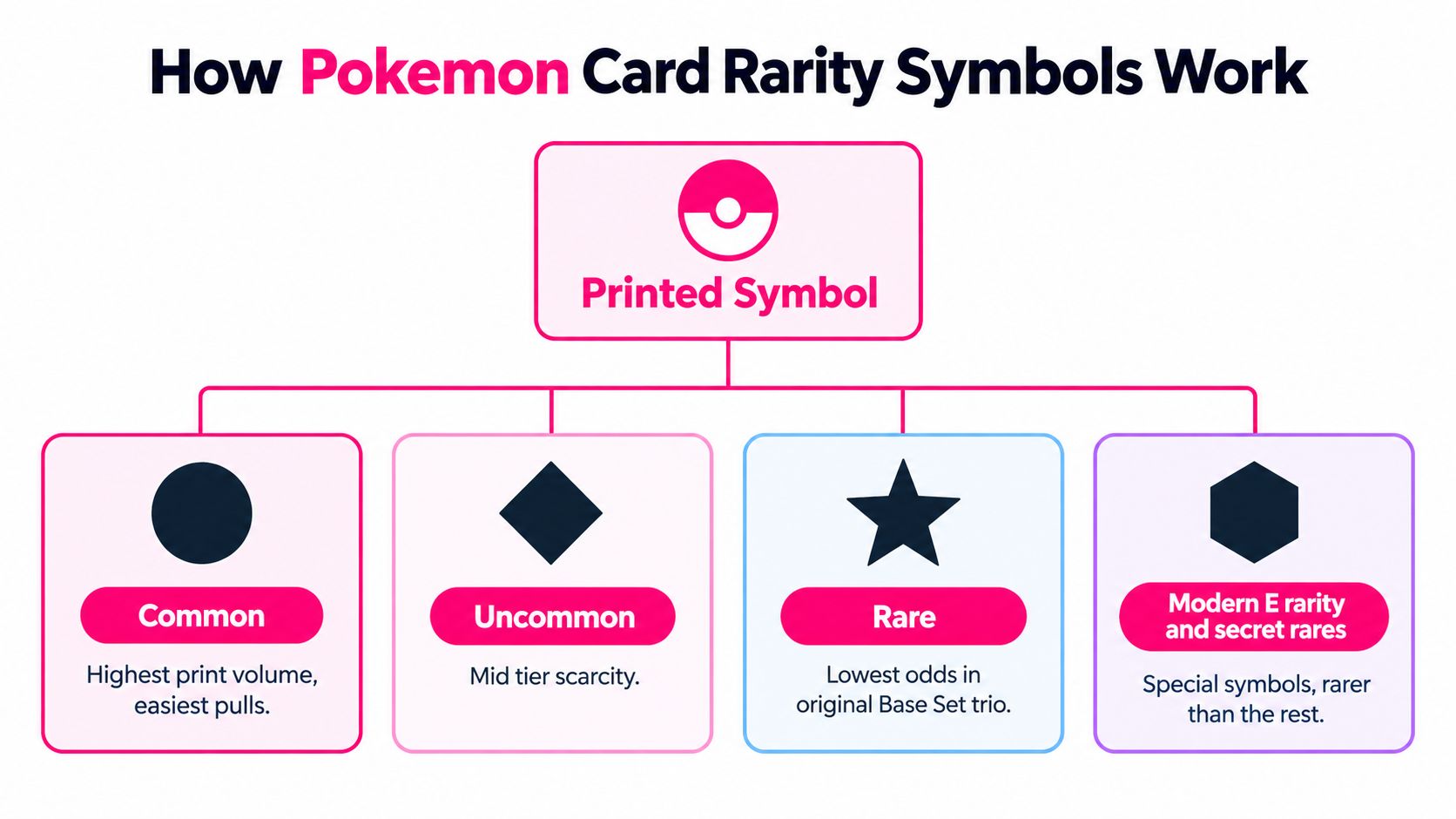
The classic symbols are still the correct place to begin, particularly with vintage cards. In the original Base Set framework, the black circle marked a common, the black diamond marked an uncommon, and the black star marked a rare. The rare position was effectively guaranteed at one per pack in that Base Set model, so the star told collectors which card occupied the rare slot rather than proving that every star card had the same long-term population. These details are documented in the reference guide to the original Pokémon rarity structure.
Reading the original map correctly
Common cards sit at the broadest end of the print hierarchy. Uncommons occupy the next tier, while rares represented the lowest pull frequency within that original three-symbol system. Those labels are useful for identifying a card's place in a set, but they don't reveal the character's popularity, the card's condition, the size of the print run, or the number of copies that later entered grading.
That limitation matters even more when comparing eras. A black star from an older set and a card from a modern chase tier don't necessarily measure scarcity in the same way. The old symbol is a broad category. Modern products added more granular layers, including illustration-driven and secret-style tiers that separate visually and statistically scarce cards from ordinary rare-slot cards.
The symbol therefore answers “What production category was this card assigned to?” It doesn't automatically answer “How difficult is this exact card to obtain today?”
Why modern symbols need context
Collectors now use “rarity” in two related ways. The first is the printed designation on the card. The second is the practical pull ratio, meaning how hard the card is to obtain within its expansion. A card may carry an attractive rarity label but remain relatively accessible if many cards compete for that tier or if the product has been heavily printed.
Set identification also matters before comparison. Confirm the expansion, card number, language, and version before using a rarity symbol to compare two cards. The same broad label can describe cards from different release contexts, and those contexts can produce very different supply conditions.
The original circle, diamond, and star remain the standard visual reference for vintage and modern discussions. They're a map, not a market verdict. Use them to classify the card, then move to pull rates, tier size, distribution history, and grade population.
Pull Rates and the Two-Layer Rarity Model
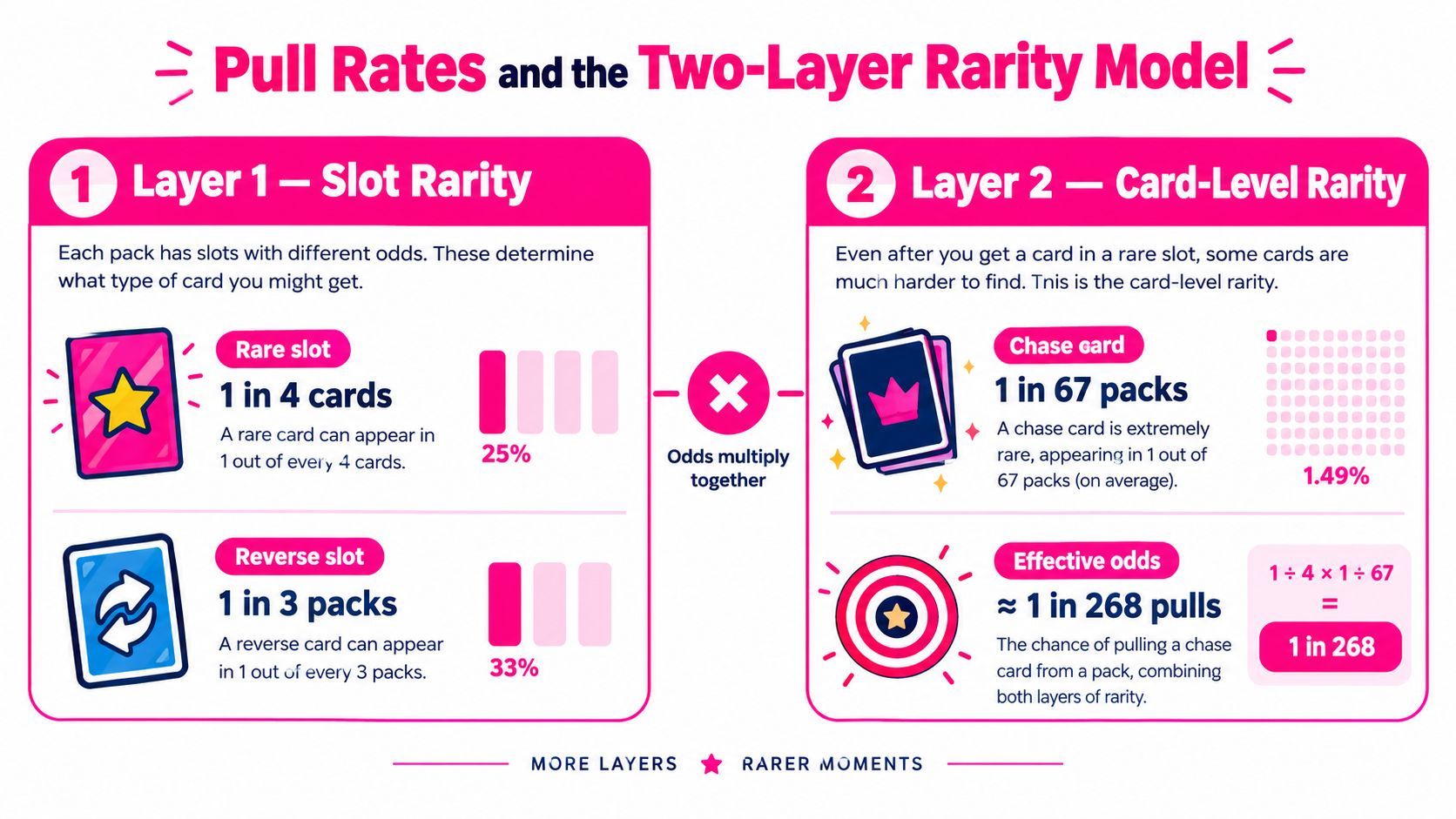
Modern chase hunting becomes clearer when you separate slot rarity from card-level rarity. Slot rarity measures how often a tier appears in a pack. Card-level rarity measures how often one specific card appears after all cards in that tier compete for the same opportunity.
Suppose a set has 25 Illustration Rares and the Illustration Rare slot appears at one in 13 packs. The tier is uncommon at the slot level, but any one of those 25 cards has only a share of the available opportunities. The resulting estimate is roughly one in 325 packs for a specific Illustration Rare, as explained in the pull-rate methodology for card-level scarcity.
Slot rarity is only the first filter
Think of a booster pack as a series of opportunities. A particular slot can produce a certain category, but the category contains multiple possible cards. The calculation therefore has two stages:
Tier appearance rate × competition within the tier = effective odds for one card
This explains why two cards that share the Illustration Rare designation can still have different market behavior. Their pack-level category is identical, but their demand may differ, and their actual supply can vary by language, release, and the number of copies collectors choose to preserve.
Independent collecting guides place lower-tier modern hits such as Illustration Rares around one in eight packs. They place Special Illustration Rares between one in 45 and one in 91 packs, depending on the set, while some Hyper Rares can be as difficult as one in 1,000 packs. Those ranges come from the modern Pokémon card rarity and pull-rate guide. The spread matters because a label like “secret rare” doesn't provide one universal probability across all expansions.
Why tier size changes the buying decision
A large tier can make an individual card less difficult to find than the headline rarity suggests. A smaller tier can concentrate scarcity among fewer cards. That means buyers should compare cards at the card level, not just at the set-label level.
The distinction becomes even sharper with historical distribution cards. Japanese trophy and contest cards from the late 1990s could be distributed outside ordinary booster channels. One documented distribution set totaled 39 copies across three contest rounds, creating a scarcity profile that pack odds cannot describe. The supply limit came from the release context, not from a booster slot.
For collectors, this produces a practical split:
- A modern card can be statistically difficult to pull but still have a substantial surviving supply after widespread product opening.
- A promotional card can have no conventional booster pull rate yet remain extremely scarce because distribution was restricted.
- A card in a crowded tier may be less scarce than its label implies.
- A card in a limited tier may deserve closer examination even if its printed designation sounds less dramatic.
If you're deciding whether to open sealed product or buy a single, compare the relevant card-level odds first. A guide to Pokémon booster boxes can help frame the sealed-product decision, but the key question remains the same: how many competing cards occupy the chase slot, and how much do you value one specific outcome?
Graded Scarcity Versus Pack Rarity
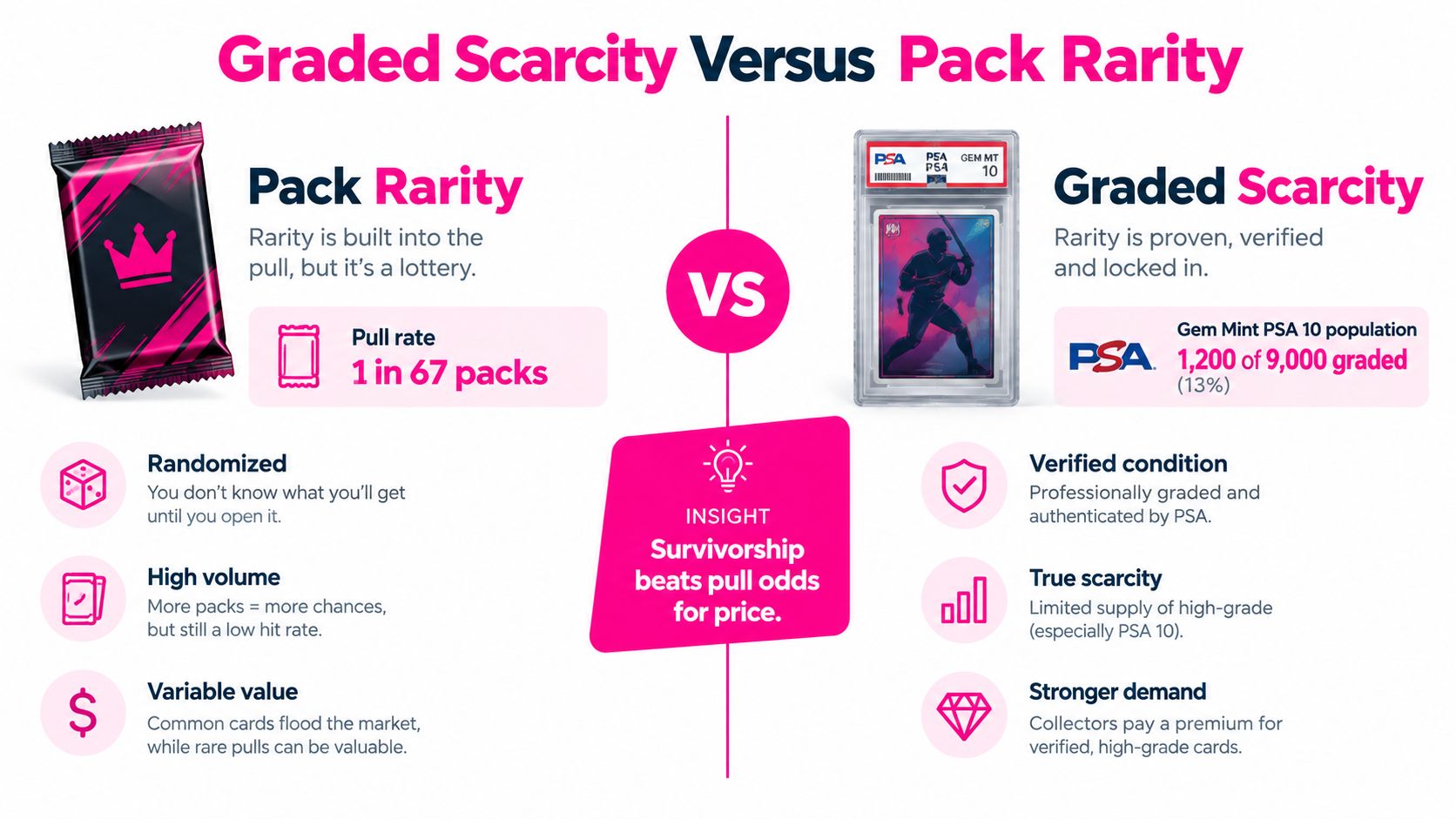
Pack rarity describes the chance of finding a card in sealed product. Graded scarcity describes how many copies survived the journey from opening to submission, authentication, and a target grade. For buyers focused on PSA slabs, the second measurement can be more useful than the first.
The relevant benchmark is the PSA 10 rate, calculated as PSA 10 population divided by total graded population. In a cited Generations population report, 22,253 cards across 141 cards had been graded, while 2,291 copies received PSA 10. That produces a 10.3% gem-mint conversion rate, according to the PSA population analysis of rarity and grading outcomes.
Survivorship changes the supply picture
A raw card can be obtainable without a buyer having many appealing high-grade copies to choose from. Centering, surface condition, corners, and edges all influence whether a submission reaches the grade a collector wants. If a card is vulnerable to manufacturing flaws or handling damage, grading can remove a large share of nominal supply from the premium segment.
That creates two different inventories:
| Supply question | What it tells you |
|---|---|
| How often was the card pulled? | Theoretical availability from sealed product |
| How many copies were graded? | Submission and authentication activity |
| How many reached PSA 10? | Availability at the top condition level |
| How does the grade distribution look? | Whether premium copies are plentiful or constrained |
The distinction is important for sellers too. A raw card may appear to be a straightforward listing, but a graded copy has a visible condition record. Buyers can evaluate the grade rather than relying only on seller language such as “pack fresh” or “near mint.”
The card's printed rarity describes its origin. The population report describes its surviving premium supply.
Applying population data without overreading it
A population report isn't a complete census of every card in existence. It records submitted and graded copies, not unopened product or raw cards sitting in collections. Still, grade distribution gives buyers a practical view of authenticated supply, especially when the purchase decision centers on PSA 10 rather than on raw ownership.
Compare cards within the same demand category and set context. A low PSA 10 share can signal condition difficulty, but it doesn't automatically make an unpopular card desirable. Scarcity has to meet demand. Conversely, a widely recognized character with a restricted top-grade population may attract stronger competition than the printed symbol alone would suggest.
For a trading platform or collection manager, the useful comparison is not “rare versus common.” It is raw supply versus authenticated supply versus top-grade supply. That sequence turns a vague rarity claim into a more measurable buying question: how many copies can a collector realistically purchase in the condition they want?
Why Printed Rarity Does Not Always Match Market Rarity
A printed rarity symbol records a card's position in a production system. Market rarity reflects the interaction between supply, demand, artwork, print strategy, language, and condition. Those systems overlap, but they aren't interchangeable.
A heavily printed modern card can carry an impressive label while remaining available across raw listings and graded inventory. A less celebrated card can be harder to source because the set was less widely opened, the release was restricted, or collectors preserved fewer copies. Demand then decides whether that scarcity becomes a meaningful premium.
Demand concentrates around specific designs
Recent market coverage describes a split between modern and older segments. The cited report describes modern singles as down roughly 20% to 45% from 2025 peaks and modern sealed product as down 20% to 50%, while vintage and low-pop authenticated cards remain at records. These figures are presented in the 2026 market discussion of Pokémon cards, and they support a broader conclusion: buyers don't distribute attention evenly across every rarity tier.
Illustration-led cards can concentrate demand because the artwork gives collectors a reason to own a particular card, not merely a reason to complete a rarity category. Japanese special art rares and Eeveelution alternate-art cards are cited as continuing to attract strong demand, while mass-printed modern cards are described as weaker. The market therefore evaluates a card through both its scarcity and its emotional or cultural appeal.
That creates opportunities on both sides of the market:
- A hyped card may be less scarce than its branding suggests.
- A limited card may remain underpriced when few buyers recognize its distribution history.
- A technically rare card can underperform if demand for its character and artwork is narrow.
- A familiar character can support a premium even when the card's rarity tier isn't the highest.
Anniversary releases can change the reference point
Pull-rate design can also weaken the connection between a premium label and actual scarcity. One recent report describes anniversary and special releases with much higher pull rates than older products, including cards that once appeared around once in 100 packs appearing around once in 18 packs in a 30th-anniversary release. Because this claim concerns a specific release and is reported as an emerging development, it should be treated as product-specific rather than applied to all anniversary sets. The larger lesson is that collectors must check the actual release mechanics instead of assuming that a familiar chase label carries an old scarcity profile.
A sealed product decision should account for that distinction. The sealed-pack guide can sit alongside current pull-rate information, but neither a sealed label nor a printed rarity symbol replaces card-level analysis.
How to Identify Truly Rare and Chase Cards
A reliable rarity check works from broad identification toward narrower supply evidence. Don't begin with the market price or the character's popularity. First confirm what you have.
Start with the card's identity
Record the set, card number, language, finish, and printed symbol. Version errors can distort comparisons, particularly when normal, foil, promotional, and special-art printings look similar at a glance. The symbol tells you the card's broad production category, while the set number helps establish which checklist and tier structure apply.
Then locate the card's tier. Ask whether it belongs to a common, uncommon, ordinary rare, Illustration Rare, Special Illustration Rare, Hyper Rare, or another product-specific category. Don't assume that a modern designation has the same pull behavior in every expansion.
Measure competition inside the tier
Next, find the relevant slot rate and count the cards competing for that slot. The important figure isn't only the chance of hitting the tier. It's the chance of hitting the exact card.
Use this working sequence:
- Confirm the slot: Identify the pack position or product distribution mechanism.
- Find the rate: Use a set-specific pull-rate source where available.
- Count the competitors: Determine how many cards share the tier.
- Estimate effective scarcity: Combine the tier opportunity with the number of possible cards.
- Check distribution: Separate booster cards from promos, contest cards, and regional releases.
- Review grade supply: Compare total graded copies with PSA 10 availability.
- Test demand: Look for sustained interest in the character, artwork, language, and set.
A Pokémon parallel set guide can help when the card belongs to a product with multiple related versions, but identification still comes first. A parallel treatment may change collectability without changing the broad rarity symbol.
Use market rarity as the final filter
A chase card earns that description through combined evidence, not through a dramatic name. Strong candidates show some combination of difficult effective odds, limited distribution, a constrained high-grade population, and concentrated buyer demand.
If one signal conflicts with the others, slow down. A low pull rate with a broad graded population may not be as scarce as it sounds. A modest printed rarity with restricted distribution and few top-grade copies may deserve closer attention. The best buying decisions come from resolving that conflict rather than choosing the most impressive label.
Building a Practical Rarity Strategy for Collectors and Sellers
Evaluate Pokémon card rarity in layers: symbol first, pull rate second, tier competition third, distribution history fourth, and graded population last. Then add demand, because scarcity without interested buyers doesn't automatically create a premium.
For collectors, this process reduces hype-driven purchases. For sellers, it helps separate ordinary inventory from cards that deserve authentication, detailed condition disclosure, or a more careful listing. Keep the evidence attached to each card, including its set identity, language, version, pull context, and grade population.
Lucardio Collectibles offers authenticated singles, sealed products, and PSA-graded items, alongside live breaks, auctions, collection storage, and insured fulfillment. Those features give collectors and sellers one place to compare verified inventory against the layered rarity signals that matter.
Visit Lucardio Collectibles to browse authenticated Pokémon singles, sealed products, and graded cards with clearer condition visibility. Use the platform's live auctions, breaks, and collection tools to make rarity-based decisions with verified inventory rather than printed symbols alone.