
Most advice about Pokémon cards worth money starts with a million-dollar auction and ends with a list of famous names. That approach is entertaining, but it misleads collectors. A valuable Pikachu Illustrator card proves that an exceptionally rare, authenticated card can command an extraordinary price. It doesn't prove that your childhood binder is an investment.
The market is sharply polarized. A small group of scarce, desirable cards attracts serious money, while the overwhelming majority of Pokémon cards are worth less than a dollar, according to independent collection valuation coverage. Your job isn't to search every card for a miracle. It's to identify the few cards with genuine scarcity, strong demand, and a realistic path to a premium grade.
Table of Contents
- The Harsh Reality of Pokémon Card Valuation
- Long-Term Market Growth and Asset Momentum
- Identifying Rarity and Print Run Variations
- The Non-Linear Economics of PSA Grading
- Record-Breaking Sales and Auction Psychology
- Population Reports and Future Scarcity Risks
- Streamlining Valuation and Secure Liquidation
The Harsh Reality of Pokémon Card Valuation
The most common mistake is treating age as a valuation shortcut. A card can be old, nostalgic, and visually appealing without being liquid or expensive. Even mixed childhood binders often total only about $10 to $40, while most cards ever printed remain below a dollar, as documented by collection valuation analysis.
That gap between nostalgia and market value matters. Sellers frequently remember opening a card, trading it at school, or storing it in a binder for years. Buyers don't pay for that history unless the card also has scarcity, condition, character demand, or a specific print variation. Emotional significance may make a card worth keeping, but it doesn't create a sale price.
Triage before you price
Start with a fast physical sort. Don't sleeve every common card or send an entire binder to a grading company.
- Separate obvious bulk: Move common, uncommon, energy, and ordinary non-holo cards into a separate pile unless a specific card has unusual play demand or a recognized variation.
- Pull visual premiums: Set aside holographic cards, full-art cards, illustration rares, secret rares, promos, and cards with unusual numbering.
- Inspect older cards: Look for edition stamps, shadowless layouts, early set symbols, and holo surfaces. These features warrant closer identification, not automatic grading.
- Protect first: Handle candidates by the edges and place them in clean sleeves before checking prices. Surface scratches and corner whitening can destroy the grade premium.
- Check actual sales: A listed price is an asking price. A completed sale gives you evidence that a buyer accepted a particular amount for a particular condition.
Practical rule: A card belongs in the investment conversation only after you can identify its exact set, printing, condition, and recent market demand.
Modern cards make the sorting problem harder because rarity symbols alone don't settle value. Some ordinary cards can briefly attract player demand, while many flashy modern hits are printed heavily enough that their premiums fade. The market rewards accurate identification, not dramatic artwork by itself.
Treat the collection as inventory. Find the candidates first, verify them second, and spend money on grading only when the likely outcome justifies the fee.
Long-Term Market Growth and Asset Momentum
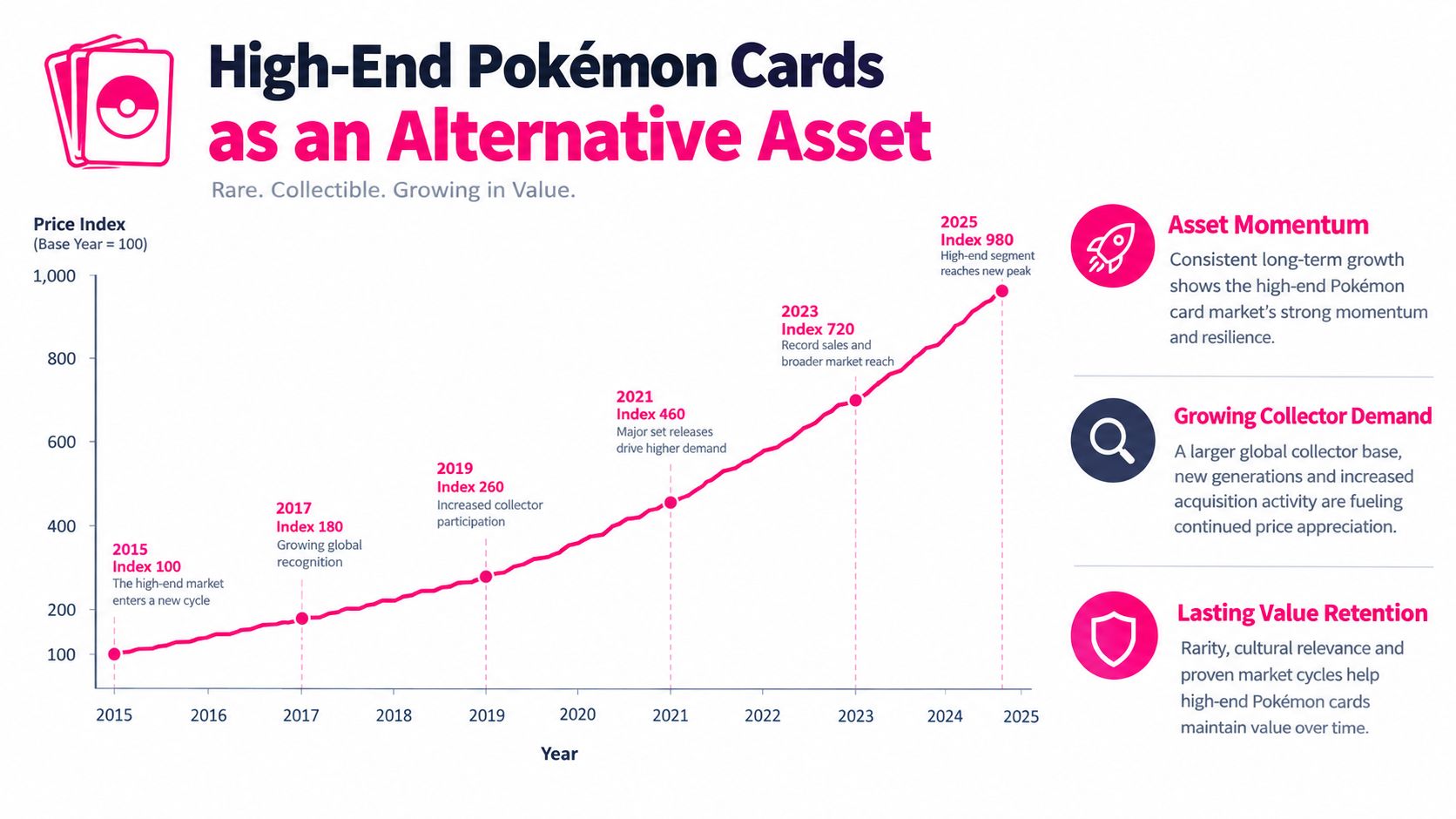
The high-end Pokémon market has produced more than isolated celebrity purchases. CNBC reported that an index compiled by Collectors showed Pokémon card prices rising 282% from 2004 to 2020 and another 1,350% since 2020. The same CNBC market report said buyers spent $450 million on cards in January 2026 alone, while the tracked basket was about 6,208% higher in 2026 than in May 2004.
Those figures describe an index and market activity, not the return of every card in circulation. That distinction is essential. The broad trend supports the idea that desirable Pokémon cards can function as a collectible asset class, but it doesn't erase the market's internal hierarchy. Iconic characters, scarce printings, vintage condition, and certified examples sit in a different category from ordinary modern pulls.
Momentum doesn't remove selection risk
The market's depth helps explain why premium cards remain attractive to serious collectors. A large buyer base creates more opportunities to sell, compare transactions, and discover price differences between raw and graded copies. It also creates competition for cards that combine recognizable Pokémon, limited supply, and strong visual appeal.
The historical numbers don't justify buying any card just because it has increased recently. They justify studying the segments that generated the growth. A serious buyer should ask:
- Is the card scarce in the grade being considered?
- Does the character have durable collector demand?
- Is the print run understood, or could additional supply appear?
- Can the card be authenticated and sold through a credible market?
- Does the purchase price leave room for fees, grading, and liquidation friction?
For more focused purchasing ideas, use this guide to Pokémon singles to buy as a starting point, then validate each candidate against actual sold listings and population data.
Authentication matters because premium buyers need confidence that the card's identity and condition are accurately represented. At the top of the market, a trusted grade isn't decorative packaging. It turns condition into a standardized signal that buyers can compare across transactions.
The sensible conclusion is narrow but powerful: Pokémon cards have demonstrated long-term market momentum, but selection determines whether you participate in that market or merely own a large quantity of low-value cardboard.
Identifying Rarity and Print Run Variations
Rarity starts with the card's production details, not its current asking price. Before you assess centering or decide whether to submit a card, establish exactly what you have. Two cards featuring the same Pokémon can occupy completely different market tiers because of a print variation, set origin, promo status, or numbering convention.
Read the card, not the hype
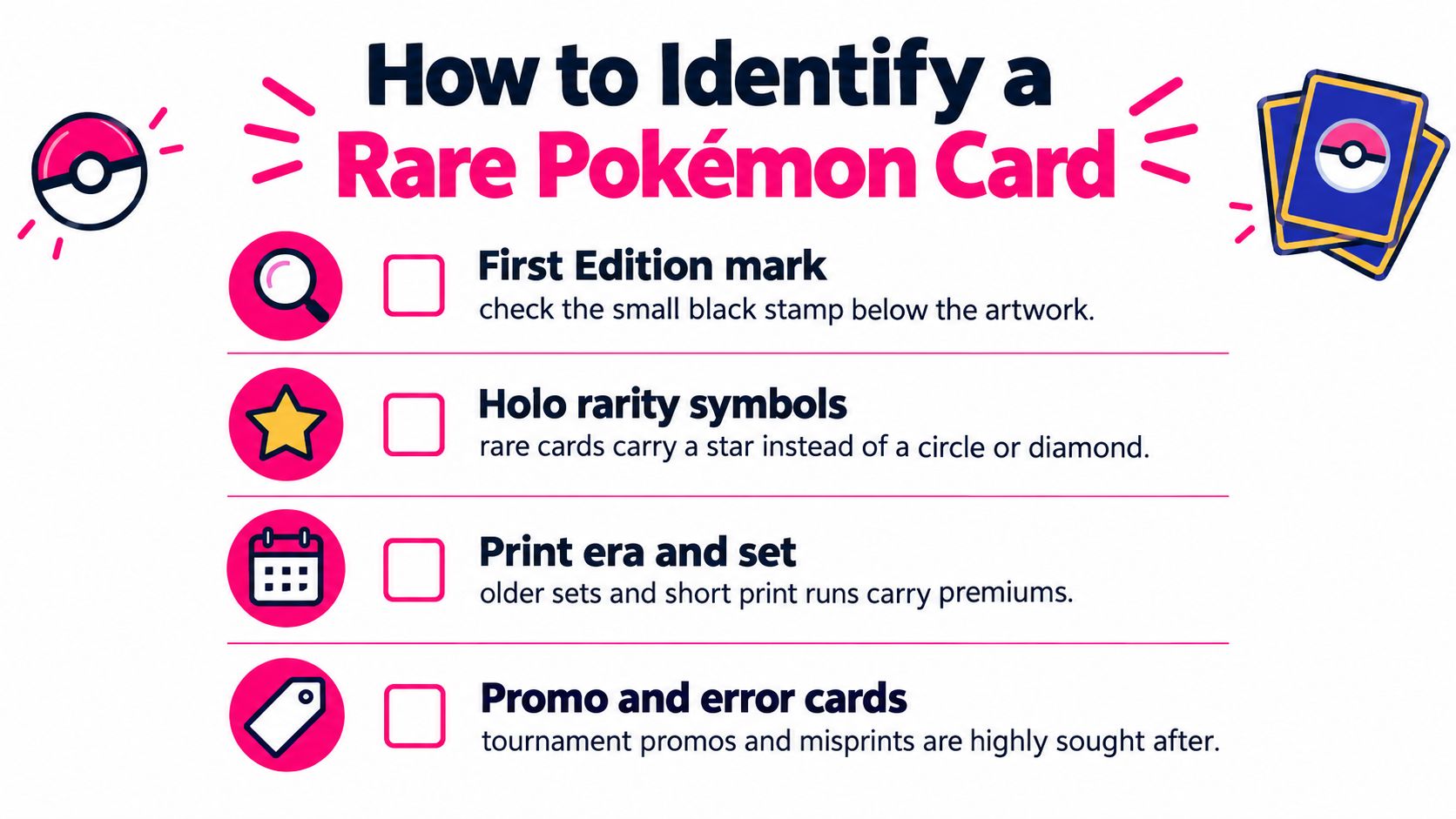
Check the lower corners and the area near the artwork for set and rarity information. A small First Edition stamp can separate an early printing from an unlimited version. A shadowless base-era layout can also matter, but don't assume every older-looking card has a premium. Confirm the exact set and compare it with a reliable card database or documented sales history.
Holo treatment deserves careful inspection. A regular holo, reverse holo, promo foil, and modern illustration card aren't interchangeable categories. The symbol, foil pattern, card number, and set abbreviation together identify the printing. A star symbol generally signals a rarer category than a circle or diamond, but rarity symbols still need to be read alongside the set's numbering system.
Use numbering to find hidden chase cards
Cards numbered above the printed set total often indicate secret or special-rarity releases. For example, a card shown as 201/198 belongs to a different search category from a standard card numbered within the set. That doesn't guarantee a high price, but it tells you to investigate rather than discard it as ordinary inventory.
Look for these signals:
- Edition marks: Verify the stamp's position, font, and relationship to the artwork. Counterfeiters imitate common marks, so visual inspection isn't authentication.
- Set and number: Record both. The same Pokémon can have multiple versions with different scarcity and demand.
- Holo pattern: Compare the foil treatment with known examples. Reverse holo and special-pattern versions can trade differently from regular copies.
- Promotional origin: Tournament, event, magazine, and distribution promos may have a distinct collector audience, especially when supply is limited.
- Errors and misprints: A genuine production error can attract collectors, but an apparent defect may just be damage or a counterfeit.
Identification comes before valuation. A familiar Pokémon name is a search term, not a price estimate.
The market also contains cards whose value comes from play rather than traditional collector rarity. Current-format demand can lift an otherwise ordinary printing when players need copies for decks, but that demand can weaken after reprints or format changes. This is why a common or uncommon card shouldn't be automatically ignored, yet it also shouldn't be treated like a vintage grail.
Build a candidate file
For every promising card, record the Pokémon, set, collector number, printing, language, visible defects, and whether it is raw or graded. Photograph the front and back under even light. Keep the card in a sleeve and avoid repeated handling while you compare it with sales.
This workflow prevents a frequent error: pricing the most famous version of a card while owning a less scarce variation. It also makes grading decisions more disciplined because you know exactly which market you're entering.
The Non-Linear Economics of PSA Grading
Grading doesn't manufacture rarity. It certifies identity and condition, then places the card into a market where buyers can compare it with other certified copies. That distinction separates profitable submissions from expensive mistakes.
Grade sensitivity is especially severe at the high end. Expert coverage notes that a half-point grade difference can create a value gap ranging from thousands to more than a million dollars for high-end cards, as explained by coverage of rare Pokémon card grading. The price curve isn't linear because buyers compete intensely for the highest grades when the population is small.
Inspect the four failure points
Centering is the first screen. Compare the left and right borders, then the top and bottom borders. A card can look excellent in a sleeve while still missing the visual balance expected from a top grade.
Surface condition is less forgiving than casual inspection suggests. Tilt the card under a single light source and look for scratches, print lines, dents, clouding, and pressure marks. Holo cards expose flaws quickly, particularly when the light moves across the foil.
Edges and corners determine whether a clean front survives close examination. Whitening, chipping, soft corners, and small bends can push a candidate out of the grade tier you need. A card that seems perfect from arm's length may not be a gem-mint submission.
Use a simple decision model:
| Question | If the answer is yes | If the answer is no |
|---|---|---|
| Is the raw card already scarce and desirable? | Continue evaluating condition | Sell raw or hold only for personal interest |
| Could a high grade change its market tier? | Compare sold prices by grade | Avoid speculative grading |
| Can the card absorb the submission cost? | Calculate expected net value | Don't submit |
| Does the population support future scarcity? | Treat grading as a strategic choice | Demand a larger safety margin |
PSA's reported entry-tier grading price is $59.99 per card, with bulk or subscription pricing around $24.99 per card under eligible conditions, according to grading cost coverage. Those costs create a hard floor. A low-value raw card must have a credible chance of a meaningful grade uplift, or the submission consumes too much of the eventual sale value.
Calculate expected value before submission
Estimate the likely grade accurately, not optimistically. Compare recent sold prices for raw copies and the relevant graded tiers, subtract grading, shipping, insurance, selling fees, and your acquisition cost. If the result depends entirely on receiving the highest possible grade, don't submit.
A PSA 10 is not a strategy. It is an outcome that requires scarcity, condition, and buyer demand to align. Grade only cards where those three factors already exist.
Record-Breaking Sales and Auction Psychology
The clearest ceiling for Pokémon card value is the PSA 10 Pikachu Illustrator. Logan Paul bought the card for $5.275 million in 2021, and the same card sold for $16.492 million at auction in February 2026 after 41 days of bidding, according to the BBC report on the sale.
That transaction established a world record for an auctioned trading card. It also shows why headline sales can't be used as ordinary valuation comparables. The card combines an exceptionally small population, a historic promotional origin, a globally recognizable mascot, a PSA 10 grade, and a provenance story that attracts attention beyond normal hobby participants.
Why the auction result matters
Auction psychology magnifies differences between an ordinary scarce card and a singular trophy asset. A private sale may produce a fair price from one buyer. A major auction gives multiple motivated buyers a public setting in which each new bid confirms the card's importance and raises the perceived cost of losing it.
The outcome reflects several reinforcing signals:
- Extreme scarcity: Few comparable cards exist at the same level.
- Certified condition: The PSA 10 grade provides a recognized condition reference.
- Cultural significance: Pikachu Illustrator has a status that reaches beyond routine set collecting.
- Provenance: A documented ownership history can reduce uncertainty around a marquee asset.
- Competitive bidding: Extended participation can push a unique card beyond ordinary price expectations.
A record auction tells you what the market may pay for a singular trophy. It doesn't tell you what a similar-looking card in a different grade is worth.
The sale's move from $5.275 million to $16.492 million demonstrates how a tiny population of elite cards can move from seven-figure to eight-figure territory when scarcity, condition, provenance, and demand converge. It also explains why authenticated PSA-graded cards dominate the top end. Buyers paying for a landmark card need more than a seller's opinion about condition.
The practical lesson is not to chase the next viral auction. It is to identify which characteristics made the sale exceptional, then apply them selectively. Most collections won't contain a Pikachu Illustrator, and most cards shouldn't be valued by comparison with one.
Population Reports and Future Scarcity Risks
A PSA 10 label doesn't guarantee lasting value. The grade describes one card, while the population report describes how many comparable examples have entered the certified supply. Those two facts must be read together.
In 2025, grading services processed 26.6 million cards, with Pokémon accounting for more than 16.1 million, according to population report analysis. The same reporting noted that TCG and non-sports grading surpassed sports cards for the first time in hobby history.
That volume changes the question modern collectors should ask. Instead of “Can this card receive a PSA 10?” ask “How many PSA 10 copies already exist, and how quickly is that number increasing?” A high grade can be common when thousands of collectors submit the same modern chase card.
Population is a supply signal
Population data doesn't predict demand by itself. A card with a large graded population can still sell well if collectors strongly want it, while a low-population card can remain illiquid if few buyers care. The report becomes useful when you combine it with character popularity, set supply, recent sales, and the distribution across grades.
Modern cards carry particular supply risk because unopened product and raw collections can continue feeding the grading pipeline. A card that appears scarce shortly after release may become much less scarce once owners submit their copies. That process can compress the premium for ordinary modern hits, even when the card remains visually impressive.
Use this review before grading:
- Population level: Is the card already crowded in the target grade?
- Population direction: Are new submissions adding copies rapidly?
- Grade distribution: Does the card have a meaningful gap between lower grades and the top grade?
- Demand quality: Are buyers collecting the character, the artwork, the set, or only chasing short-term excitement?
- Supply outside the slab: Could large quantities of raw or sealed product still enter the market?
For a practical explanation of how condition and scarcity affect transaction prices, consult this guide to graded card prices.
The strongest modern candidates aren't merely cards that can grade well. They're cards whose future supply is difficult to expand and whose demand doesn't depend on a temporary competitive deck, influencer promotion, or opening-season excitement.
Streamlining Valuation and Secure Liquidation
Finding a valuable card is only half the job. Sellers lose money through inaccurate descriptions, counterfeit purchases, weak packaging, uninsured shipments, and fragmented price research. A card can be correctly identified and still produce a poor result if the liquidation process creates too much friction.
Start with a controlled record. Capture the card's set, number, printing, grade, certification details, purchase basis, and recent sold references. Keep front and back photographs, especially when the card has a visible flaw or unusual variation.
Choose a workflow that reduces handoffs
A fragmented process forces you to move between price guides, storage spreadsheets, marketplaces, payment services, and shipping tools. Each handoff creates another opportunity for a data error or custody problem.
A specialized platform such as Lucardio Collectibles combines authenticated Pokémon singles, sealed inventory, PSA-graded items, a digital Card Vault, collection valuation, instant cash-out options, live breaks, auctions, prize draws, and insured fulfillment. Those tools address different stages of ownership, but the useful principle is simple: keep the identity, condition, value, and transaction record connected.
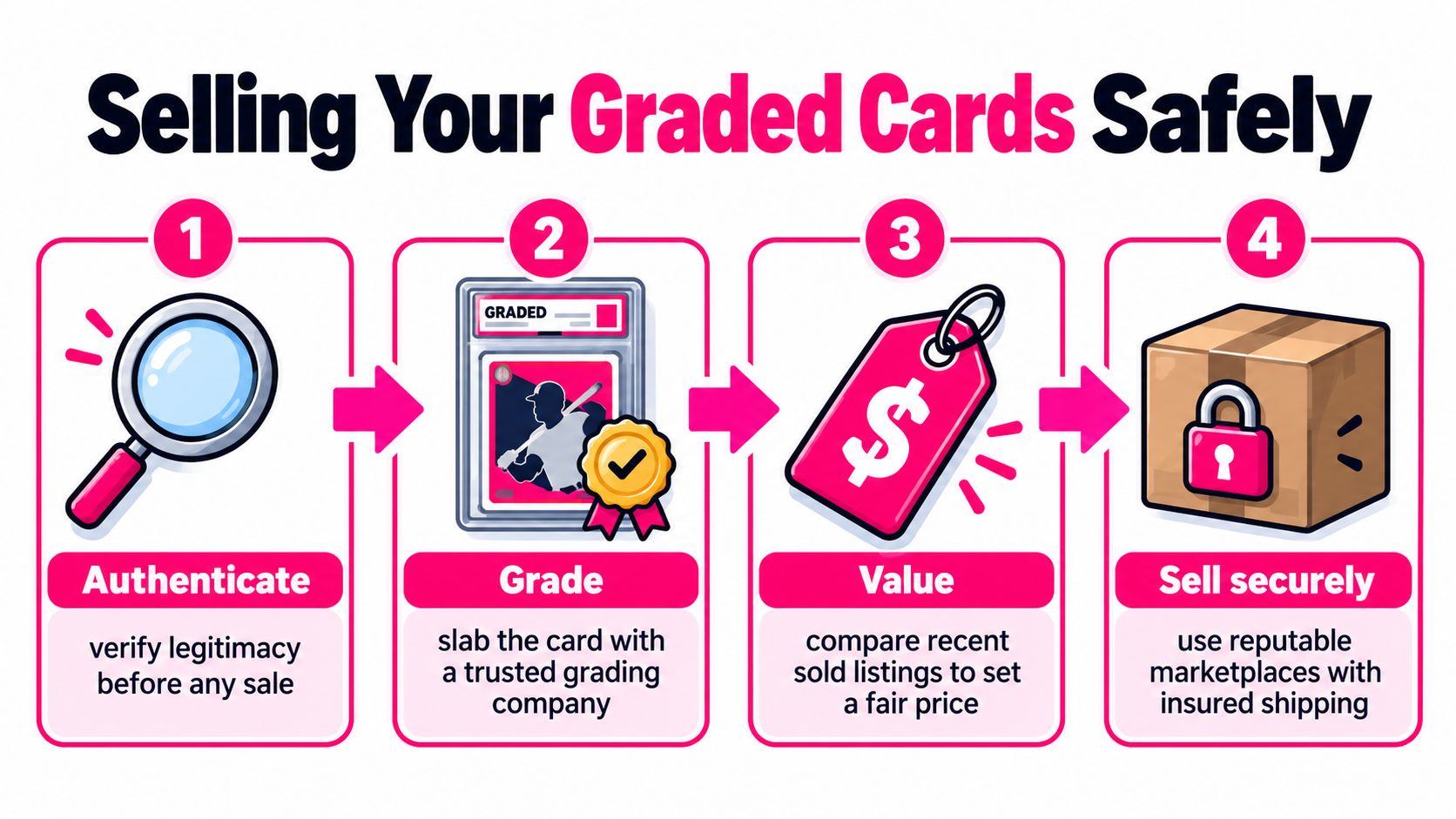
Before you list a card, verify:
- The slab certification and card description match.
- The price reflects completed sales, not optimistic listings.
- The buyer or platform explains fees clearly.
- Packaging protects the slab from impact and moisture.
- Shipping includes tracking and appropriate insurance.
- You retain a record of the transaction and final amount.
The choice of selling venue depends on the card's value, urgency, and buyer audience. A broad marketplace may provide reach, while a specialist audience may understand graded condition and premium print variations more accurately. Use this guide to where you can sell a card collection to compare the practical routes before moving high-value inventory.
Selling discipline: Never let urgency replace authentication, documented pricing, or insured fulfillment.
For most collections, the best result comes from separating bulk liquidation from premium-card sales. Move ordinary inventory efficiently, then give scarce, well-conditioned, authenticated cards the presentation and buyer access they deserve. That approach keeps low-value stock from consuming the time and fees that should be reserved for genuine Pokémon cards worth money.
Lucardio Collectibles offers authenticated Pokémon singles, PSA-graded items, Card Vault collection management, valuation and instant cash-out workflows, live auctions, and insured fulfillment. Visit Lucardio Collectibles to organize, evaluate, and sell the cards in your collection with a more controlled process.