
Most beginner advice gets the Pokémon parallel set wrong. A parallel isn't always a perfect reverse-holo copy of every card in the expansion, and treating it that way is one of the fastest ways to build an incomplete master set or overpay for a card that doesn't belong in the checklist you're using.
The useful definition is narrower and more practical. A parallel set is a related print treatment that gives cards from a main expansion a different finish, foil pattern, stamp, or rarity presentation. The exact scope changes by era and by release, so serious collectors should stop relying on a base-set-plus-reverse-holo formula and start verifying every target against the appropriate checklist.
Table of Contents
- The Truth About Pokémon Parallel Sets
- How Parallel Card Logic Evolved Over Time
- Breaking Down Modern Parallel Treatments
- Identifying Parallels Using Official Checklists
- The Master Set Completion Burden
- Strategic Acquisition Through Live Breaks
- Managing and Liquidating Your Parallel Collection
The Truth About Pokémon Parallel Sets
A parallel set usually keeps the same card identity while changing the physical treatment. The card number and game role may remain familiar, but the surface, foil pattern, stamp, or rarity classification separates the parallel from the standard printing. That sounds simple until you compare different Pokémon TCG eras.
The most common beginner shortcut is “parallel set means reverse holo.” That shortcut works as a rough description for some releases, but it fails as a universal rule. Pokémon's official Platinum product page describes an “exciting holographic parallel set” as a distinct collector feature shipped alongside the main expansion. That language matters because it frames the parallel as an identifiable product component, not merely an informal nickname for any shiny card.
Era changes the answer
Collectors working with Diamond & Pearl era products may encounter a parallel structure that doesn't map neatly onto the checklist conventions used for modern expansions. A reverse holo may be central to the set, but that doesn't prove every card in the broader release received the same treatment. Promos, subset cards, secret cards, and special inserts can sit outside the parallel structure.
Modern Pokémon collecting adds even more labels. Reverse holos, stamped reverses, pack-exclusive holos, Rainbow Rares, Secret Rares, Full Arts, and Alternate Arts all belong to a broader ecosystem of enhanced treatments, but they don't automatically form one parallel set. Card Codex's explanation of parallel-set terminology highlights the central problem, different sources disagree about what a parallel set includes and whether it must cover the entire main checklist.
Collector rule: Never decide that a card counts toward a master set because it looks shinier. Confirm its card number, treatment, and checklist status.
That rule protects both collectors and investors. A visually attractive card can be a standard holo, a reverse holo, a stamped promotional issue, or a separate secret rarity. Those categories can have very different collector demand and liquidity. If you mix them together, your binder may look complete while your inventory records remain inaccurate.
The better definition is operational. Identify the card list, identify the treatment attached to that list, then record exceptions. A Pokémon parallel set isn't a universal mathematical equation. It's a checklist relationship that must be proven for each expansion.
How Parallel Card Logic Evolved Over Time
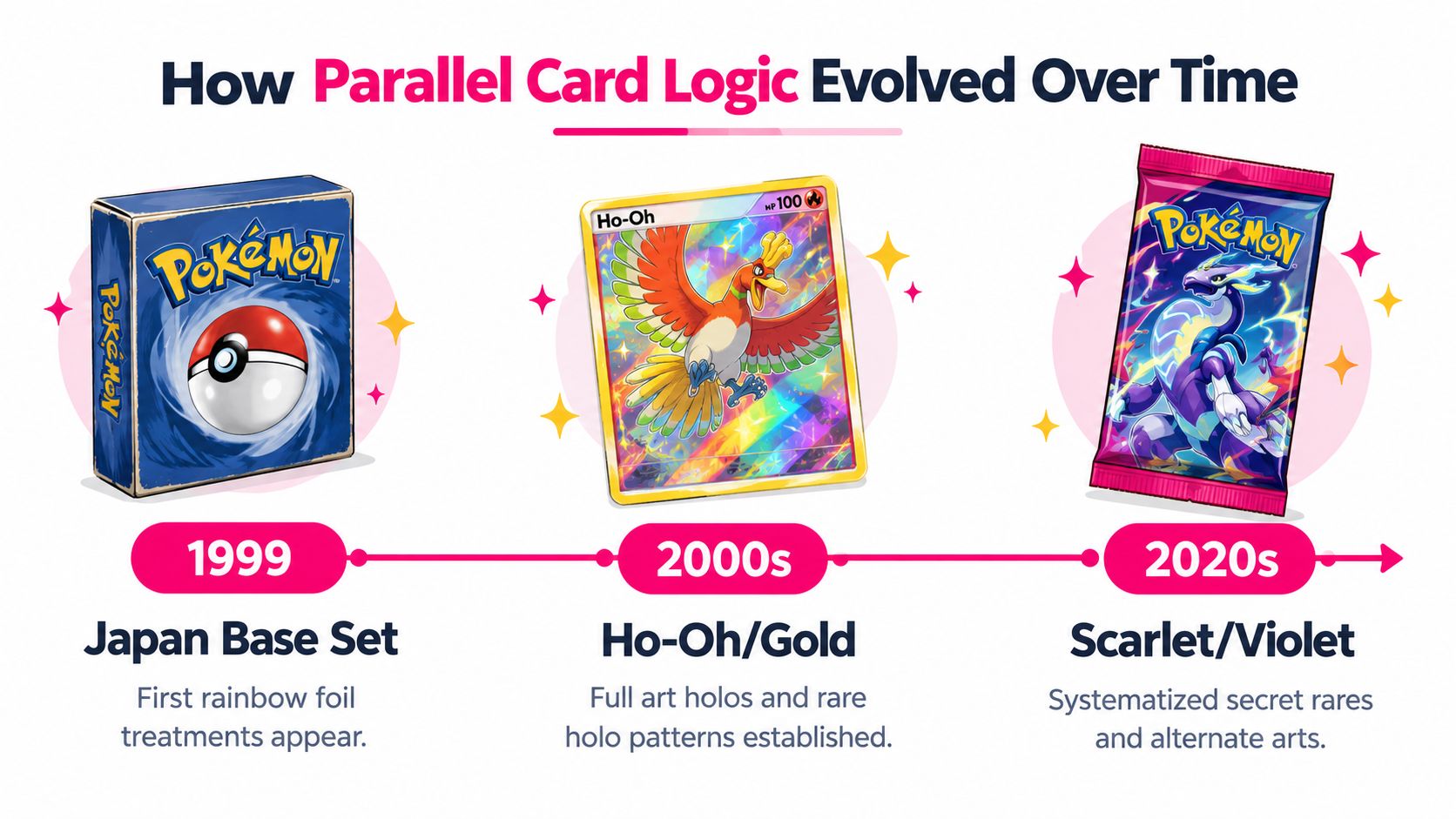
The Pokémon TCG established its collecting foundation across its two largest early markets. The game first released in Japan in October 1996 and reached the United States in January 1999, creating a durable collecting framework across both markets. Hobby Card Index documents that early release history, which helps explain why parallel-card habits became so persistent among collectors comparing Japanese and English products.
Early collecting often centered on whether a card was standard, holo, or otherwise visually enhanced. That distinction became much more consequential when expansions began offering broader foil coverage instead of reserving special finishes for a narrow group of chase cards. A collector no longer had only one obvious version to locate. The same card identity could now support multiple physical targets.
Legendary Collection changed the chase
The widely cited turning point was 2002's Legendary Collection. Every card in the set had a reverse-holo version with a distinctive firework-like pattern, making the parallel treatment impossible to ignore. The result was a new kind of completion pressure. A collector pursuing the regular checklist had another complete layer to pursue, and the reverse-holo pattern had an identity of its own.
This is why Legendary Collection still matters to modern investors. It didn't merely add attractive foil. It made the idea of a parallel version culturally legible within the hobby. Collectors could separate the ordinary version from the visually distinctive version, compare condition, and decide whether one treatment deserved a larger premium.
From finish variation to scarcity tiers
The modern market developed from that basic distinction into a layered chase system. A guide to Pokémon card variants lists reverse holos, stamped reverses, pack-exclusive holos, Rainbow Rares, Secret Rares, Full Arts, and Alternate Arts as part of the expanded variant lineup. These categories don't all carry identical checklist status, but they show how the hobby moved from “regular or reverse” toward several levels of visual and perceived scarcity.
That evolution changed acquisition behavior. A collector who wants a binder-complete set may prioritize broad reverse-holo coverage, while a collector focused on long-term value may concentrate on visually distinctive cards with stronger character appeal, recognizable artwork, or a clear premium position within the release. Those goals overlap, but they're not the same strategy.
The historical lesson is straightforward. Foil treatments become valuable when collectors understand what makes them distinct and when the checklist gives them a defined place. A parallel that looks unusual but lacks clear documentation creates confusion. A documented treatment with a memorable pattern can become a lasting anchor for the set.
Breaking Down Modern Parallel Treatments
Modern Pokémon products require a taxonomy, not a single label. A reverse holo may be a completion target, while an Alternate Art may be the centerpiece of the set's chase. Calling both “parallels” can be useful in casual conversation, but it hides the difference between accessibility, visual identity, and investment risk.
| Parallel Type | Typical Rarity | Collector Role |
|---|---|---|
| Reverse holo | Broadly distributed within applicable checklists | Fills the parallel layer of a master set |
| Stamped reverse | Product, event, or promotion-linked | Adds provenance and a distinct release connection |
| Pack-exclusive holo | Product-specific | Rewards collectors who identify the correct sealed product |
| Rainbow Rare | High-end foil treatment | Serves as a premium chase and visual variant |
| Secret Rare | Outside the ordinary numbered sequence or special in checklist structure | Creates an additional completion and chase target |
| Full Art | Enhanced artwork and presentation | Appeals to display-focused collectors |
| Alternate Art | Distinctive artwork with strong chase appeal | Often becomes a flagship target for collectors |
A reverse holo is usually the most important category for traditional master-set builders. Modern sets often print reverse-holo versions for non-foil common, uncommon, and rare cards, so one base card can have at least two physical forms. That broad coverage makes reverse holos useful for completion, but broad availability alone doesn't guarantee strong resale demand.
A stamped reverse has a different investment logic. The stamp can connect the card to a product, event, or promotion, which gives the card a story beyond the underlying Pokémon. Verification becomes more important because the stamp is part of the card's identity. Don't record it as a generic reverse if the checklist treats it as a separate issue.
Accessibility and chase appeal aren't the same
Pack-exclusive holos, Rainbow Rares, Secret Rares, Full Arts, and Alternate Arts sit in more specialized positions. They can carry stronger visual appeal or scarcity perception, but collectors shouldn't assume that every premium treatment will retain equal demand. Character popularity, artwork, condition, grading potential, set reputation, and the clarity of the checklist all influence how buyers evaluate a card.
For a deeper explanation of foil terminology, consult this guide to foil trading cards, then apply the terminology to the specific Pokémon checklist rather than using it as a substitute for one.
The practical allocation is simple:
- For binder completion: Buy missing reverse holos as singles once opening sealed product stops producing useful additions.
- For display value: Prioritize Full Arts and Alternate Arts whose artwork has obvious visual impact.
- For product-linked collecting: Verify stamped reverses and pack-exclusive holos against the original release structure.
- For speculative buying: Track condition, demand, and checklist clarity before paying a premium for a treatment label.
A booster pack gives you exposure to the ecosystem. It doesn't give you control over which tier you receive. That distinction is the foundation of a disciplined acquisition plan.
Identifying Parallels Using Official Checklists
A parallel card should be verified in three places: on the card itself, in a reliable checklist, and against the release structure. Marketplace titles are useful for discovery, but they aren't evidence. Sellers can misidentify a reverse holo as a standard holo, classify a stamped card incorrectly, or list a special treatment without explaining whether it belongs to the main set.
Use a repeatable verification process
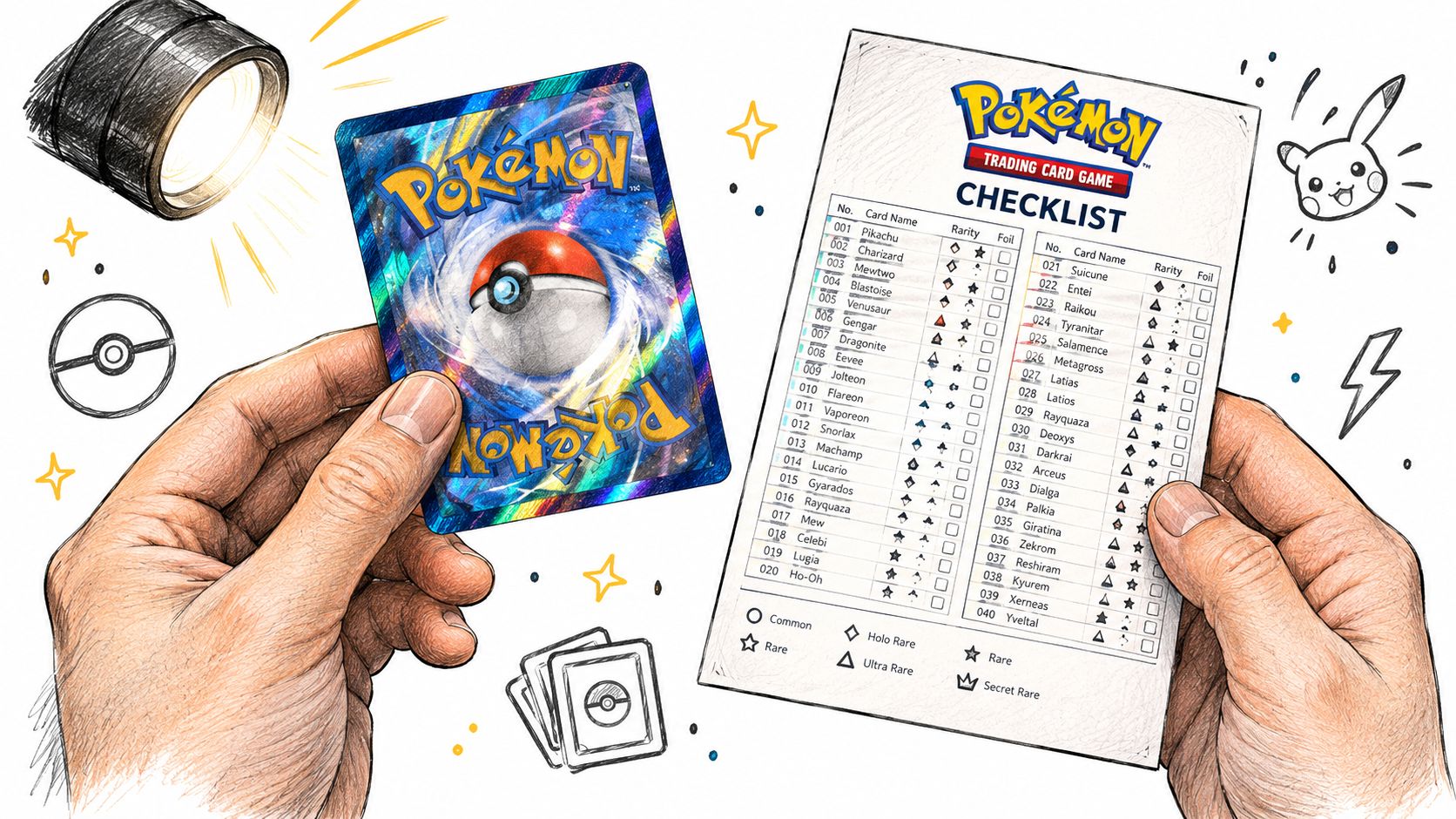
Start with the card number and set symbol. Compare them with the checklist entry, not just the Pokémon name. Two cards can feature the same character while belonging to different products, subsets, languages, or promotional releases.
Next, inspect the foil pattern under direct light. A reverse holo generally places the reflective treatment across the card background while leaving the illustration area visually distinct, but patterns vary across eras. Look for the texture, direction, and coverage of the foil rather than relying on a quick glance in a seller photograph.
Then check for stamps, symbols, and rarity markers. A product stamp may change the card's classification. A special symbol may distinguish a parallel entry from the standard version. Digital checklists often use icons or separate columns to mark these variants, which makes the checklist more reliable than a flat list of card names.
Use the official product description when the release provides one. Pokémon product pages have explicitly described holographic parallel sets, while set checklists provide the practical card-by-card identification layer. The product page establishes that the feature exists. The checklist tells you which cards qualify.
After at least one substantive comparison, use the video below as a visual aid for handling and checking card treatments. It shouldn't replace the checklist, especially when a subtle finish or edge case is involved.
Record exceptions instead of forcing a clean pattern
Some cards may never receive a matching parallel treatment. Others may belong to a separate subset, have a special stamp, or appear only in a particular product. PokéCardHQ describes the parallel set as a treatment of the same card list, commonly involving standard and reverse-holo versions, but that description still needs to be tested against the expansion's actual checklist.
Keep a spreadsheet or collection app with separate fields for card number, standard version, parallel version, finish, condition, and source. If a checklist doesn't show a parallel entry, mark the card as not applicable, not missing. That small distinction prevents endless searching for a version that was never printed.
The Master Set Completion Burden
A master set isn't just a complete numbered checklist. For many collectors, it includes the standard cards plus the relevant reverse holos, special treatments, and other documented variants connected to the expansion. That definition creates a second layer of work, and sometimes several layers, depending on how the set is structured.
The mathematics become obvious with a simple example. If a card list supports both a regular version and a reverse-holo version, every card slot can create at least two collectible forms. PokéCardHQ explains that collectors often treat both versions as necessary for a master set. The burden doesn't just increase because there are more cards to find. It increases because each missing slot can have a different condition, price, and sourcing difficulty.
Set size changes the strategy
One data source estimates 20,493 unique English cards across 163 sets from 1999 onward. Lens' Pokémon card variant guide provides that estimate, and the number illustrates the scale of the modern collecting environment. Parallel treatments multiply the number of meaningful targets without changing the underlying card identity.
That distinction matters for budgeting. A collector may own the standard version of a common card and still have an unfinished master set because the reverse holo is missing. A binder can therefore appear nearly complete while the parallel page remains expensive, time-consuming, or condition-sensitive.
Practical rule: Decide whether you're building a numbered set, a reverse-holo master set, or a full variant collection before you buy sealed product.
Buy sealed for discovery, singles for control
Opening sealed product is useful when you enjoy the experience, want broad exposure to a release, or are chasing a particular high-end card. It becomes less efficient once your collection contains most of the accessible cards and the remaining gaps are specific variants. At that point, targeted singles let you choose the exact card number, finish, and condition.
Use three separate checklists:
- Base checklist, including regular cards and the set's standard rarity structure.
- Parallel checklist, including reverse holos, stamped reverses, or other documented treatments.
- Chase checklist, covering premium variants such as Full Arts, Alternate Arts, or Secret Rares where the release structure includes them.
This framework also helps with liquidation. A complete reverse-holo layer may appeal to a specialist collector, while individual chase cards may attract a wider buyer pool. Keep those categories separated in your records and storage. Clear organization makes it easier to value the collection accurately and prevents a future buyer from paying for an assumed “complete” set that contains unverified gaps.
Strategic Acquisition Through Live Breaks
Blind pack opening is entertainment. It isn't a complete acquisition strategy for a collector who knows which parallel cards are missing. Once you have a target list, buying specific singles usually gives you more control than repeatedly opening packs and accepting whatever treatment appears.
That doesn't make sealed product irrelevant. Sealed boxes provide discovery, liquidity, and the possibility of finding a card in original pack condition. The mistake is treating every purchase as if it serves the same objective. A sealed product purchase can support a chase. It can't guarantee the reverse holo or Alternate Art you need.
Match the buying method to the target
Use live breaks when you want the excitement of opening sealed product with real-time visibility. A reputable stream should identify the product clearly, explain the break format, show the cards as they're pulled, and provide an understandable process for assigning results to participants. That transparency helps you distinguish a genuine product opening from a vague listing built around a broad promise.
Real-time auctions can work for collectors who already understand the card's condition and market position. They create urgency, so set a ceiling before bidding. Never let the speed of a closing auction replace a checklist review or condition inspection.
Authenticated singles are the most direct route for a defined master-set gap. Ask for clear photographs, inspect corners and surface where possible, and confirm whether the listing describes the exact parallel treatment. For graded cards, verify the certification details and make sure the label matches the card shown.
Stop paying for luck after the target is known
The Pokémon booster box buying guide is useful when choosing sealed products for an exact set. Use that principle as written. Confirm the expansion name, language, product configuration, and whether the sealed item really contains the cards you intend to chase.
A strong acquisition sequence looks like this:
- Open selectively: Use sealed product for enjoyment and broad discovery.
- Track duplicates: Separate standard cards, reverse holos, and premium variants immediately.
- Buy the gap: Source exact missing cards as singles once your checklist becomes narrow.
- Use live formats carefully: Join breaks and auctions when the product, process, and card assignment are transparent.
- Keep a price limit: Decide what the card is worth before the stream or auction creates pressure.
Live commerce adds a social layer that singles marketplaces don't provide, but community energy can also encourage emotional bidding. Treat the event as a buying channel, not as a reason to abandon your collection plan.
Managing and Liquidating Your Parallel Collection
A parallel-heavy collection becomes difficult to value when every card sits in the same box. Standard cards, reverse holos, stamped issues, and premium chase cards need separate records because buyers evaluate them differently. The first management decision is therefore classification, not grading.
Create a digital inventory with the set, card number, variant, language, condition, purchase source, and storage location. Add photographs for unusual finishes and stamped cards. That record gives you an audit trail when a marketplace listing uses a different name for the same treatment.
Build a condition-first storage system
Store cards by set and variant, not only by Pokémon name. Keep regular cards apart from reverse holos so you don't accidentally sell the wrong finish or miscount a master set. Use sleeves and rigid protection appropriate to the card's condition, and avoid repeatedly handling surfaces that may later be submitted for grading.
Reserve grading for cards where condition and demand justify the process. A premium treatment with whitening, scratches, print lines, or centering issues may not produce the result you expect. Inspect the front, back, corners, edges, and surface under strong light before sending anything out.
Digital vault tools can simplify this stage by showing owned items, missing checklist entries, and stored inventory in one place. A vault is most useful when it mirrors your physical organization. If the digital record says you own a reverse holo but the card is filed with standard copies, the system creates confidence without creating accuracy.
Liquidate in separate lots
When you decide to sell, don't automatically combine every card into one large collection lot. Separate the inventory into logical groups:
- Premium graded cards: List individually with certification and clear condition details.
- Raw chase cards: Photograph surfaces and corners carefully, then describe condition conservatively.
- Reverse-holo master sets: Present them as checklist-based lots with missing-card disclosures.
- Duplicates and lower-demand cards: Group them by set and treatment where that helps buyers understand the contents.
A structured sell-your-collection process can help when you want valuation and a faster route to funds. This guide to selling a card collection is a useful reference for comparing direct sale, marketplace listing, and specialist handling.
Lucardio Collectibles combines authenticated singles, sealed products, PSA-graded inventory, live breaks, auctions, a Card Vault, and a sell-your-collection workflow with insured fulfillment. For a collector focused on parallel cards, that combination can support discovery, organization, and eventual liquidation without forcing every item into the same sales format.
Visit Lucardio Collectibles to explore authenticated Pokémon singles, sealed products, graded cards, live breaks, and collection-management options. Use your verified parallel checklist first, then choose the buying or selling format that fits the exact cards you still need.