
You're scrolling through dozens of Pokémon singles for sale when one listing catches your eye. The price is lower than the others, the card looks clean in a small photo, and the seller says “near mint.” Then you notice the image is a stock photo, the back of the card isn't shown, and there's no clear answer about whitening, centering, or authenticity. A cheap purchase can become an expensive lesson once the card arrives with surface scratches, edge wear, or a condition that doesn't match the description.
The safer objective isn't just finding the lowest sticker price. It's buying a card whose identity, authenticity, condition, and total cost you can defend. Pokémon is the best-selling trading card game in history, with more than 75 billion cards sold worldwide, according to documented Pokémon sales data. That enormous supply supports a deep secondary market, but it also creates room for counterfeit cards, misleading listings, hidden flaws, and optimistic pricing.
This guide uses a practical collector's filter. You'll learn how to compare authenticated raw cards with graded slabs, evaluate sellers and platforms, match sold comps correctly, decide when grading makes financial sense, and protect valuable purchases during fulfillment. A useful starting point for narrowing your targets is this guide to the best Pokémon singles to buy, but the same buying discipline applies whether you want a display card, a grading candidate, or a future resale piece.
Table of Contents
- Introduction to Buying Pokemon Singles with Confidence
- Where to Find Authenticated and Graded Pokemon Singles for Sale
- How to Verify Listings Before You Buy
- Bidding vs Buy Now and Understanding True Costs
- Securing Your Purchase with Shipping Insurance and Smart Platform Tools
- Your Next Smart Purchase Starts Now
Introduction to Buying Pokemon Singles with Confidence
You find a familiar Pokémon at a low price, then discover the listing uses a stock image and identifies only the character. The set, language, card number, reverse-holo treatment, and printing may all differ from the card you researched. A cheap listing is useful only when its identity and condition are as clear as its price.
The first question is whether you trust the card more than the price. Poor photos, incomplete details, vague condition notes, and weak buyer protection can make a low sticker price expensive. Compare like with like before judging value, especially when a raw card is being compared with a graded slab or a different printing.
Practical rule: Buy the exact card you researched, not the character or artwork you recognized first.
Condition trust beats sticker-price trust
A raw card requires you to estimate what the listing does not show. Check the back for whitening, inspect borders for edge wear, and look for creases, print lines, dents, and surface marks under angled light. A clean front image can conceal defects that affect both grading potential and resale value.
A graded slab reduces some uncertainty through a stated grade and encapsulation, but it does not eliminate every check. Confirm that the certification number matches the card and slab, and review the holder for signs of tampering. The premium can make sense when it buys verified authenticity, a clearer condition signal, and easier resale. It makes less sense when the grade is low, the card has little price spread between grades, or grading fees would consume the likely gain.
An authenticated raw card sits between an ordinary raw listing and a slab. It may suit a buyer seeking a lower entry price or planning to submit the card for grading. Before paying extra, identify what the authentication covers, how flaws are documented, whether returns are available, and whether delivery is insured. Pay for a defined reduction in uncertainty, not for a vague “authentic” label.
For a broader target list, use this guide to the best Pokémon singles to buy, then apply the same checks to every listing.
What a safe purchase looks like
Before payment, answer four questions:
- What exactly is the card? Record the set, year, card number, language, variant, and stated condition.
- What evidence supports the condition? Look for clear front, back, corner, edge, and surface views. Ask for additional photos when glare or cropping hides details.
- Why is this price reasonable? Compare completed sales for the same printing and condition. Active asking prices show ambition, not necessarily market value.
- What happens if delivery goes wrong? Check tracking, insurance limits, return terms, and the process for damage, loss, or a card that differs from the description.
This filter does not remove every risk. It prevents an unclear raw listing from being treated as equivalent to a verified card, and it shows when a premium for authenticity, condition evidence, grading economics, or insured fulfillment is justified.
Where to Find Authenticated and Graded Pokemon Singles for Sale
Different buying venues solve different problems. A marketplace may offer breadth, an auction may create access to a scarce card, and a graded inventory page may give you the clearest condition signal. The best choice depends on whether your priority is price discovery, condition certainty, speed, or resale liquidity.
Authenticated raw inventory
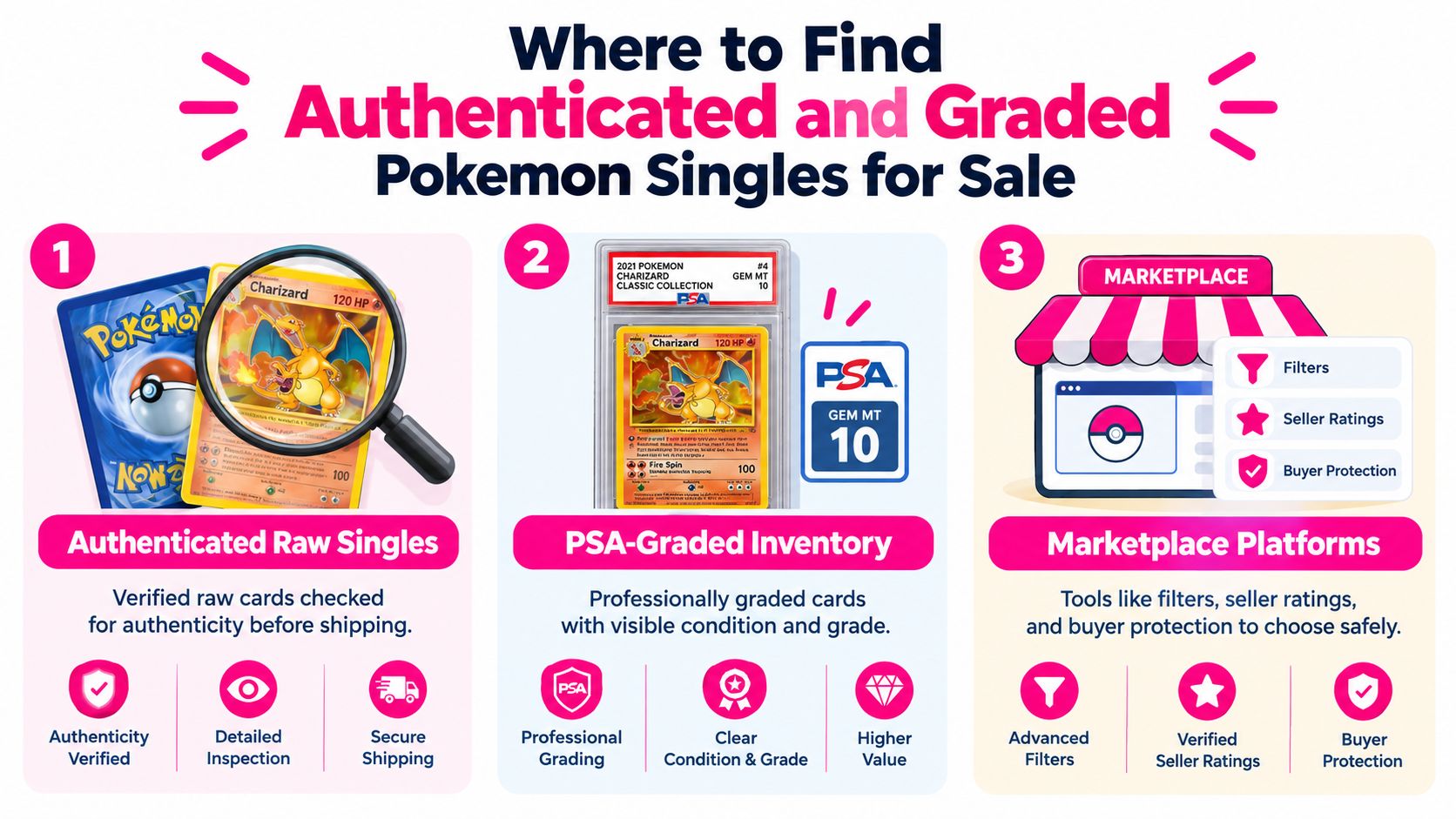
Authenticated raw singles work well when you want a specific card without immediately paying for a high grade. The important distinction is between a seller who labels a card “authentic” and a service that has a defined verification process, clear photographs, and a meaningful remedy if the card fails inspection.
Raw cards suit collectors who care about the artwork, players buying a playable copy, and buyers who can evaluate condition themselves. They also suit future grading candidates, but only when the raw-to-graded price spread leaves room for submission cost, waiting time, and the possibility of a lower grade.
A verified raw card can justify a premium over an unclear listing when the seller documents flaws and protects the transaction. That premium buys condition trust, not a promise that the card will receive a top grade.
PSA-graded inventory
A slab is usually the cleaner option when condition uncertainty would dominate the purchase decision. The card's grade gives buyers a shared reference point, and a visible slab image lets you inspect the holder, label, card, and certification details before paying.
Don't accept a cropped label or a description that says “PSA graded” without showing the certification number. For high-value cards, verify the number directly with the grading company and make sure the card pictured matches the label. A high grade doesn't eliminate every concern, but it improves price comparability and makes future resale easier to explain.
You can use this guide to PSA-graded cards for sale when deciding whether the slab premium is solving a real problem or merely adding cost to a card whose raw condition is already adequately documented.
Marketplaces, auctions, and live commerce
Large marketplaces provide filters, seller histories, buyer protection, and a wide range of active listings. They also require more work because inventory quality varies. Search tools help you find candidates, but they don't authenticate the photos or make a vague condition description accurate.
Live auctions and breaks add immediacy and entertainment, but that format can encourage impulsive decisions. Set your maximum before the event starts, confirm what item or pull you're buying, and understand shipping and redemption terms. A unified destination that combines authenticated inventory, graded collectibles, live auctions, breaks, storage, and collection tools can reduce the need to track every transaction across separate services, but you should still review the item-level evidence.
| Buying Venue | Best For | Trust Signal to Require | Watch Out For |
|---|---|---|---|
| Authenticated raw singles | Lower-entry purchases and grading candidates | Defined authentication process, detailed photos, honest flaws | Hidden wear and optimistic condition labels |
| PSA-graded inventory | Condition-sensitive purchases and easier resale | Visible slab and verifiable certification number | Cropped images, damaged holders, or label mismatches |
| Marketplace platforms | Broad selection and price comparison | Seller history, buyer protection, and sold-comparable data | Stock photos, inconsistent grading, and convenience premiums |
| Live auctions and breaks | Real-time access and community participation | Clear item terms, host reputation, and fulfillment policy | Emotional bidding and unclear delivery expectations |
Use this video as a practical visual supplement before joining a live format:
The venue matters, but the individual listing still decides whether the purchase is sound. A trusted platform can't make mismatched comps or incomplete photos disappear.
How to Verify Listings Before You Buy
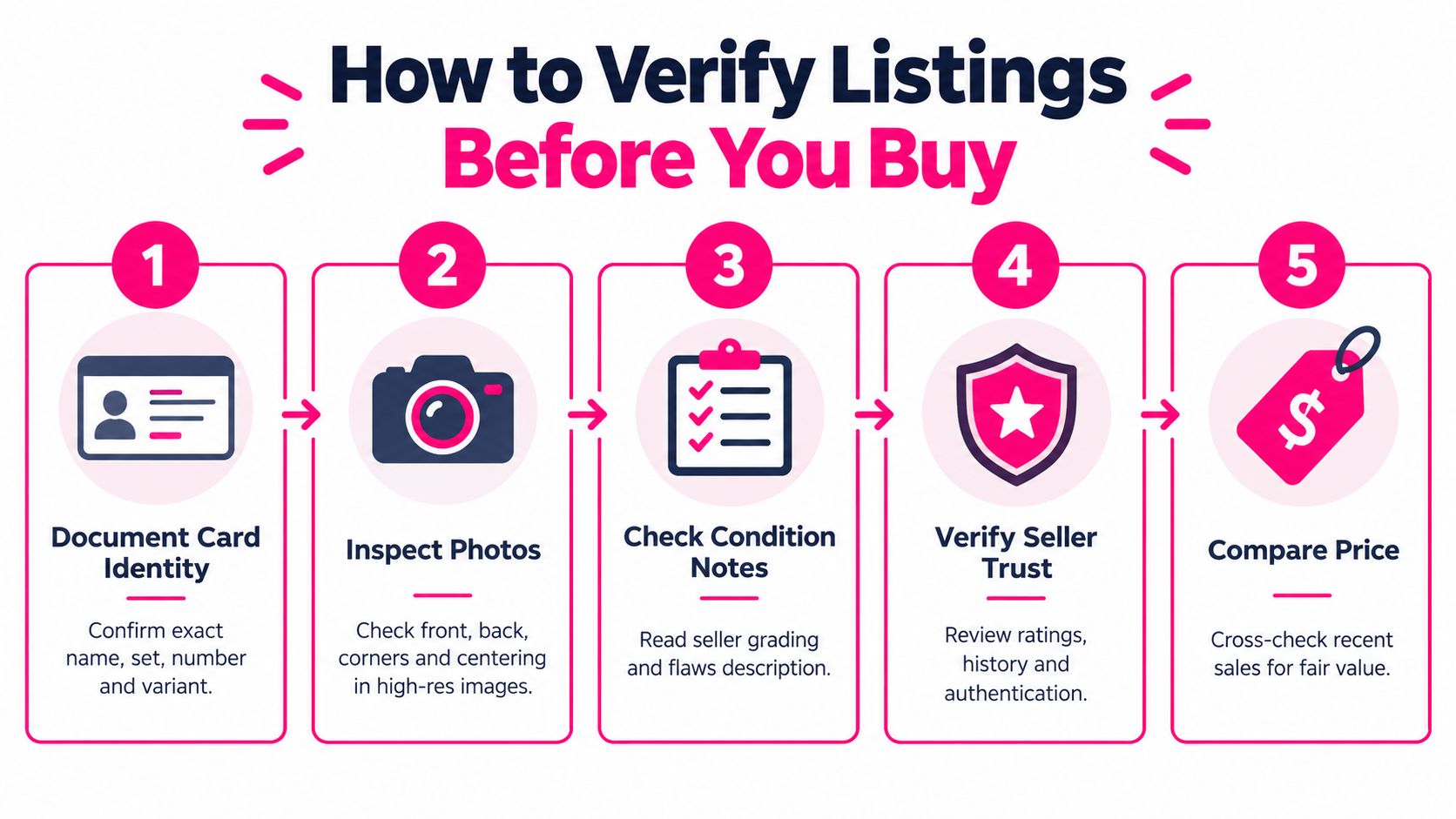
A listing can look cheap and still be a bad buy. Start with identity, not the asking price. Write down the exact card details before you compare anything else, set, year, card number, language, print variation, serial number or autograph if relevant, and the stated condition. That keeps you from mixing up a first print or special variant with a later version that only shares the same artwork.
Start with the evidence in the listing
Stock images help you spot inventory. They do not prove the condition of the exact card for sale. For raw Pokémon singles, ask for clear front and back photos with enough detail to inspect the corners, edges, centering, holo surface, and any dents, scratches, or print defects.
A seller's condition label is only a starting point. Near mint can mean different things to different sellers, and a card that looks clean head-on may show wear as soon as the light changes. Ask specific questions instead of sending a vague message:
- Surface: Are there scratches, print lines, dents, foil pressure marks, or other marks that only show at an angle?
- Edges: Is there whitening on the back, chipping, silvering, or rough cut evidence?
- Corners: Are any corners soft, bent, rounded, or separated from the layer?
- Centering: Does the border look materially uneven from front to back?
- Storage: Has the card stayed in a sleeve, top loader, semi-rigid holder, or binder?
A deceptive listing often uses one bright front photo, crops the back, and hides the worst edge in shadow. A verifiable listing shows the full card, the back, and at least one angled shot that reveals the surface. If the seller claims clean edges but only provides a straight-on image, assume you have not seen enough yet.
For graded cards, the slab should be visible and the certification number should match the grading company record. Inspect the holder for cracks, tampering signs, label inconsistencies, or a card that does not match the cert record. If the slab looks odd, use Lucardio Collectibles' guide to spotting a fake PSA slab before you pay.
Check the seller as carefully as the card
Seller ratings matter, but the pattern behind them matters more. A strong history of accurately described collectibles is more useful than a high score built mostly from unrelated low-value items. Look for consistent photos, clear answers, proper packaging, and a return policy that covers misrepresentation.
If a seller avoids showing the back, refuses to discuss flaws, or pressures you to move off-platform, treat that as part of the risk. The price only makes sense if the evidence is strong enough to support it. A card can be authentic and still be a poor purchase if the listing hides condition problems.
Use verification as a price filter
A premium is easier to justify when the listing removes uncertainty. Clean photos, matching cert data, and honest condition notes can make a higher price more sensible than a cheaper raw listing with weak evidence. That is especially true when a card is a grading candidate, because surface wear, edge whitening, and poor centering affect both resale and submission results.
The trading card flipping workflow is useful here because it keeps the focus on what you can prove before money changes hands. For a buyer, the same discipline applies. Pay for verification when the listing gives you enough proof to trust the card, not when the card merely looks cheap.
A clean comparison starts with matching identity, then condition, then confidence in the seller. That order protects you from the most common trap, paying a bargain price for a card that still needs more inspection than the listing gives you.
Bidding vs Buy Now and Understanding True Costs
A clean Buy Now listing saves time when the card is documented well and the price still leaves room for profit or personal value. Bidding works better when recent comps are clear, the card is hard to find, and you can set a hard ceiling before the auction starts.
The mistake is treating the sticker price as the full cost. A buyer may still need to cover marketplace fees where they apply, payment processing, shipping, insurance, grading, and a return allowance. A seller who plans to flip also has to count the cost of getting the card into sellable shape and the time the money stays tied up.
When a single sits above roughly $100, identity matching and net proceeds matter more, as noted in the high-value Pokémon singles selling workflow. The same logic helps buyers. Do not compare a raw card with a graded copy until you know what the premium is paying for.
Set a maximum before the timer starts
Use the strongest matching sold comps, then decide what the card is worth after every cost. If the auction reaches that number, stop. A last-minute bid can feel small next to the rush of winning, but the card does not gain value because you spent time watching it.
Buy Now can justify a premium when it removes real uncertainty. Verified authenticity, detailed condition evidence, a return process you can rely on, and insured delivery all have value. A cheaper raw listing with no condition guarantee can cost more in practice if the card arrives with damage or cannot be resold with confidence.
Grading is a calculation, not a ritual
Raw cards above roughly $75-$100 are often where grading math starts to matter. That is not a submission rule. You still need a realistic grade estimate, the likely graded value, submission cost, waiting time, and a backup plan if the grade comes in lower than expected.
Published 2026 pricing examples place standard single-card grading around $14-$20, expedited services at $40-$150 or more, and PSA entry-level individual grading around $59.99. Treat those as cited examples, not fixed prices, because service levels and membership terms can change.
| Cost Component | What to Check | Example Range |
|---|---|---|
| Card price | Matching sold comps and exact identity | Use the card's documented market evidence |
| Marketplace and payment costs | Buyer or seller fees, taxes, and processing | Varies by platform and transaction |
| Shipping | Tracking, protective packaging, and delivery speed | Varies by service and destination |
| Insurance | Coverage limit, exclusions, and claim process | Confirm before payment |
| Grading | Service level, membership terms, and return time | $14-$20 standard, $40-$150+ expedited, or around $59.99 PSA entry-level in published 2026 examples |
The test is expected value. If a borderline card earns a low grade, the slab can be less appealing than selling it raw. A clean candidate can justify the submission. Never build the purchase around the best possible grade.
Securing Your Purchase with Shipping Insurance and Smart Platform Tools
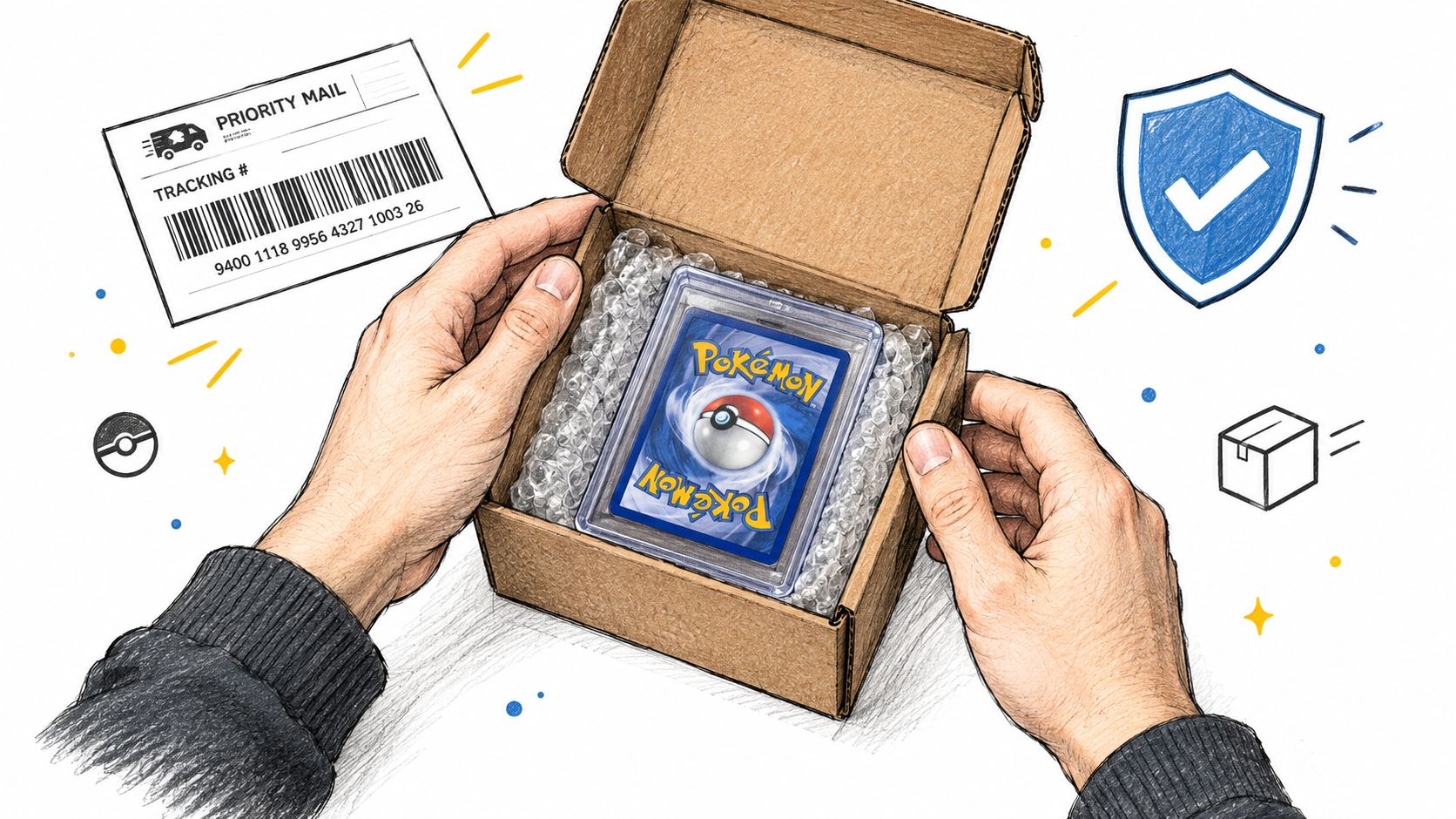
A correct buying decision can still go wrong during delivery. Valuable singles should travel in a sleeve and rigid protection, inside packaging that prevents movement, with tracking and insurance appropriate to the card's value. Before checkout, confirm who carries the risk during transit and what evidence the carrier or platform requires for a claim.
Inspect the delivery immediately
Record the package condition before opening it, especially if the outer mailer is crushed, wet, or torn. Open carefully, photograph the packaging and card, and compare the delivered item with the listing images and description. Keep the packaging until you're satisfied that the card arrived safely and the transaction is complete.
If a slab is cracked or a raw card has new damage, don't clean, press, alter, or repackage it before documenting the issue. Contact the seller and platform through the official transaction channel, then follow the stated claim or return process.
Reduce handling after arrival
A Card Vault or comparable digital collection tool can help you record what you own, organize cards by set or grade, and showcase the collection without repeatedly handling the physical items. Storage isn't a substitute for protective sleeves, semi-rigid holders, or suitable environmental conditions, but it can reduce unnecessary movement and make your inventory easier to audit.
Save the card identity, purchase date, price, condition notes, and comp rationale. Those records help you decide whether to hold, grade, sell, or bundle the card later. They also make collection valuation less dependent on memory.
Use alerts and plan the exit
Email alerts for new drops can help you review desirable inventory before it disappears, but an alert shouldn't override your maximum price. The same rule applies to live auctions, prize draws, and community challenges. Participate because the format suits you, not because urgency has replaced verification.
Lucardio Collectibles is one example of a platform combining authenticated singles, sealed products, PSA-graded collectibles, live breaks, auctions, a Card Vault, and a sell-your-collection flow with valuation and instant cash-out options. Its stated fulfillment model includes fast, insured, trackable shipping, which is the type of delivery evidence buyers should look for when comparing services.
Your Next Smart Purchase Starts Now
Pick one target card this week and define it precisely before browsing. Write the set, card number, language, variant, and preferred condition. Then set an all-in maximum that includes shipping, insurance, fees, and any grading cost you may incur.
Use the cheapest raw listing only when its front and back photos, seller history, and condition details support the risk. Pay a premium for authentication or a graded slab when an altered card, hidden whitening, centering issue, or weak resale record would cost more than the verification. A low headline price offers little value if you cannot trust what will arrive.
For a raw card, save the listing photos and compare them with the received card under consistent lighting. For a slab, check the certification number and confirm that the label matches the card. Walk away when the seller cannot provide clear evidence or when the photos avoid the corners, edges, and surface.
Choose fulfillment that includes tracking and insurance, then keep the packaging and delivery evidence until the transaction is complete. Lucardio Collectibles offers authenticated Pokémon singles, PSA-graded items, live auctions and breaks, Card Vault collection management, and insured, trackable fulfillment. Visit Lucardio Collectibles to review the platform before buying.
A Card Vault or similar collection tool can preserve the card's identity, purchase rationale, and later resale decision without repeated handling. Alerts may help you spot inventory, but they should never raise your maximum or replace verification. The purchase is ready when the evidence supports the condition, the total cost fits your limit, and the delivery process gives you a documented way to resolve a problem.