

A Topps Chrome blaster box is a product family where configuration and pull odds change with every release. SuperFractor chases in products like 2026 Topps Chrome VeeFriends sit so deep in the pack odds that no single retail box is a realistic route to one. A blaster can still be a sensible buy, but only when you have verified its exact configuration on the named checklist, converted its stated pack odds into expected cards per box, and matched the price to the cards you want.
Table of Contents
- What Sits Inside a Topps Chrome Blaster Box
- How Blasters Differ From Hobby and Mega Boxes
- Chase Parallels and Their Real Pull Odds
- Verify Before You Pay and Inspect After You Open
- What a Blaster Is Really Worth Per Card
- Confirm Your Goal Before Buying a Blaster
What Sits Inside a Topps Chrome Blaster Box
Seven packs, four cards each, 28 cards in total. That is the configuration BaseballCardPedia lists for 2026 Topps Chrome Baseball, where the same reference puts base-card refractors at odds of approximately 1:4 blaster packs. Multiply packs by cards per pack and you can audit any listing in seconds.
Those figures belong to that release alone. A Topps Chrome blaster box is a retail format whose specification resets with every product: pack count, cards per pack, inserts, parallels, and autograph odds all change by sport, year, and product line. Carrying a configuration from one Chrome box to another is how buyers pay for cards that were never inside.
| Release | Packs per box | Cards per pack | Total cards |
|---|---|---|---|
| 2026 Topps Chrome Baseball | 7 | 4 | 28 |
| 2025 Topps Chrome Platinum '55 Baseball Blaster | 8 | 4 | 32 |
| 2025 Topps Chrome Football | 7 | 6 | 42 |
Read down the total column and the point sharpens: the football blaster holds 14 more cards than the baseball one, so a per-card price comparison between releases starts from very different box contents.
What a Pack Actually Contains
Each pack is a sealed unit holding several cards, and most of those cards in a typical retail box will be base cards. Refractor-style parallels and occasional inserts are spread across packs according to the product's odds structure, which is why counting only the box total gives an incomplete picture. Applied to the 2026 baseball configuration, the stated 1:4 refractor odds across 7 packs work out to an expected yield under two refractors per box, meaning most individual packs contain none.
Two boxes can hold the same number of cards while offering different parallel structures. A retail blaster also may not include the autograph or relic cards associated with premium formats, and that absence is significant. If a seller implies a guaranteed hit, the manufacturer's checklist has to state it; listing language alone proves nothing.
Verification rule: Match the release year, sport, set, and pack count against the official Topps checklist before you treat a configuration as confirmed.
Topps checklists are the authoritative place to verify those details, though checklists can be missing from the archive for older products. For an older sealed box, compensate with clear packaging photos, the printed product code, and seller records that identify the exact release. Readers comparing retail formats across brands can see the same logic applied in our guide to the Mosaic mega box format and contents. The checklist decides what sits inside; the Chrome name on the wrapper tells you only which family you bought.
How Blasters Differ From Hobby and Mega Boxes
Three formats can carry the Chrome name and behave like three different products. The trade-off is consistent: a blaster is the lower-cost retail entry point, while hobby and mega boxes are built around larger configurations, different parallel distribution, and whatever premium hits that release's checklist promises. Compare formats through their published configurations, never the name on the wrapper.
| Format | Pack count | Guaranteed premium hits | Best for |
|---|---|---|---|
| Topps Chrome blaster | 7 to 8 packs in confirmed baseball and football examples | Usually not guaranteed | Set building and retail-exclusive parallels |
| 2025 Star Wars Chrome value box | Retail-sized, confirmed against its own checklist | Not guaranteed; exclusive parallels listed on its checklist | Themed collecting and parallel hunting |
| Hobby box | Set by the checklist for that release | Only the hits expressly stated on that checklist | Chasing guaranteed autographs and numbered cards |
| Mega box | Set by the checklist for that release | Only the hits expressly stated on that checklist | More cards when the checklist confirms the value |
The Chrome name spans far more than baseball. The Topps racing page describing the growth of Chrome into Formula 1 treats the 2020 Topps Chrome Formula 1 release as a milestone for racing-card collectors, and 2025 Star Wars Chrome ships in its own value-box format with exclusive parallels attached to that release rather than to the baseball checklist. A baseball blaster, a Formula 1 retail box, and a Star Wars value box share branding while differing in scarcity structure, so the only reliable comparison is checklist against checklist.
Because a blaster holds fewer packs, each pack carries more weight in the expected-output math. One missing parallel category changes the whole box's yield, which is why a smaller format punishes a weak checklist harder than a mega box does.
That gap matters at the listing stage. When a seller calls a product a blaster but describes hobby-style guarantees, ask for the checklist entry before paying. The same check applies when you weigh a Topps Chrome blaster against a cross-brand format, as in our Mosaic hobby box breakdown.
Choose a blaster for set building and accessible retail parallels. Choose a hobby box when a guaranteed premium hit is the reason for the purchase. Choose a mega box when its checklist shows enough extra cards or exclusive content to justify the higher price.
Chase Parallels and Their Real Pull Odds
Pack odds don't describe your chance of pulling one named player. They normally describe how often a whole card category appears. That's the distinction buyers miss most often, and it can turn a plausible category hit into an unrealistic expectation for a specific rookie, character, or serial-numbered card.
For the reported VeeFriends figures in The Collector Nation's 2026 Topps Chrome VeeFriends release coverage, Yellow Refractors appear at roughly 1:2 packs, while a SuperFractor is reported at 1:631,061 packs in blasters. The same coverage explains why a category rate such as 1:160 applies to an entire rare-parallel category, not to one character or serial-numbered card.
| Parallel or insert | Reported odds | Expected per seven-pack box | What it means for a buyer |
|---|---|---|---|
| Base-card refractor | About 1:4 packs | About 1.75 | Likely, but not guaranteed |
| Yellow Refractor | About 1:2 packs | About 3.5 | Expect several across seven packs |
| VeeFriends SuperFractor, reported | 1:631,061 packs | About 0.000011 | Do not buy a box expecting this card |
Convert Odds Before You Pay
Use three calculations:
- Expected count: Multiply packs by the per-pack probability. Seven packs at 1:4 gives about 1.75 refractors.
- Chance of at least one: Calculate one minus the chance of missing in every pack. At 1:4, a seven-pack box still has about a 13 percent chance of containing no base refractor, so the chance of at least one is about 87 percent.
- Specific-card reality: Divide the category expectation mentally across every player or character in that category. A category can be reasonably common while your exact target remains uncommon.
At 1:2, the chance of at least one Yellow Refractor in seven packs is about 99 percent, and the expected count is about 3.5. Even then, expectation isn't a promise for an individual box. Pack-to-pack variance can leave you below the average, just as another box lands above it.
A parallel can exist in the product without being a plausible outcome for one sealed box.
That's why a low box price doesn't automatically mean better value. A Topps Chrome blaster box may be attractive for accessible exclusive parallels while offering materially weaker odds for elite cards than hobby formats. Separate collecting value, entertainment value, and resale value, then match your target card to its odds row before paying a premium.
Verify Before You Pay and Inspect After You Open
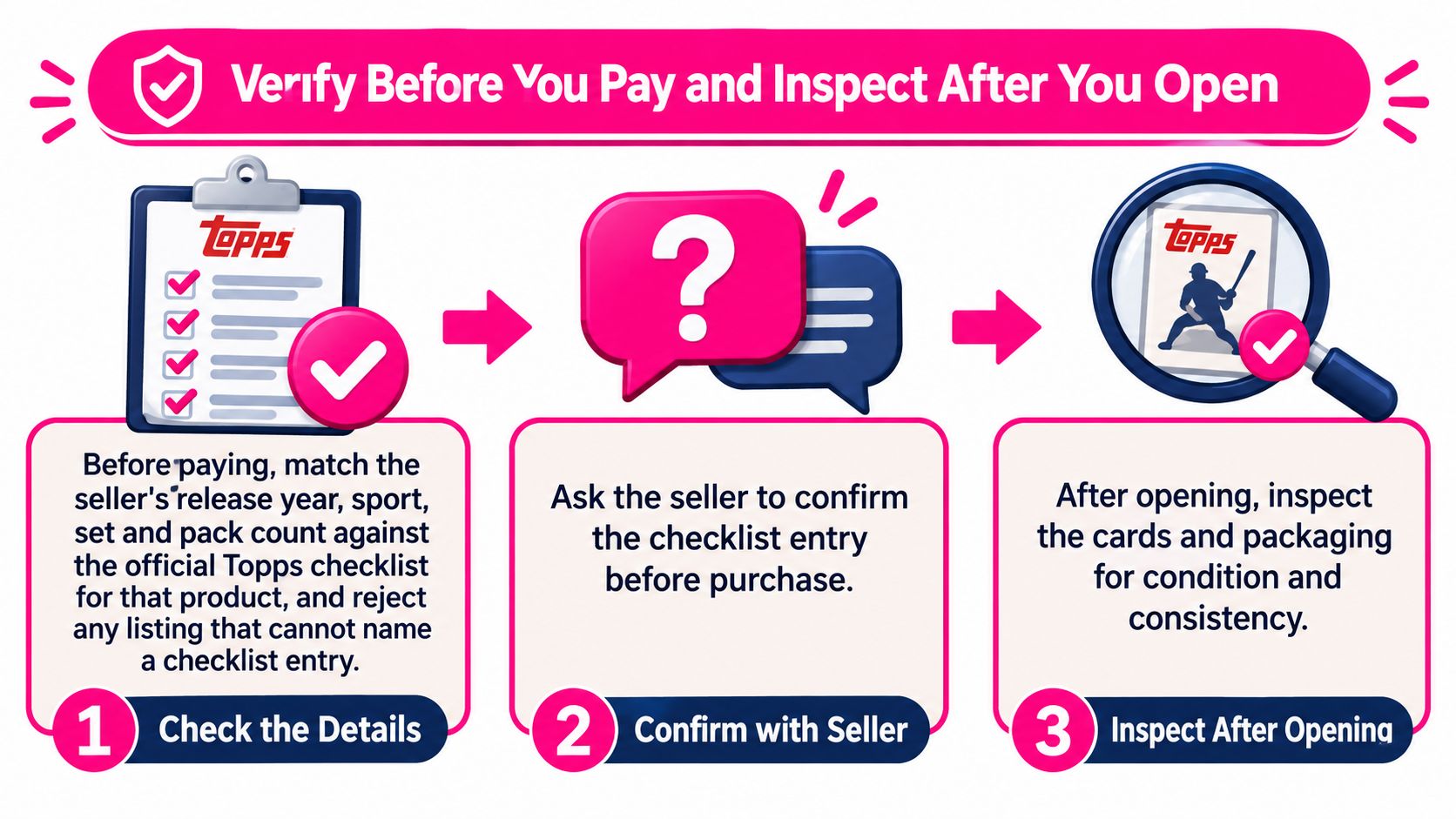
A listing that can't name its own release has already failed verification. Work through the sequence in the infographic before any money moves.
Before You Pay
- Match the checklist entry: Confirm the seller's release year, sport, set, and pack count against the official Topps checklist. Reject a listing that can't identify the corresponding product.
- Inspect the seal evidence: Ask for photos of the factory shrink wrap, seams, product code, and printed pack count. A box sold as containing seven packs shouldn't arrive with packaging that says otherwise.
- Challenge unsupported promises: Treat a price far below recent sold prices, refusal to provide seal photos, or a promised hit the manufacturer doesn't publish as a reason to walk away.
Configuration claims deserve the same scrutiny as seal photos. The Best Buy listing for 2025 Topps Chrome Football is a mega box listing that shows seven packs and 42 cards, so check that count against the release checklist before you treat it as a blaster configuration.
For a graded single, compare the card with a verified checklist image for consistent refractor finish, sharp printing, and correct card-back text, then check the PSA certification number. All cards sold by Lucardio Collectibles are guaranteed to be authentic, which removes one uncertainty. You should still verify that the sealed product configuration matches the release you intended to buy.
Watch the opening process in the video below, then run the inspection sequence on every card that might justify grading.
After You Open
- Record the pull: Photograph each chase card before further handling so you preserve evidence of its condition.
- Check centering: Compare the borders on the front and back. Uneven borders can keep an otherwise strong Chrome card from reaching a high grade.
- Use angled light: Tilt the card under a lamp and look for print lines, dimples, scratches, edge damage, and packaging-related flaws. Chrome surfaces reveal defects that flat, direct light can hide.
- Inspect edges and corners last: Run your eyes around the full perimeter before sleeving the card. Don't wipe the surface repeatedly, since unnecessary handling creates new risk.
Then make the economic decision with the card in front of you. Compare recent raw sales with realistic graded sales at the grade this specific copy could plausibly earn, and subtract grading fees, shipping, insurance, and selling costs. Grade when the expected graded value clears every cost with margin. Sell raw when a visible flaw makes a top grade unlikely or when the net gain is too small to justify the wait. Keep the card when its value to your set or collection exceeds either route.
A numbered rookie that looks valuable raw can lose much of its market premium if it doesn't grade well. For a Topps Chrome blaster box, expected grade matters more than rarity alone.
What a Blaster Is Really Worth Per Card
Cost per card gives you a floor, not a verdict. Dunham's Sports listed the 2025 Topps Chrome Platinum '55 Baseball Blaster Box at $29.99 and described it as containing 8 packs of 4 cards, or 32 cards total, in 2025. Divide $29.99 by 32 and you get about $0.94 per card before assigning value to any parallel, insert, or chase card.
Run the Four-Step Calculation
- Base cost: Divide the delivered box price by the confirmed card count.
- Expected chase value: Estimate the target card's realistic sale price and multiply it by its expected count per box. Don't multiply the best possible sale price by one because the card exists in the product.
- Ownership costs: Subtract shipping, market fees, grading fees, and return shipping where they apply.
- Direct-purchase comparison: Compare the remaining figure with buying the base cards, parallels, or target single directly. Our guide to how much a trading card is worth can help you structure that comparison with recent sales rather than asking prices.
At $29.99, the box needs either meaningful pull value, useful set-building cards, desirable retail parallels, or entertainment value you're consciously willing to fund. It doesn't need all four, but one of them must carry the purchase.
That's the proper conclusion from $0.94 per card. It's not evidence that every card is worth that amount, and it doesn't make the box cheap if most pulls have little use to you. A Topps Chrome blaster box can win on accessible exclusive parallels and lose badly as a route to an elite single. Check recent sold listings for both the sealed box and your target card before relying on any price, because the comparison expires as the market moves.
Confirm Your Goal Before Buying a Blaster
Your goal should determine whether a blaster belongs in your cart.
- Set builders: Buy when the checklist confirms that the base set and parallels you need are present in this retail configuration. Multiple boxes may still be inefficient if duplication rises faster than set completion.
- Single-card chasers: Run the target's category odds first, then compare the expected opening cost with the single's sold price. Buying the card directly is often the cleaner route.
- Grade-focused investors: Treat a blaster as the weakest route to one PSA-gradeable card. You must overcome pull odds first and condition risk second.
- Pack openers: Buy for the experience at a predictable cost, but label that spending as entertainment rather than expected profit.
Before paying, confirm the year, sport, set, and pack count, run the relevant odds calculation, compare cost per card with buying singles, and check authenticity and return terms. Decide before opening whether a strong raw pull will be graded, sold, or kept. That decision is easier before excitement takes over.
Lucardio Collectibles sells trading cards, sealed booster boxes, and PSA graded cards, and it runs live breaks where customers can join the action live. For a reader who wants exposure to an opening without buying a full sealed Topps Chrome blaster box, a break is another route to consider, provided the break's product, slots, and allocation rules are clear before entry.
Pick one goal, verify one checklist, and run one odds row. If those three checks support the price, open the box, inspect the pulls promptly, and decide within a day whether to grade or sell raw.
Ready to compare sealed products, authenticated singles, and PSA graded cards before your next purchase? Visit Lucardio Collectibles to explore trading cards and sealed booster boxes, join a live break, and buy with the configuration and authenticity checks already front of mind.