

The listing says 20 packs, one autograph guaranteed, and the photo shows a sealed box with that unmistakable shine. You're trying to work out whether it's $320 well spent or an expensive way to end up with a stack of cards nobody wants.
That question has a real answer. A Topps Chrome hobby box isn't a mystery bag with a fixed prize inside. It's a known number of draws from a pool with published odds. Learn to read those odds and the box stops being a gamble you can't evaluate and becomes arithmetic you can do.
Here's the build, in order: what the product is, what's physically in the box, what the pack odds mean, how to judge a card once it's in your hand, and how the reported prices stack up against what you're likely to pull.
Table of Contents
- What a Topps Chrome Hobby Box Is
- Box Contents, Packs and Cards by Year
- Parallels, Pack Odds and What They Mean
- Rarity, Condition and Grading Checks
- Reported Prices and Whether a Box Pays Off
- Choose the Right Box for Your Goal
What a Topps Chrome Hobby Box Is
A collector opening a Topps Chrome hobby box gets a fixed set of packs and a limited number of chances at the cards on that year's checklist. The box is a hobby-channel product, with chromium-finished cards built around the familiar Topps flagship design. Its appeal comes from the combination of glossy stock, a selected checklist and scarce parallels.
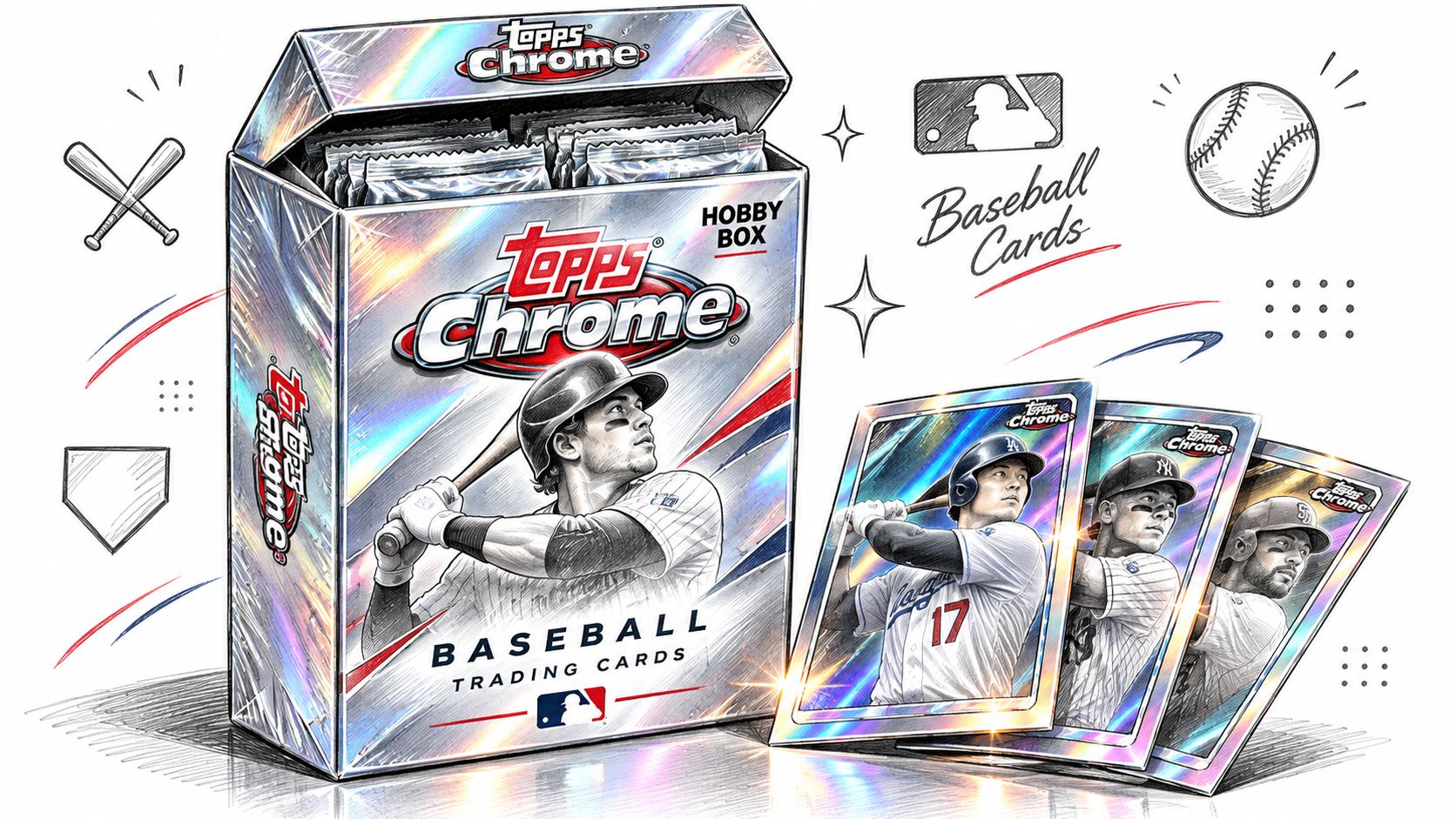
Chrome is a checklist decision as well as a finish. Topps Chrome baseball debuted in 1996 as a premium counterpart to the flagship set, using laminated chromium stock, as Topps' brand history records. The launch followed Topps Finest as card makers began offering premium products.
The checklist shapes what a box can deliver. Flagship Topps Baseball aims for broad team and player coverage, while Chrome focuses on a more selective group of players. That can concentrate collector interest, especially around rookies, but it does not guarantee a particular player or card.
The 1996 release also included Refractor parallels, a shinier variation of the base card. Their appeal comes from scarcity, though a box offers only a finite number of attempts at any particular parallel or subject.
- Premium stock. Chromium surfaces reflect light, making the finish distinctive and condition flaws easier to spot.
- A selective checklist. A focused player selection gives collectors a smaller pool to pursue; rookie cards often draw particular attention.
- Scarce parallels. These special finishes add another target, not a promised result.
A hobby box is a limited run of chances at specific cards, not a complete set or a guaranteed haul.
Box Contents, Packs and Cards by Year
A 2025 Topps Chrome Baseball Hobby box gives you 20 packs of four cards, or 80 cards in total, plus one guaranteed autograph. A hobby case contains 12 boxes, for 240 packs altogether, according to Cardsmiths Breaks' 2025 hobby checklist.
The 80-card total is the number of cards in the box, not a promise of 80 different base cards. The autograph guarantee works the same way: it promises a signed card, not a particular player, rookie, numbered parallel or autograph tier. The box sets the number of attempts; the checklist and pack odds determine which specific cards you might pull.
Other sports have different formats. A 2024-25 Topps Chrome Basketball hobby box contains 12 packs of eight cards, or 96 cards total. Its reported averages are about 1.1 autographs per box and one numbered card per 2.7 boxes, according to Cardsmiths Breaks' basketball checklist. A 2024 Topps F1 Chrome hobby box also contains 12 packs of eight cards. Grid Cards UK's F1 Chrome guide reports a release price of $230.
| Product | Packs per box | Cards per pack | Cards per box | Configuration notes |
|---|---|---|---|---|
| 2025 Topps Chrome Baseball Hobby | 20 | 4 | 80 | One autograph guaranteed per box; 12 boxes per case; 300-card base set with 100 rookies |
| 2024-25 Topps Chrome Basketball Hobby | 12 | 8 | 96 | About 1.1 autographs per box on average; one numbered card per 2.7 boxes on average |
| 2024 Topps F1 Chrome Hobby | 12 | 8 | 96 | Reported release price: $230 |
| 1996 Topps Chrome Basketball | 20 | 4 | 80 | 220-card set; Season's Best at 1 in 6 packs, ProFiles at 1 in 8, YouthQuake at 1 in 12 |
| 1996 Topps Chrome Football | 24 | 5 | 120 | 165-card set; Refractors limited to two per box |
| 1996 Topps Chrome Baseball | 24 | 4 | 96 | Original Refractors at 1 in 12 packs |
How to read a box listing in four checks
- Multiply packs by cards per pack. This gives the box's total card count. A 20-pack box with four cards per pack contains 80 cards; a 12-pack box with eight cards contains 96.
- Check the year and sport. Configurations change between releases, so the details for one year or sport do not establish the contents of another.
- Separate guarantees from averages. One autograph per box is a stated guarantee. An average such as 1.1 autographs per box describes results across boxes, not what any single box must contain.
- Confirm the format. Hobby, jumbo hobby, mega and blaster boxes can have different pack counts and card selections. Make sure the listing describes the format you intend to buy.
Parallels, Pack Odds and What They Mean
A parallel is a variant of a base card with a different finish or numbering. Same player, same photo, different surface: a Prism, a Negative, a Teal, a Purple. The base card is the original; parallels are versions with a twist and usually a shorter print run.
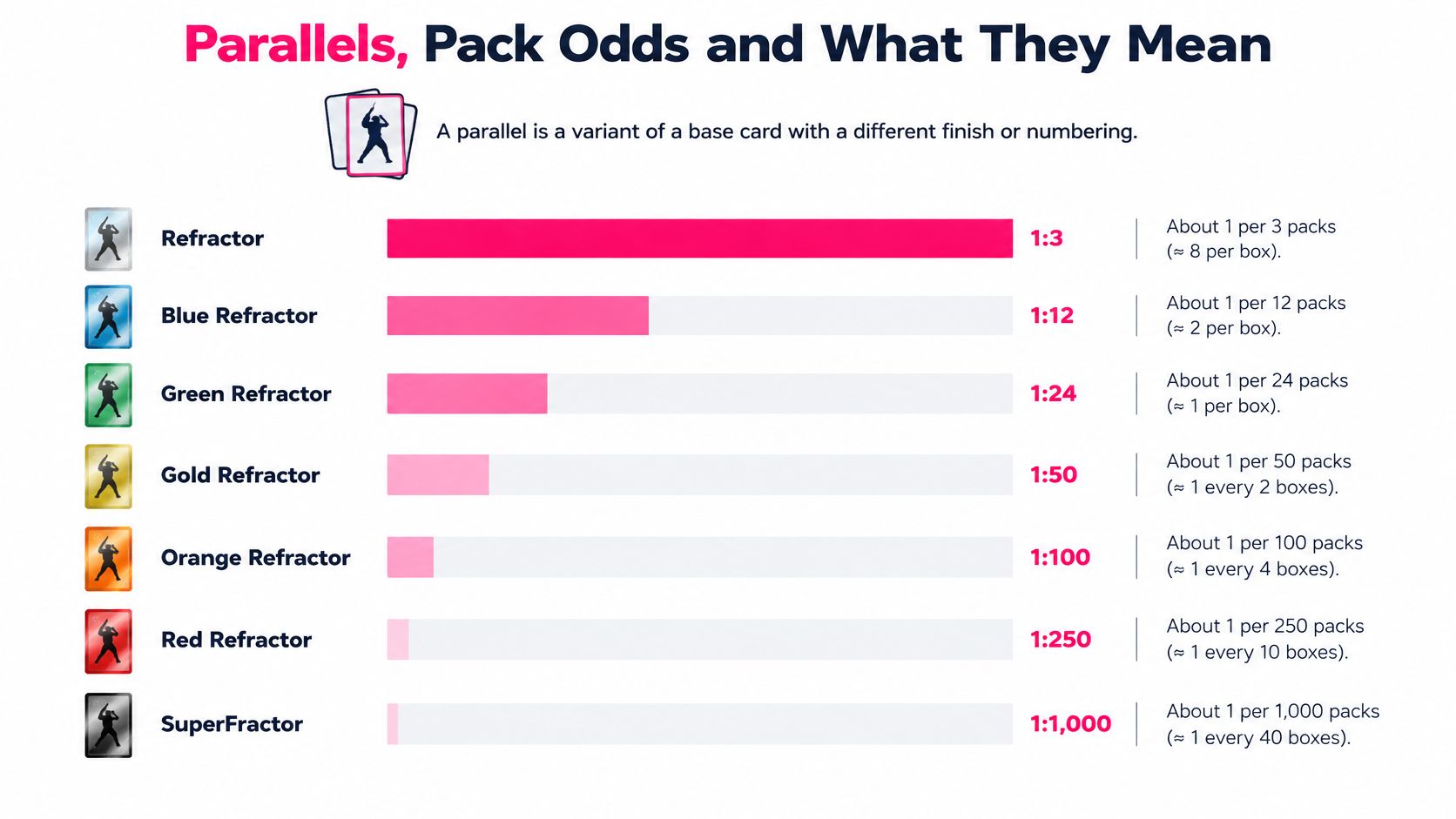
The math is simpler than it looks. Take the packs in a box and divide by the pack rate.
20 packs ÷ 3 = about 6.7 Refractors per box.
Run that division for every tier and you get a full expectation map. The 2025 product uses a 300-card base set that includes 100 rookies, with hobby pack odds listing Refractor at 1:3 packs, Prism Refractor at 1:6, Negative Refractor at 1:54, Teal Refractor at 1:108 and Purple Refractor at 1:130, per Dugout Vault's 2025 checklist data.
| Parallel | Reported odds | Expected per box |
|---|---|---|
| Refractor | 1 in 3 packs | About 6.7 |
| Prism Refractor | 1 in 6 packs | About 3.3 |
| Negative Refractor | 1 in 54 packs | About 0.37 |
| Teal Refractor | 1 in 108 packs | About 0.19 |
| Purple Refractor | 1 in 130 packs | About 0.15 |
Read the right-hand column as an average, never as a packing list. A box that promises one autograph delivers one autograph. A box that averages 6.7 Refractors might hand you four, or nine. Odds describe how a print run distributes across thousands of packs, not what sits in the box on your table.
The spread between tiers is the part worth internalising. One Refractor every three packs is an ordinary pull you'll see several times in an evening. One Purple every 130 packs is closer to a once-in-six-boxes event.
Why a parallel is a scarcity label, not a price
It's tempting to read the odds as a price list, where rarer automatically means more valuable. It doesn't work that way, because the 100-card rookie segment spreads parallels across a large number of subjects. Player demand, grading outcomes, centering, surface quality and serial numbering all push the final number, and none of them appear on the odds sheet.
For sellers, the practical habit is to log the exact parallel name, the serial denominator when one is printed, the card number, the rookie designation and the condition before assigning any value. If you're comparing formats first, our breakdown of the Topps Chrome blaster box shows how a smaller configuration changes the same arithmetic.
Rarity, Condition and Grading Checks
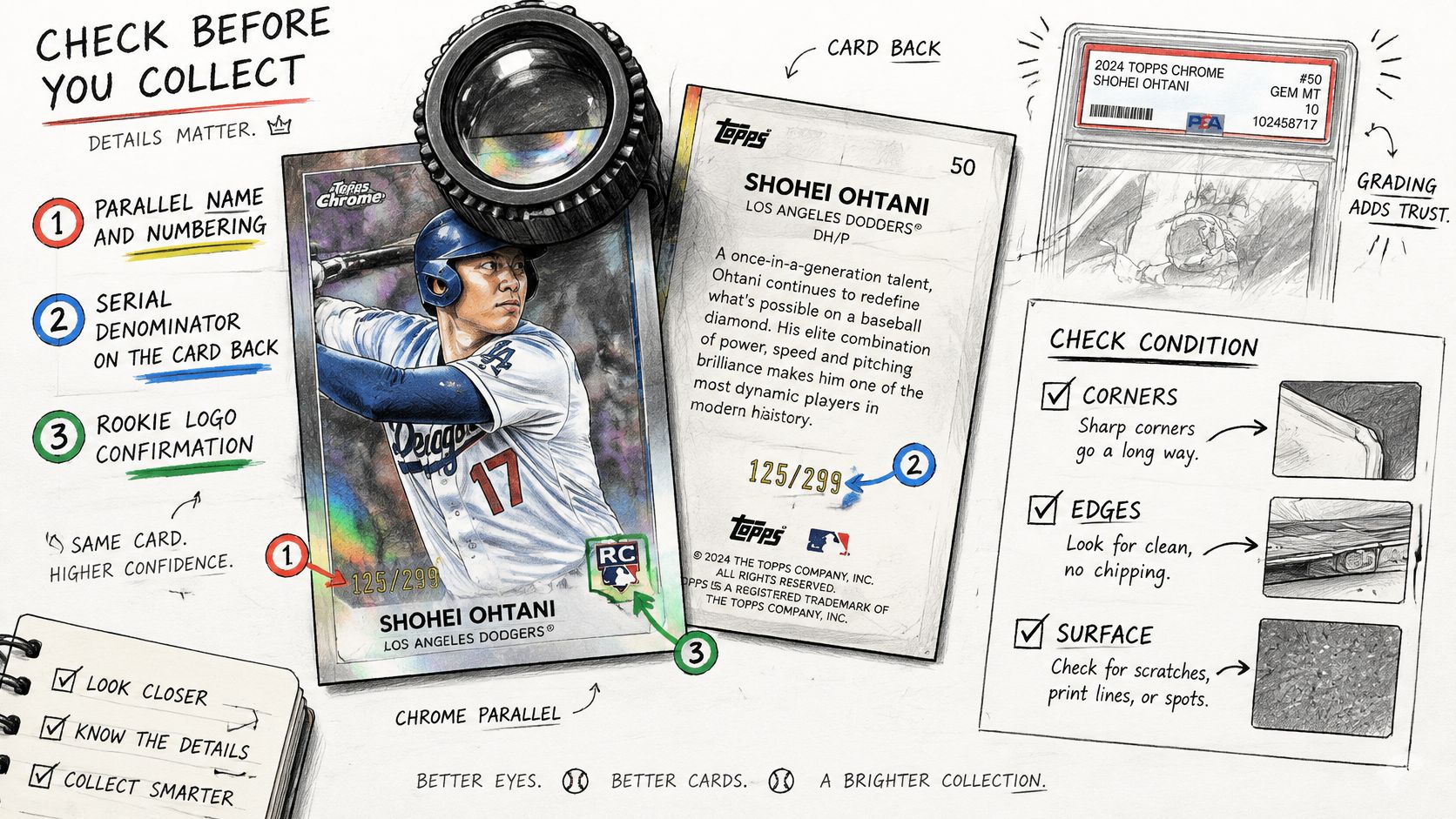
Pack odds tell you how hard a card is to pull. They don't tell you whether the card in your hand is worth grading, holding or listing tonight. That call takes six checks, in this order.
- Confirm the exact parallel name and whether it's numbered. A card described only as "Chrome" tells you almost nothing. The finish name and the numbering do the work.
- Read the serial denominator. A "12/25" means 25 copies exist. An unnumbered parallel has an undisclosed print run, which is a very different thing from a small one.
- Confirm the rookie designation and the player's demand. With 100 rookies in the 2025 base set, the rookie flag alone doesn't separate one card from ninety-nine others.
- Inspect centering, edges and surface under a light held at an angle. Chromium finishes make scratches, print lines and refractor chipping more visible than matte cardboard ever does.
- Check grading status and population figures for any slab you're buying or any card you're thinking of submitting.
- Compare recent realized sales, not asking prices. Asking prices are wishes. Sold prices are evidence.
Rarity versus availability
These get used interchangeably and they shouldn't be. Rarity is how many copies exist. Availability is how many a buyer can pull over a few boxes.
A 2025 community analysis estimated 2,721,160 hobby packs, roughly 2% below the estimated 2,775,528 packs for 2024, and noted that unnumbered refractors can appear around one per three packs while numbered cards and short-printed inserts sit far lower, per The Collector Nation's product analysis. A 2% swing in supply doesn't turn an easy pull into a scarce one.
That's why the "Chrome" label is a poor proxy for rarity. A long checklist dilutes demand across many visually similar cards, so a shiny unnumbered parallel can feel like a hit without being scarce at all.
Say two unnumbered Refractors of different rookies come out of the same box. Both are 1-in-3 pulls, both shine identically. One player already has a deep graded population, so mint copies are plentiful and grading adds little. The other has a thin population nationwide, and a high grade changes what the card is worth. Same scarcity on paper, completely different outcome in the market.
Practical rule: photograph the parallel under consistent lighting and note the centering and any surface flaws before you list it. Buyers dispute what they can't see clearly.
Grading rewards preparation, and it punishes surprises. If you're weighing whether a submission is worth the fee, our guide to graded card prices walks through how the market treats condition and population.
Reported Prices and Whether a Box Pays Off
A collector pays $320 for a box, opens it, and finds cards that might resell for much less. That gap is the core trade-off: a hobby box offers a finite number of attempts at scarce cards, not a guaranteed return.
For 2025 Topps Chrome Baseball, the box promises one autograph, compared with two in earlier releases. The $300 to $335 reported price range comes from Sports Card Investor's 2025 Topps Chrome Baseball price guide. A lower price can still buy fewer guaranteed hits.
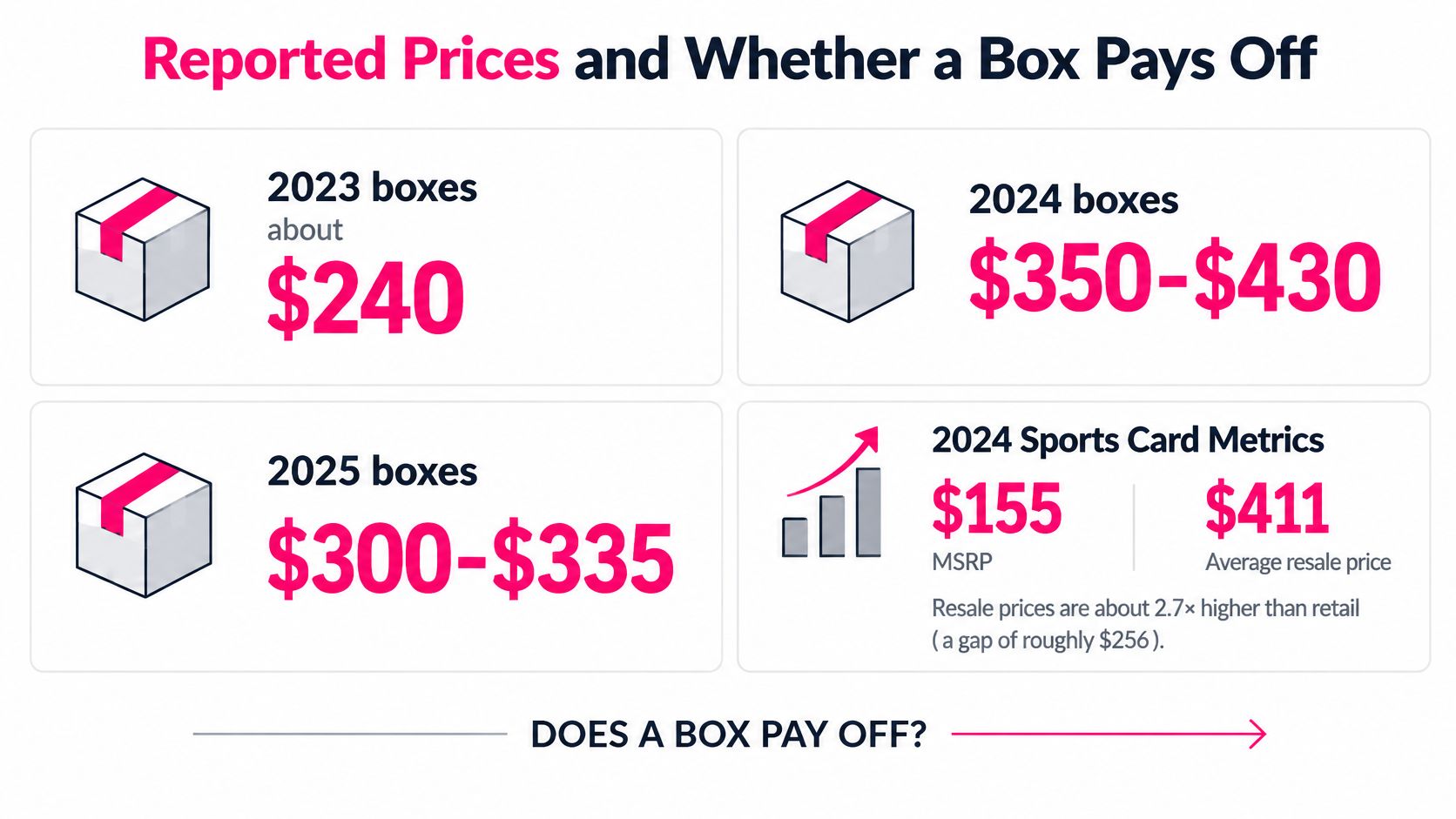
Sports Card Metrics lists the 2024 Topps Chrome Baseball hobby box at a $155 MSRP and a $411 recorded sold price, a $256 premium over MSRP, with one autograph per 1.3 boxes (Sports Card Metrics). A recorded sale is a market snapshot, not a promise that the box will sell for that amount again.
| Year | Reported price | Autographs per box | Note |
|---|---|---|---|
| 2023 | Price not stated | Autograph count not reported | Reported box price |
| 2024 | Price not stated | Two in prior releases (reported) | Reported box price |
| 2024 Sports Card Metrics | $155 MSRP | One per 1.3 boxes | Recorded sold price $411; $256 premium over MSRP |
| 2025 | $300 to $335 | One | Lower price, half the guaranteed autographs of prior releases |
A numbered parallel gives collectors a defined print run to chase; an unnumbered Refractor does not carry that same stated limit. Either way, a box gives you attempts, not a particular player or parallel.
Here's a look at a Topps Chrome hobby break in practice.
Three boxes, three outcomes
Consider three hypothetical outcomes from the same $320 box. These figures illustrate how results can vary, not average resale values.
The typical box. The autograph is a mid-tier rookie with modest demand, while the unnumbered Refractors are commons. If the cards together resell for roughly $40, the shortfall is about $280.
The strong box. A numbered card joins a more sought-after autograph. If those two cards resell for around $120 to $150, the box still falls short of its purchase price, though the rip may feel more rewarding.
The exceptional box. A scarce parallel of a sought-after rookie has strong resale demand. It could return more than the box cost, but that outcome is possible, not guaranteed.
The rule that settles it: compare the box price with the resale value you realistically expect, not the best possible pull. If the price is higher, you're paying for the chase as well as the cards.
Reported prices capture particular moments, not current quotes. Sealed-box prices can shift with rookie interest and product availability, so treat past sales as reference points rather than promises.
Choose the Right Box for Your Goal
A box can guarantee an autograph without guaranteeing the player, parallel, or resale value you want. Choose a format based on your goal, then check what the product or seller promises.
| Buyer goal | Best format | What to verify before buying |
|---|---|---|
| Complete a set | Hobby box | Checklist, base-card count, autograph configuration |
| Chase one player | Graded single | Parallel name, serial number, certification, population report |
| Experience the rip without a full box | Live break | Break rules, guaranteed versus probable hits, shipping and insurance terms |
| Hold value as an investment | Sealed box or graded singles | Recent sold prices, player demand, expected versus guaranteed value |
Set builders should start with the checklist. Check how many base cards the set includes and what the box guarantees. One autograph gives you a defined hit, but it does not guarantee that you will complete a set.
Player collectors usually have a more direct route: buy the specific card. Pulling one player's Refractor from a box is uncertain, while a single lets you select the exact card. For a graded card, check the certification and population report.
Break participants should read the rules before joining. Confirm which cards are assigned to you, what is guaranteed, and how shipping and insurance work. A break offers a chance to join the rip without buying a full box, but it does not make a particular card more certain.
Investors should compare the purchase price with recent sold prices for boxes and singles. Expected value is an estimate, not a promise. A sealed box can deliver its stated autograph configuration and still be worth less than it cost.
Before you commit: check the box format, the autograph guarantee, and the seller's shipping and insurance terms.
If you are comparing sellers, use this guide to choose where to buy hobby boxes online. Lucardio Collectibles sells trading cards, sealed booster boxes, and PSA-graded cards, with every card guaranteed authentic and secure shipping with insured delivery. Subscribing is free and provides access to giveaways, early access to new drops, and collector updates.