

A PSA 10 is the figure people repeat for Ultra Ball Plasma Freeze. The grade book behind it is narrower than that headline. Recorded submissions put a gem mint on only a small share of copies sent in, and ungraded copies do not trade every week. A high asking price can sit on a card that takes longer to exit than a cheaper card from the same era.
Treat the premium as a grade-distribution and liquidity question. Confirm the copy, place the set, then read any quote as a snapshot tied to condition and to how often similar copies sell.
Table of Contents
- Ultra Ball Card Details at a Glance
- Where Ultra Ball Fits in the Plasma Freeze Set
- How Ultra Ball Plays Out in Practice
- What Ultra Ball Is Worth Right Now
- Why the PSA 10 Premium Changes the Math
- Liquidity, Authentication and Your Buying Verdict
Ultra Ball Card Details at a Glance
| Attribute | Detail | What It Means for Collectors |
|---|---|---|
| Set | Black & White Plasma Freeze (English) | Late Black & White era, before the XY series |
| Card number | 122/116 | Printed beyond the 116-card main checklist |
| Set code | PLF | Use it to match listings to the correct set |
| Rarity | Secret Rare holofoil | Marks it as the set's chase card |
| Card type | Trainer, Item | Confirms the category when reading card text |
| Effect | Discard 2 cards from hand, then search for any Pokémon | Compare the exact wording when authenticating |
| Release date | May 8, 2013 (English) | Dates the card to the Black & White era |
The Serebii card page lists Ultra Ball as a Secret Rare Trainer Item numbered 122/116, printed past the 116-card base checklist, from the English expansion on May 8, 2013. That number is the first checkpoint. A title that says "Ultra Ball" without 122/116 can be a different printing.
PLF is the set code that ties a listing to this English expansion. If the code is missing, or if the seller substitutes another set's code, pause before you pay a Plasma Freeze price. The holographic Secret Rare finish is the second visual check. A non-holo Item with the same name is not this card.
The effect runs in a fixed order. You discard two other cards from your hand, search your deck for any Pokémon, reveal it, add it to your hand, and shuffle. That text is an authentication line, not only a rules line. Listings that omit the number, the rarity, PLF, or this wording need a second look, because those are the fields a wrong copy fails first.
A four-point check on the copy in hand
- Number: The corner reads 122/116, not a number inside the main 116.
- Rarity: The card is a holographic Secret Rare, not a common Item reprint.
- Set code: PLF appears with the Black & White Plasma Freeze identity.
- Text: Discard two other cards, search for any Pokémon, reveal it, add it, shuffle.
If one of those four fails, you are not holding the chase copy this market is pricing. Seller titles are optional. The card face is not.
Where Ultra Ball Fits in the Plasma Freeze Set
Collectors meet this card inside a set that arrived in two waves. On December 14, 2012, the Japanese products Spiral Force and Thunder Knuckle reached shops. The English expansion followed on May 8, 2013, as the ninth main set of the Black & White series, according to the Pokémon TCG Plasma Freeze page. A gap of nearly five months between the two releases is why Japanese and English sealed product should never share one price tag.
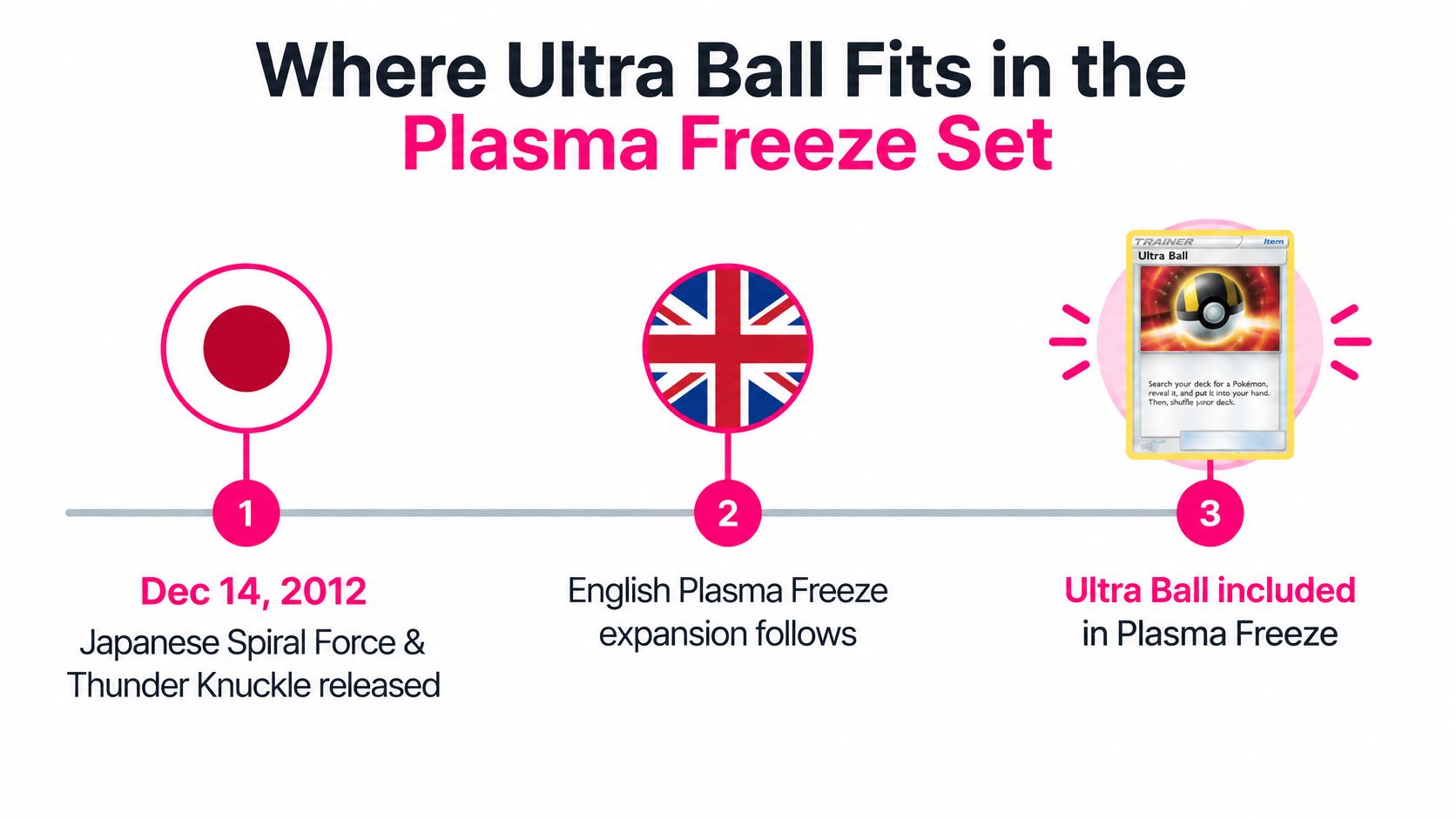
Team Plasma is the design you can spot across a binder page. Cards carry distinctive blue borders and Plasma shields, so a mixed lot is easier to sort than a plain Black & White pile. The complete English checklist settles at 122 cards: 116 in the main numbered run and six secret cards past 116. Ultra Ball sits in that secret group, which is why its number runs past the base set.
The set's high-rarity reach runs wider than that one secret slot. The release also included several Pokémon-EX and ACE SPEC cards, so a "complete Plasma Freeze" hunt spans three different kinds of chase. Someone building a master set is chasing EX artwork, ACE SPEC text, and the secret slot together. Someone buying a single is only in the last of those lanes, and should not pay a master-set premium for one card.
That width matters for how the market treats this card. A set with several parallel chase lanes spreads collector attention and sealed-product demand across all of them, which means each lane develops its own trading depth rather than borrowing depth from the set's headline reputation. Ultra Ball's lane is the narrowest of the three by count, and thin lanes are where headline prices and actual liquidity most often diverge.
The dates put the expansion in the late Black & White period, before the XY series began. Collectors who track generation changes treat it as a bridge set: Team Plasma styling on one side, the next era's design language on the other. If you are still learning how secret, EX, and ACE SPEC slots differ, the Pokémon card rarity guide is the cleaner map. The 122-card frame and its separate high-rarity groups are what let sealed boxes, raw singles, and graded chase cards get cataloged as distinct markets instead of one pile.
How Ultra Ball Plays Out in Practice
In a game, this Item is a consistency tool with a visible bill. You give up two cards you could have kept, and you gain a Pokémon you name from the deck. The search stops being a coin flip. The hand gets smaller on purpose.
Say you are holding five cards and the board loses if you miss one specific Pokémon this turn. Two of the five are the search target's substitutes, and the other three do little until later. Paying two of the weak cards leaves you three cards plus the Pokémon you needed. With a full hand, that trade is affordable. The same payment is ugly when you are holding three cards total, because the discard takes most of what you had left and you still have to sequence the rest of the turn.
When the discard works against you
The two cards do not vanish into a void. They change the game in three ways.
- You lose a card you wanted later. A situational Supporter or a one-of tool can be the piece you pitch, then need on the following turn.
- Discard piles are public resources. Some effects care what has been discarded. You might be feeding your own engine, or you might be feeding the opponent's.
- A short hand makes the cost steep. Searching is only "free" if the two pitched cards were the worst cards you held. If they were your only energy or your only switch option, the search bought a Pokémon you cannot use.
Practical rule: Play the card when the two discarded cards are the least useful cards in your hand. If you cannot name two cards you are happy to lose, do not search yet.
That rule is stricter than "always search for consistency." The card reduces the chance you whiff a Pokémon. It does not reduce the chance you stranded yourself with nothing else to do.
What Ultra Ball Is Worth Right Now
Two trackers can quote a near-mint raw copy of the same card and land far apart, and both readings can be honest snapshots of different marketplaces on different days. The Plasma Freeze set tracker treats this secret rare holofoil as the set's most valuable card and assigns it about 17% of the set's total tracked value in its model. The rest of the expansion's tracked cards and variants split the remaining value, which makes the headline price both the draw and the risk.
| Source | Metric | Reported value |
|---|---|---|
| Plasma Freeze set tracker | Rank within Plasma Freeze | Most valuable card in the set |
| Plasma Freeze set tracker | Share of tracked set value | About 17% |
How to read a range that moves
Any quoted price is a snapshot. Condition, grading, sales volume, and the day of the reading all move it. A wide gap between two quotes usually means the measurements were taken apart, on copies that may not match. Where a gap stays wide for months, the usual cause is thin comparable sales rather than disagreement about the card itself.
Use the range as a comparison start, not a bid.
- Write down the date of any quote before you argue with a seller. A number without a day is not a comp.
- Match the quote to condition. A near-mint raw reading does not describe a played copy, a crease, or a slab.
- Treat the raw figure as a floor for conversation. It marks the ungraded neighborhood and leaves open what a specific copy cleared last week.
Roughly 17% of one model's tracked set value sitting in a single card shows how concentrated the money is. It says nothing about whether a holder can sell near the top of the quoted range this week. A headline price is silent on time-to-sale, and a card can hold the top slot in its set while trading thinly. Concentration and liquidity are different facts. Only the first one is in this table.
Why the PSA 10 Premium Changes the Math
Price guides often print a raw number next to a PSA 10 number and stop. That pair looks like a return. It is a spread between two different objects, and the population behind the top grade is modest.
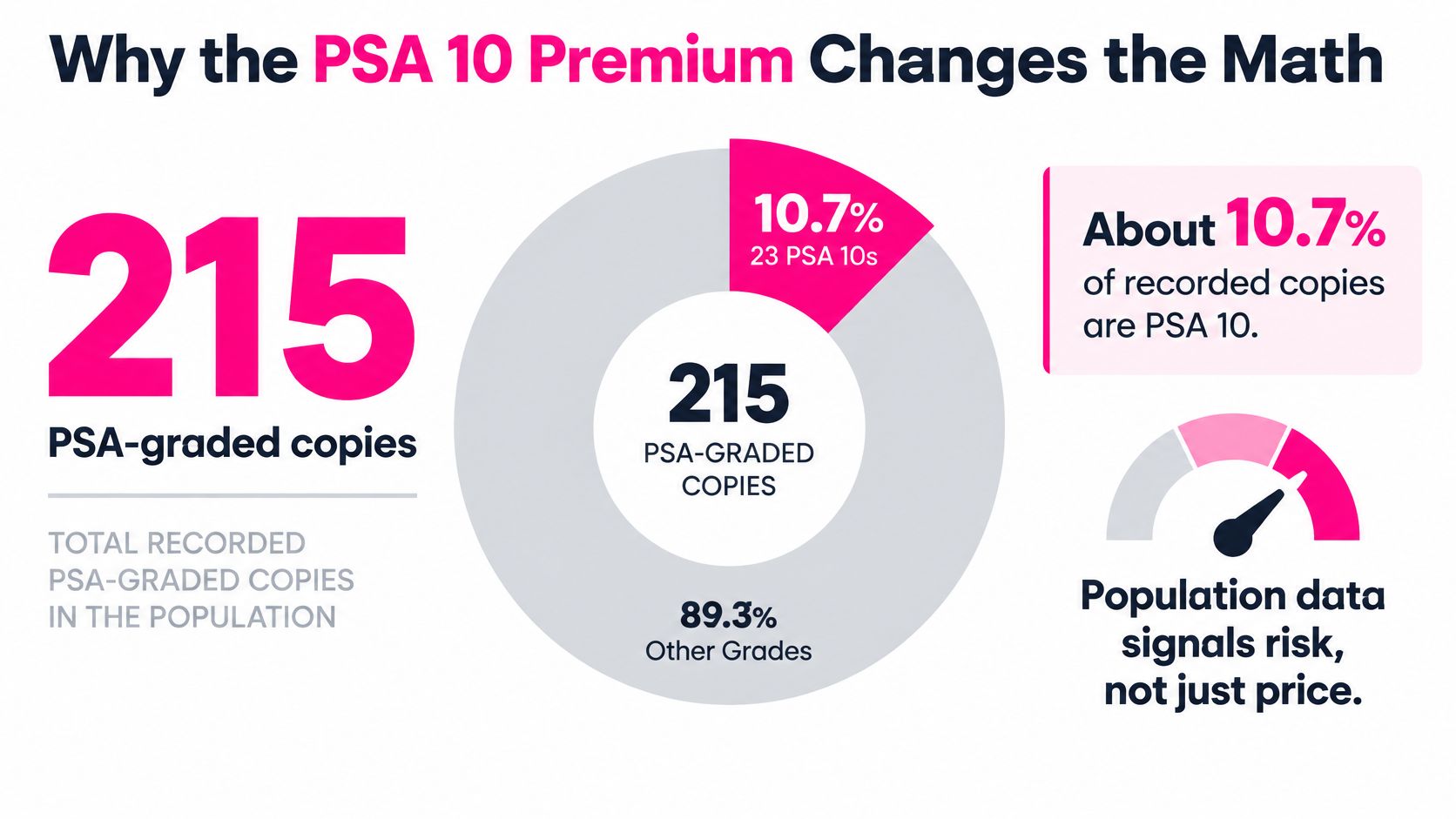
The PriceCharting population page lists 215 PSA-graded copies, including 23 PSA 10s, so roughly 10.7% of recorded submissions received a 10. The same report shows 68 PSA 9s and 45 PSA 8s, with the remaining 79 copies sitting below PSA 8. A 10 is uncommon inside this graded pool. It is not a one-of-one, and a 9 is the single largest grade in the report.
| PSA Grade | Recorded Copies |
|---|---|
| PSA 10 | 23 |
| PSA 9 | 68 |
| PSA 8 | 45 |
| All other grades combined | 79 |
| Total | 215 |
Two price pairs, not one market
Reported prices for this card diverge across sources and across grades. A raw quote and a PSA 10 quote describe different objects pulled from different tracker methodologies, so each grade should be compared against its own recent sales rather than merged into a single trend line. Stacking a raw reading from one source beside a PSA 10 reading from another produces a gap that measures the datasets, not the card.
The spread is still the point. An advertised slab value and a price a buyer can execute are not the same number, and the 23-copy PSA 10 count means the top of the market rests on a thin base of certified examples. Scarcity of the grade does not, by itself, promise a rarity-adjusted return. For a wider look at how grade bands price apart, see this breakdown of graded card prices.
What a population report leaves out
Three limits sit on every one of these counts.
- Resubmissions can inflate the book. A card cracked out and sent again can appear more than once. The 215 is recorded submissions, not proven unique copies.
- Ungraded inventory is invisible. Raw copies in binders never enter the percentage. The 10.7% figure describes what was submitted, not what exists.
- The report does not say who would sell. A population is not a listing count. Owners can hold through the current ask.
Centering and surface explain why so many submissions miss the 10, and why a raw card with soft corners should not be priced as a future gem. The premium partly reflects how strict the grading event is rather than a shortage of the printing itself. That distinction matters for the math: the PSA 10 price is the value of a selection outcome that roughly one submission in ten achieves, not a multiplier a buyer can apply to any raw copy. Price each grade on its own comps, because a single estimate for "the card" hides the risk that sits between an 8, a 9, and a 10.
A PSA 10 price is a scarce outcome inside a submitted pool, not a forecast that the next raw copy becomes that outcome.
Liquidity, Authentication and Your Buying Verdict
"Most valuable in the set" is a rank, and a rank does not make a hold thesis. The Ultra Ball card listing records roughly 28 ungraded sales in 90 days. Umbreon 64, a lower-priced card from the same set, changes hands on the same marketplaces at a visibly faster pace. Ultra Ball's appeal mixes secret-rare status, 2013 nostalgia, and recognition as a playable Item. That mix supports a bid. It does not keep the bid liquid.
| Card | Ungraded Sales | Time Window | Price Level |
|---|---|---|---|
| Ultra Ball 122/116 | About 28 | 90 days | Set's most valuable card |
| Umbreon 64 | More frequent | Weeks rather than months | Lower-priced card |
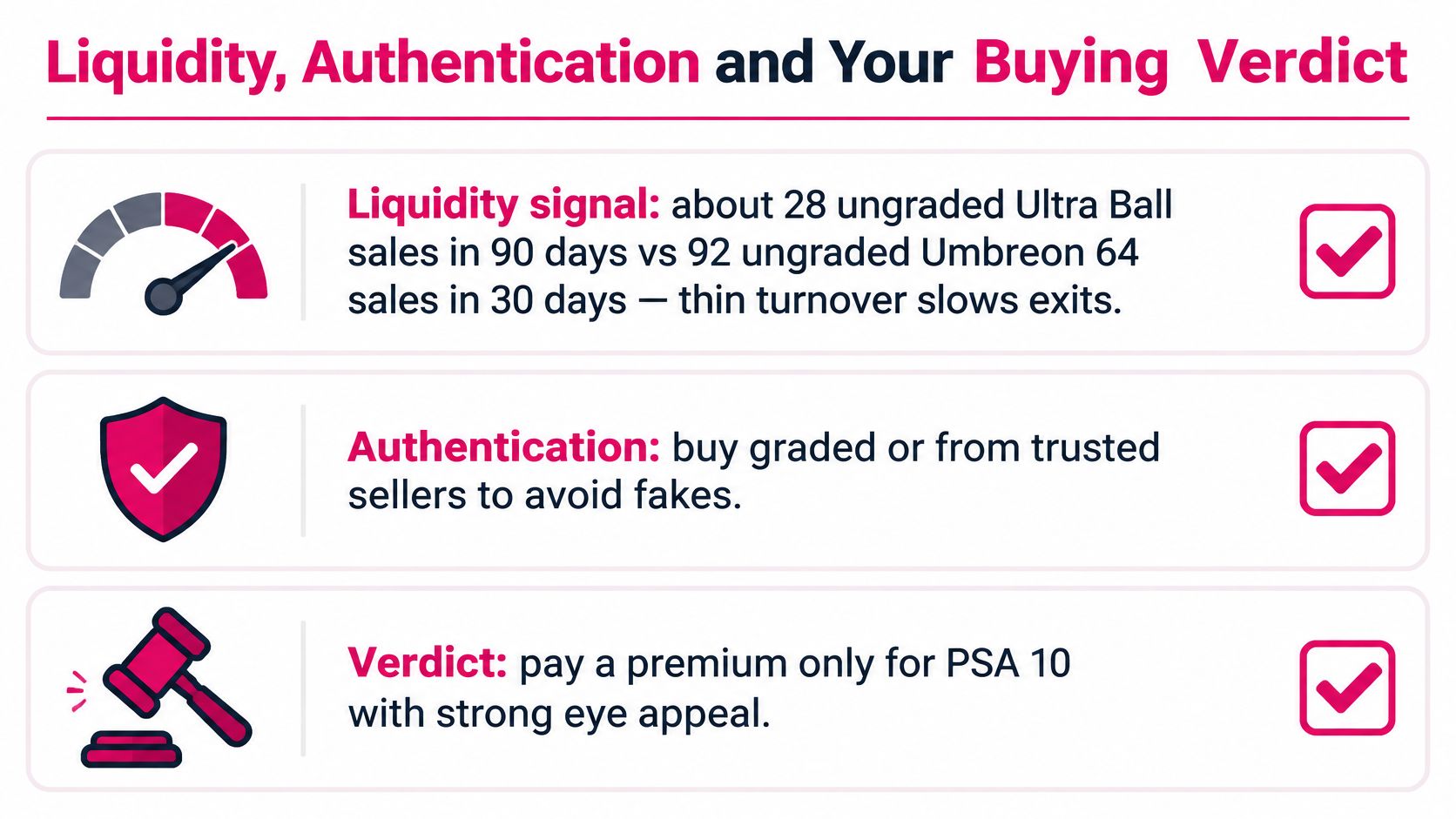
Thin turnover widens the gap between the ask and what a buyer will pay. It stretches the time a seller waits for a fill, and it lets one or two unusual sales yank the visible price in either direction. You cannot yet say this secret rare outperforms other secret rares once grade and sales frequency are held constant, because that test has not been run in these snapshots. Compare same-grade sales over a similar window before calling Ultra Ball the better hold.
That is the whole liquidity argument: a high price on a slow tape is a quote, not a market.
Before you pay
- Match the identity. Confirm 122/116 and PLF on the card, not only in the listing title.
- Open the cert. On a graded copy, read the certificate number against the slab. A label without a matching cert is not a grade.
- Compare the photos. Check surface, centering, and the holo pattern against the pictures in the listing. A stock photo is not your card.
- Pull three comps. Use recent sales of the same grade. Ignore the headline number if those three do not cluster near it.
- Require a protected exit path. Pay only when fulfillment is insured and trackable. A raw or a slab at this level is a poor candidate for an uninsured envelope.
If you are unsure the card is genuine, walk through how to tell if a Pokémon card is fake before you compare prices at all. A fake with the right set number is still a fake.
Then run one exit test. Could you sell this exact copy, at a price you would accept, within a few weeks? If the only support for that price is a single peak sale, the answer is no.
Three buyers, three different decisions
A collector who wants the flagship of the era, and who also likes that the Item saw play, can buy a raw copy and live with its uncertainty. The goal is the card in hand, not a resale clock. Pay inside recent raw comps for the condition you can see, and assume you may wait if you later change your mind.
A hobby investor should not buy "the card." Buy a verified grade that already has recent same-grade sales behind it. If the last comps are months old, you are underwriting illiquidity. That can pay off, and it can also trap the money. The snapshots here do not show which outcome you will get.
A seller should price by grade and expect a slower exit than a common card or a lower-priced chase card delivers. About 28 ungraded sales in 90 days is the observed pace, not a promise. Listing at the top snapshot because the card ranks first in the set is how copies sit unsold.
Lucardio Collectibles lists authenticated and PSA-graded singles with condition visible before checkout, and a PSA 10 Moonbreon is one of the prizes offered in the weekly prize draws. Check what is listed before you plan a purchase around a single quote. A buyer who cannot authenticate the card or insure the shipment is taking a risk the rank of the card does not cover.
The verdict is narrow on purpose. Ultra Ball can be the right card for a Plasma Freeze collection. It is not automatically the right investment, because the same scarcity that lifts the ask also thins the tape.
Lucardio Collectibles brings together authenticated Pokémon singles, sealed product, and PSA-graded slabs, with insured fulfillment when you buy or redeem. If you are weighing a Plasma Freeze chase card, start from verified condition rather than a headline rank. Visit Lucardio Collectibles to see current inventory and upcoming prize draws.