
If you ask around about XY Roaring Skies, the advice comes back fast. Rip a booster box for the chase cards, and grade the cheap singles, because somebody's Pikachu sold for four figures in a PSA 10. Both halves of that advice lean on numbers that fall apart under inspection.
A pull-rate table can print a secret rare at one in 125 packs and read like manufacturer data, while no published study for this set exists at all. A four-figure slab price can look like a market, while it rests on seven sales in ninety days. Neither number is a lie. Both are being asked to do a job they can't do, which is tell you what your box or your raw card will return.
Read the set in order and the money questions get easier. What the product is, which cards people hunt, how the rarity stack adds up, why the odds charts overreach, and when a grading submission pays for itself.
Table of Contents
- What XY Roaring Skies Actually Is
- Cards Collectors Still Hunt and How to Read Them
- How the 112-Card Rarity Stack Works
- Why Pull Rate Charts Overclaim
- When Grading a Roaring Skies Card Pays
- Choose Raw Graded or Sealed Next
What XY Roaring Skies Actually Is
Most collectors meet XY Roaring Skies through one card. Shaymin-EX dominates the conversation so thoroughly that the set behind it turns into a footnote, and that framing hides the product. The correction starts with the record: the official Pokémon TCG page for XY Roaring Skies places it as the sixth main expansion in the XY Series, released in English on May 6, 2015.
Its Japanese counterpart, Emerald Break, arrived earlier, on March 14, 2015, 53 days before the English street date. The gap isn't trivia. Japanese and English printings of this set live in separate catalogues with separate card counts, so an Emerald Break card and an English Roaring Skies card are related products, not interchangeable ones.
The set ties to Pokémon Omega Ruby and Alpha Sapphire and builds around Mega Rayquaza, which is why the Mega Evolution presence runs through the art. The same official description counts more than 100 cards, including 4 new Mega Evolution Pokémon and 11 new Pokémon-EX overall. It also lists 9 full-art Rare Ultra Pokémon-EX cards, 17 Trainer cards and 1 new Special Energy card.
Read that contents list as a description of a competitive set, not a collector's insert. Powerful Pokémon-EX mechanics, full-art treatments and Trainer support were the selling points in 2015, and they're the reason boxes still get opened today.
| Fact | English set | Japanese counterpart |
|---|---|---|
| Name | XY Roaring Skies | Emerald Break |
| Release date | May 6, 2015 | March 14, 2015 |
| Series place | Sixth main XY Series expansion | Japanese printing of the same era |
| Theme | Omega Ruby and Alpha Sapphire, Mega Rayquaza | Same Mega Evolution theme |
| Official size note | More than 100 cards | Catalogued separately from English |
| Headline contents | 4 new Mega Evolution Pokémon, 11 new Pokémon-EX, 9 full-art Rare Ultra Pokémon-EX, 17 Trainers, 1 new Special Energy | Not the same card count as English |
Two facts in that table do most of the work in 2026. The May 2015 date places the set in modern XY-era vintage, old enough to be long out of print and recent enough that sealed supply still circulates.
Working rule: a sealed booster box, a numbered single, a secret rare and a graded slab are four different inventory units even when they share the same set logo.
The release also shipped with ready-to-play theme decks alongside the booster product, which is why fixed deck listings turn up in set searches. Keep them mentally separate from pack pulls. And the set size question stays open, because catalogues disagree about whether this is a 110-card set or a 112-card one.
Cards Collectors Still Hunt and How to Read Them
A familiar name on the card is not enough to identify a Roaring Skies print. Artwork, card number, language, and condition all affect what a listing means, so check those details before comparing prices.
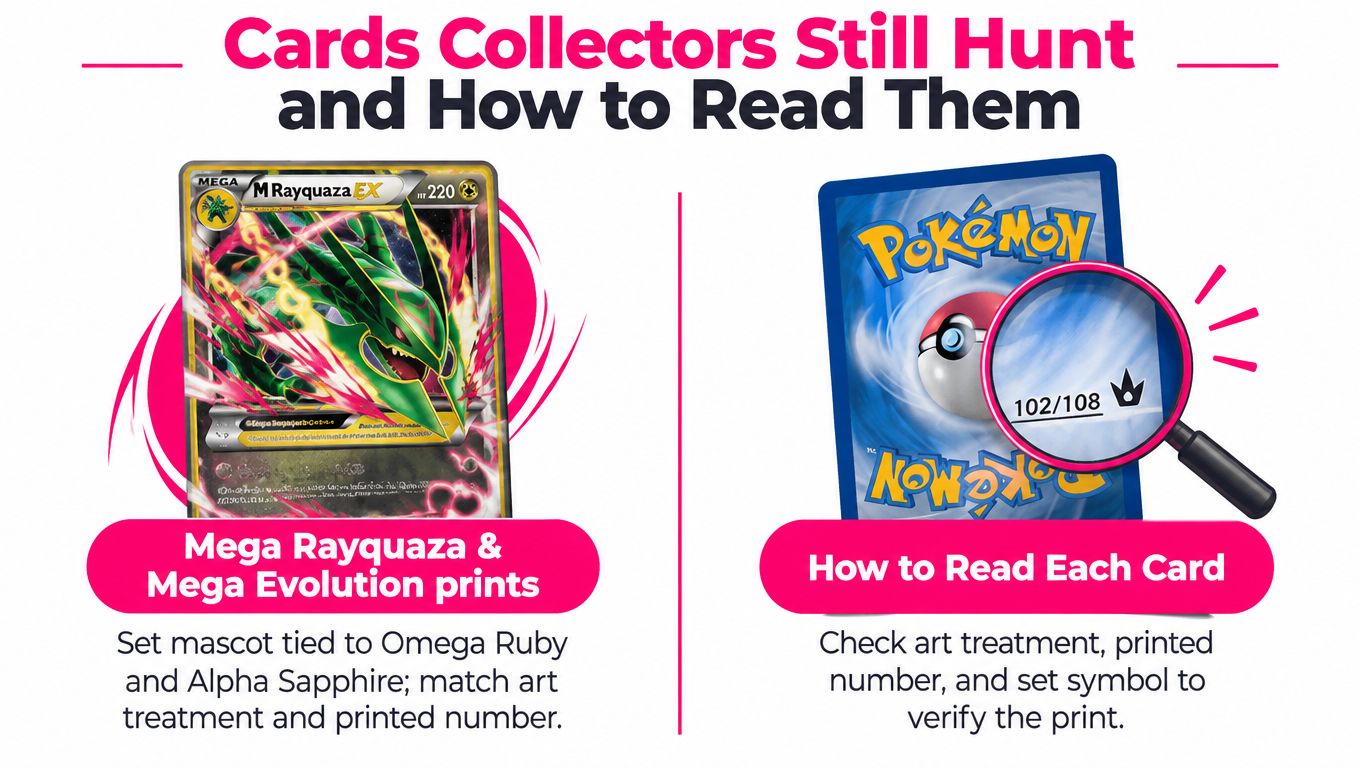
Start with the mascot print
Mega Rayquaza gives the set its visual identity, but search results can mix English Roaring Skies cards with Japanese Emerald Break cards. Check the language and printed number, then compare the artwork and treatment. The shiny Rayquaza EX price factors illustrate why the exact print matters: card number and treatment can change which versions are being compared.
Shaymin-EX teaches the whole reading method
Shaymin-EX rewards close reading because its appeal comes from its card text. The official Shaymin-EX card page lists 110 HP, the Ability Set Up, and the attack Sky Return. Set Up lets you draw until you have six cards when Shaymin-EX is played from your hand onto the Bench. Sky Return deals 30 damage and returns Shaymin-EX and every card attached to it to your hand.
Together, those effects explain its role in a game. Like other Pokémon-EX of its era, it gives up two Prize cards when Knocked Out instead of one. Set Up provides a burst of consistency, while leaving Shaymin-EX exposed gives the opponent a two-Prize target.
Collectors can apply the same close-reading habit to a listing. A card's name alone may not distinguish it from another version.
Identification rule: if a seller can't show the printed number and Set Up text in the same photo, you don't yet know which Shaymin you're buying.
The bands above and below the headliners
Full-art Rare Ultra Pokémon-EX make up the set's illustration-focused chase band. They can be mistaken for regular EX prints, so check that the art is full-bleed and confirm the printed number before comparing listings.
The two Rare Secret cards form the smallest rarity group. With fewer cards to compare, a thin set of listings can make a price look more persuasive than it is. Check the secret symbol and the number beyond the main set before treating a card as a secret rare.
Pikachu 20/108 shows the gap between a cheap raw card and a striking PSA 10 headline. A single high graded listing is not a dependable estimate of what the card will sell for. Look for actual sales and how many there are before using the headline as a guide.
Aurora Blast and Storm Rider are fixed 60-card theme decks sold alongside the booster release. They are ready-to-play products, not booster packs, so a sealed deck belongs in a different comparison from a card pulled from a pack.
| Card or product | Why it matters | Verify before you buy |
|---|---|---|
| Mega Rayquaza and Mega Evolution prints | Set mascot linked to Omega Ruby and Alpha Sapphire | Artwork, printed number, and English or Japanese Emerald Break version |
| Shaymin-EX | Gameplay icon with Set Up and Sky Return | 110 HP, card text, two-Prize rule, and printed number |
| Nine full-art Rare Ultra Pokémon-EX | Illustration-focused chase band | Full-art treatment and printed number |
| Two Rare Secret cards | Smallest rarity group in the 112-card count | Secret symbol and a number beyond the main set |
| Pikachu 20/108 | Cheap raw card with a striking PSA 10 headline | Number of sales behind any graded price, not just the asking price |
| Aurora Blast and Storm Rider | Fixed 60-card theme decks sold with the release | Whether the deck is sealed or opened; deck contents are not booster pulls |
For every listing, match the product to the evidence: the named card, its print details, and its condition. If those don't line up, the price comparison doesn't either.
How the 112-Card Rarity Stack Works
A set's card count depends on what the catalogue includes. Bulbapedia's Roaring Skies entry) lists 110 English cards and 91 Japanese cards. Some catalogues count additional cards, so a “complete set” can refer to different inventories.
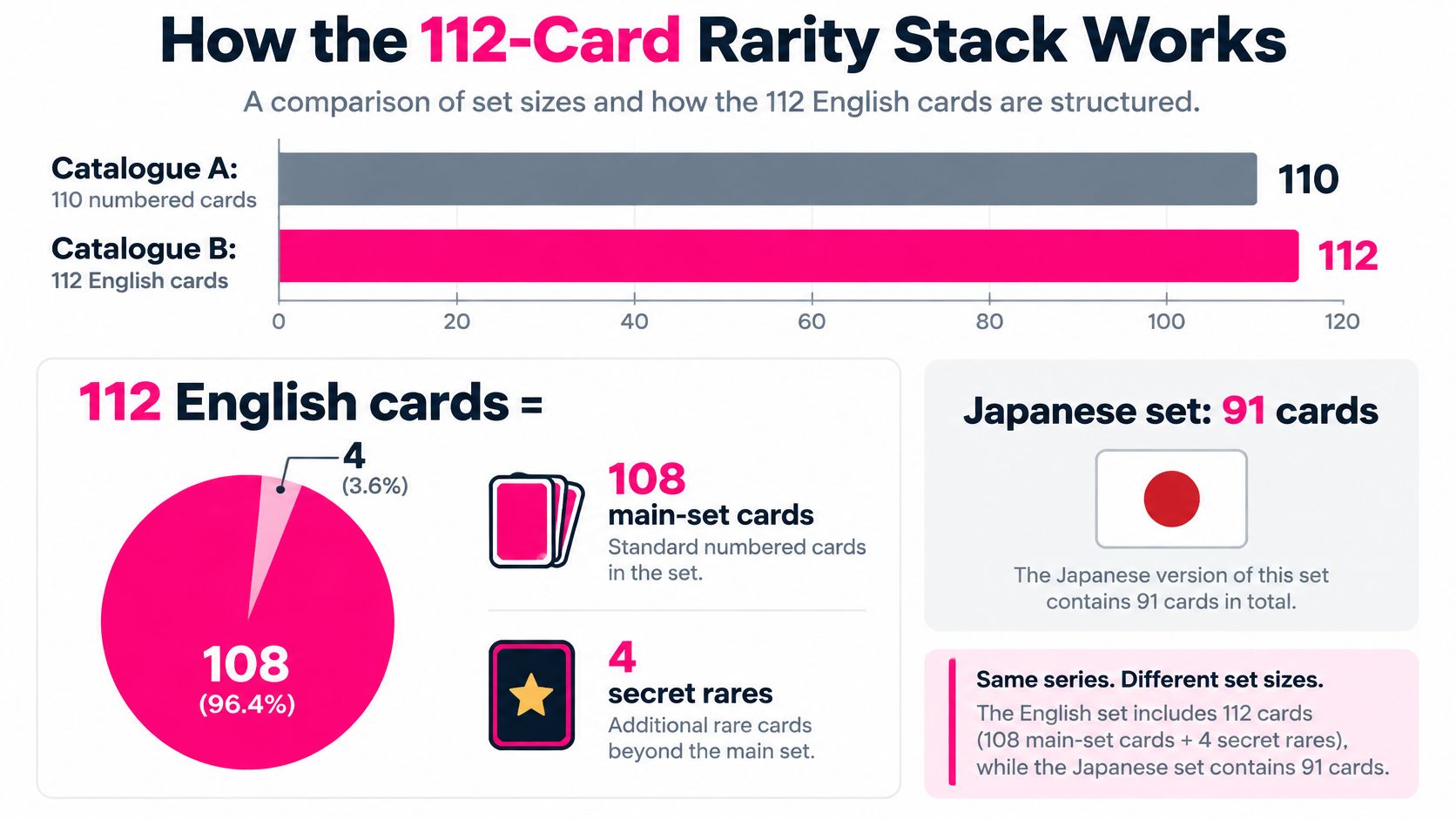
A useful way to read the rarity stack is to separate the broad tiers from the chase-side tiers. Commons and uncommons form the wide base; holos, EXs, Ultra Rares and Secret Rares make up the narrower group collectors often focus on. For a closer explanation of the naming hierarchy, see this guide to Pokémon card rarity tiers.
That distinction helps prevent a common mix-up: a set can have several sought-after cards without most cards being in those higher rarity categories. The rarity label describes a card's place in the set's structure, not a guaranteed return from a pack.
| Rarity bucket | Typical place in the stack |
|---|---|
| Common and uncommon | Wide base |
| Rare | Between the base and higher tiers |
| Rare Holo and Rare Holo-EX | Chase-side tiers |
| Rare Ultra and Rare Secret | Smaller, higher-rarity tiers |
Before comparing complete-set listings, check which cards the seller includes and how the set is counted. A numbered-card list and a catalogue that includes extras may represent different inventories. A sealed box, a group of singles and a folder of graded cards are different products, too.
Why Pull Rate Charts Overclaim
The most precise numbers you'll find about this set are the ones with the least behind them. A set-tracker page cited on Moonstone's Roaring Skies database entry estimates a Secret Rare at 1 in 125 packs and an Ultra Rare at 1 in 17 packs, and that same page states plainly that no published pull-rate study exists for the set.
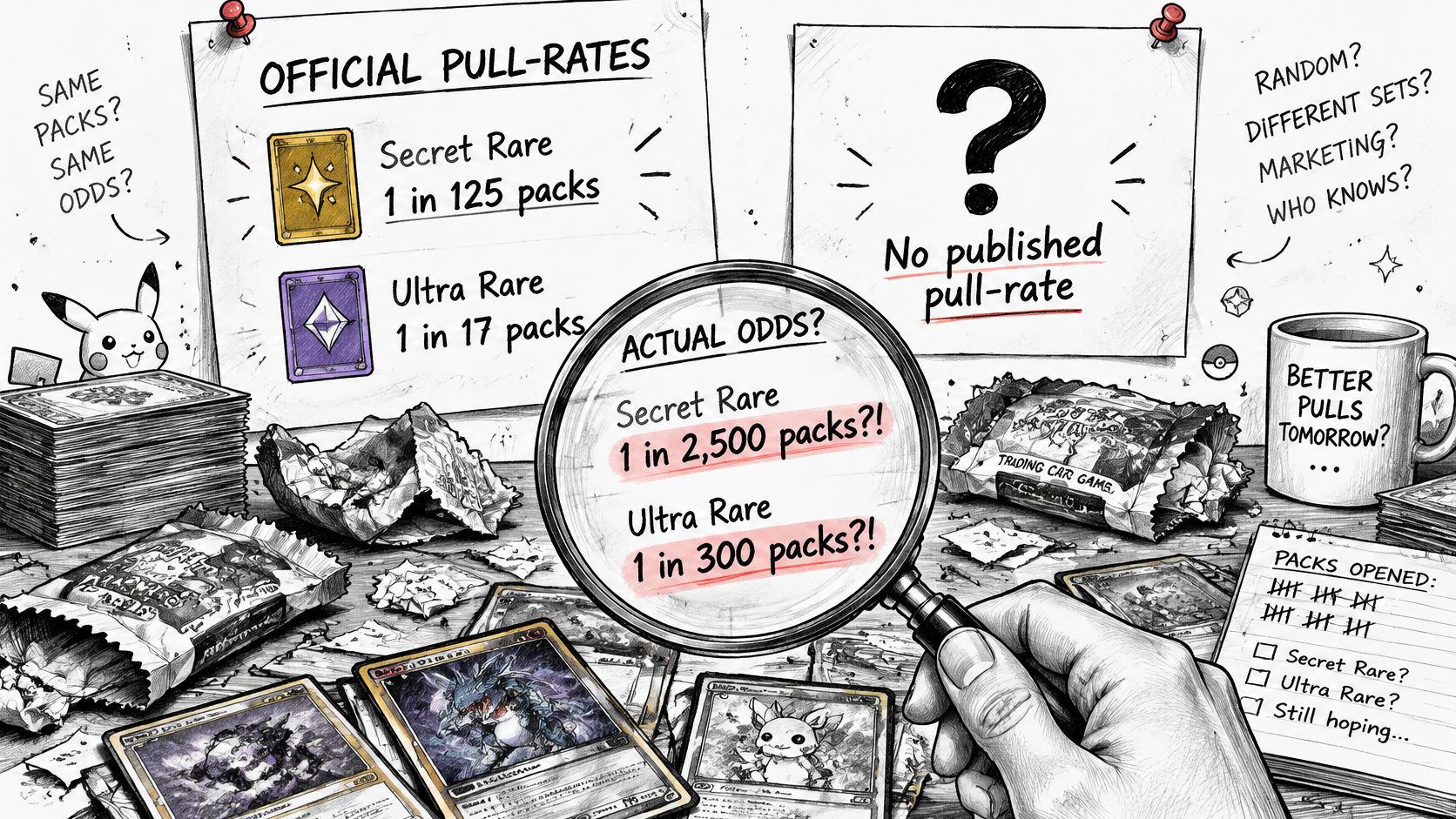
Both statements can live online at once because they answer different questions. One is a tally somebody assembled. The other is a statement about whether a controlled study exists. When a chart shows 1 in 125 with no sample size attached, you're reading the first while assuming the second.
Three things people call a pull rate
- An observed estimate. Someone opened packs, counted hits and wrote down a ratio. The sample size decides whether it describes anything beyond that person's case.
- A verified rate. This would name who ran the sample, how many packs it covered and when. For this set, that document isn't in circulation.
- Expected value. An average across a large number of boxes. It says nothing about your next box, your loose pack, or the break you just joined.
If a chart can't tell you how many packs were opened, treat the number as a rumor with decimals.
Roaring Skies shipped in 2015, more than a decade ago, and the tables circulating today may rest on user-submitted openings, inferred collation patterns or partial sales data. None of those is a controlled sample. That's not a knock on the people building them. It's a limit on what the output can support.
Loose packs and sealed boxes don't share one odds table either. An opened 2015 box can be refilled and rewrapped, which is why a sealed unit needs its seal checked on every side, along with the seams and the wrap, plus whatever purchase history the seller can show. Without that, you're buying a shape.
Watching a break of this era of product is useful preparation, because it shows how much of a box is ordinary commons and uncommons and how rarely the thin top shelf appears.
The practical move is to stop treating odds as the product. Price the named card or the sealed unit, keep the chart as a footnote, and when a break lands light, treat it as one sample rather than proof of a bad box.
When Grading a Roaring Skies Card Pays
A $1,000 PSA 10 sticker on a card that sells raw for a couple of dollars looks like found money. It usually overstates what that cheap copy will return. Pikachu 20/108 is the cleanest way to see the gap. Ultraball's page for the Roaring Skies Pikachu reports the card at roughly $2.50 ungraded, about $150 in PSA 9 and about $1,000 in PSA 10.
The $1,000 rests on seven sales in 90 days. The raw price rests on 271. Seven sales is a handful of well-centered copies that happened to sell in the same quarter, not a market you can plan a submission around. Who chose to send a card in, how the centering differs, and how rarely a 10 trades all sit inside that thin sample.
| Copy | Reported price | Sales noted | How to read it |
|---|---|---|---|
| Ungraded Pikachu 20/108 | about $2.50 | 271 sales | Liquid raw market |
| PSA 9 | about $150 | Count not published in that comparison | Mid grade, still far above raw |
| PSA 10 | about $1,000 | 7 sales in 90 days | Thin sample, easy to overread |
| Cards with enough graded sales to judge | Most Roaring Skies cards fall short of that bar | A PSA 10 rate needs repeated graded sales, which most of these cards do not show | Missing sales are a warning, not a gem rate |
A huge 10 price on a cheap raw card works like a shop window. The display piece is real, and it is not the price of the stack behind the counter. Most Roaring Skies cards lack enough graded sales to judge a PSA 10 rate at all. Without that sample, a gem probability is a guess dressed up as a percentage.
The arithmetic that decides a submission
Build the sum before you mail anything. The upside rarely looks like the sticker.
- Start at the 9. Use a realistic PSA 9 sale as your base case, not the headline 10.
- Add every cost. Grading fees, postage both ways, insurance, marketplace selling fees and any tax you owe.
- Weight by how often a 10 appears. If gem results are uncommon, or you cannot see enough graded sales to tell, most submissions land in the 9 bucket or worse.
- Rerun it internationally. Higher shipping and import tax can erase a margin that looked safe on a US price.
Decision line: grade only when the price you pay plus fees is covered by the likely grade, not the best sale someone else posted.
A sharp copy bought well under the PSA 9 market can still clear a profit once slabbed, and a low-population secret can justify the wait. A played cheap uncommon usually shouldn't be slabbed at all, because the fee is larger than any grade premium it could earn. Our guide to whether getting cards PSA graded is worth it walks the same calculation across other sets.
Turnaround time is a cost too. Money tied up for months is not available for the next card. A $1,000 sticker that almost never clears does not rescue a $2.50 buy.
Choose Raw Graded or Sealed Next
Everything above collapses into one decision per card, and there are only three answers worth giving.
- Raw numbered single. Pick this when the art, number and language match and you don't need a slab to enjoy or resell the card. It's the default for most of XY Roaring Skies.
- PSA slab. Pick this for a card with real graded sales where the price still works after a likely 9, using the net check above.
- Sealed product. Pick a booster box when the sealed unit is the thing you want to own, not because an odds chart looked exact.
Then narrow to one named target this week. Shaymin-EX, a specific Mega Rayquaza print, or a sealed box, with the language confirmed before you shop. Compare raw, graded and sealed offers against the same checklist rather than against each other's prices.
We sell trading cards, sealed booster boxes and PSA graded cards, so you can run that comparison in one place, and we expect to be judged by the same checklist as every other seller. A raw card that matches the checklist stays the default. Upgrade to a slab or a sealed unit only when the named target and the price both hold up.
Lucardio Collectibles stocks authenticated singles, sealed booster boxes and PSA graded slabs, and runs live breaks and weekly prize draws for collectors who'd rather watch a box come out of its wrap than trust an odds chart. Bring the checklist from this guide, compare the raw, graded and sealed version of one named card, and buy the copy whose price you can verify. Start at Lucardio Collectibles and see what's live.